

Three Springs, Westlake Village CA: Homes, HOA & Schools
Westlake Village Neighborhood Guide
Three Springs
Five builders, 1988–1990 · about 465 homes in the hills south of the lake
2683 Grandoaks Drive, sold by Gary Jacobs
Three Springs is the neighborhood most people picture when they think of a big, late-1980s Westlake Village family home: two stories, four or five bedrooms, a three-car garage, and a lot large enough for a real pool and a real lawn. It sits in the hills on the south side of the lake, above Triunfo Canyon Road with the Santa Monica Mountains open space at its back, and it has stayed one of the most consistently in-demand tracts in the Conejo Valley for more than thirty years. This guide covers the builders, the original floor plans (with the drawings), the streets and lots, what the HOA actually does, the school-district line, and where prices have landed.
Highlighted area is the approximate footprint of the Three Springs tract, drawn from the parcels in county records. Labels mark the other Westlake Village neighborhoods; click one to open its guide.
Homes for sale and recently sold in Three Springs
These listings are drawn to the outline of the Three Springs tract shown on the map above, so they cover Three Springs and nothing from the tracts next door. They come from the CSMAR multiple listing service and update as agents post them. A section can legitimately come back empty: in a tract this size, weeks can pass with nothing for sale.
For sale in Three Springs now
Every active listing inside the tract.
Loading…
In escrow in Three Springs
Under contract but not yet closed, which is the earliest read on where prices are heading.
Loading…
Sold in Three Springs, last two years
Closed sales with price, size and year built.
Loading…
Where Three Springs is
Three Springs streets and how the tract is laid out
Three Springs Drive climbs from Triunfo Canyon Road and loops through the tract; nearly everything else hangs off it. Kirsten Lee Drive is the largest single street with close to 90 homes, followed by Three Springs Drive itself, Grandoaks Drive, Bowman Knoll Drive and Barrett Drive. Denver Springs Drive, Memory Lane, Timberridge Court, Wellbrook Drive, Sandycreek Drive, Fallview Road, Yellowwood Drive, Ranchgrove Drive, Peachwood Place, Pinebluff Place, Sandpiper Court, Fastwater Court, Jean Lane and Southshore Place round out the map.
The two county tract maps roughly divide the neighborhood into a western half (tract 34835, about 255 homes, slightly larger at a median of about 3,650 square feet and lots near 15,700 square feet) and an eastern half (tract 42801, about 220 homes, median about 3,200 square feet on lots near 11,800). Buyers rarely think in those terms, but it explains why two houses that look similar from the curb can differ by 500 square feet and a quarter-acre of yard.
The best lots back to open hillside on the southern and western edges, where the tract meets the mountain open space and the county line. Those homes get long views north across the lake and the valley, and the highest streets look out toward the Santa Monica Mountains ridgeline. Interior streets are flatter and quieter, with the classic sidewalk-and-parkway layout that makes the tract walkable to the park.
The original floor plans, builder by builder, with the drawings
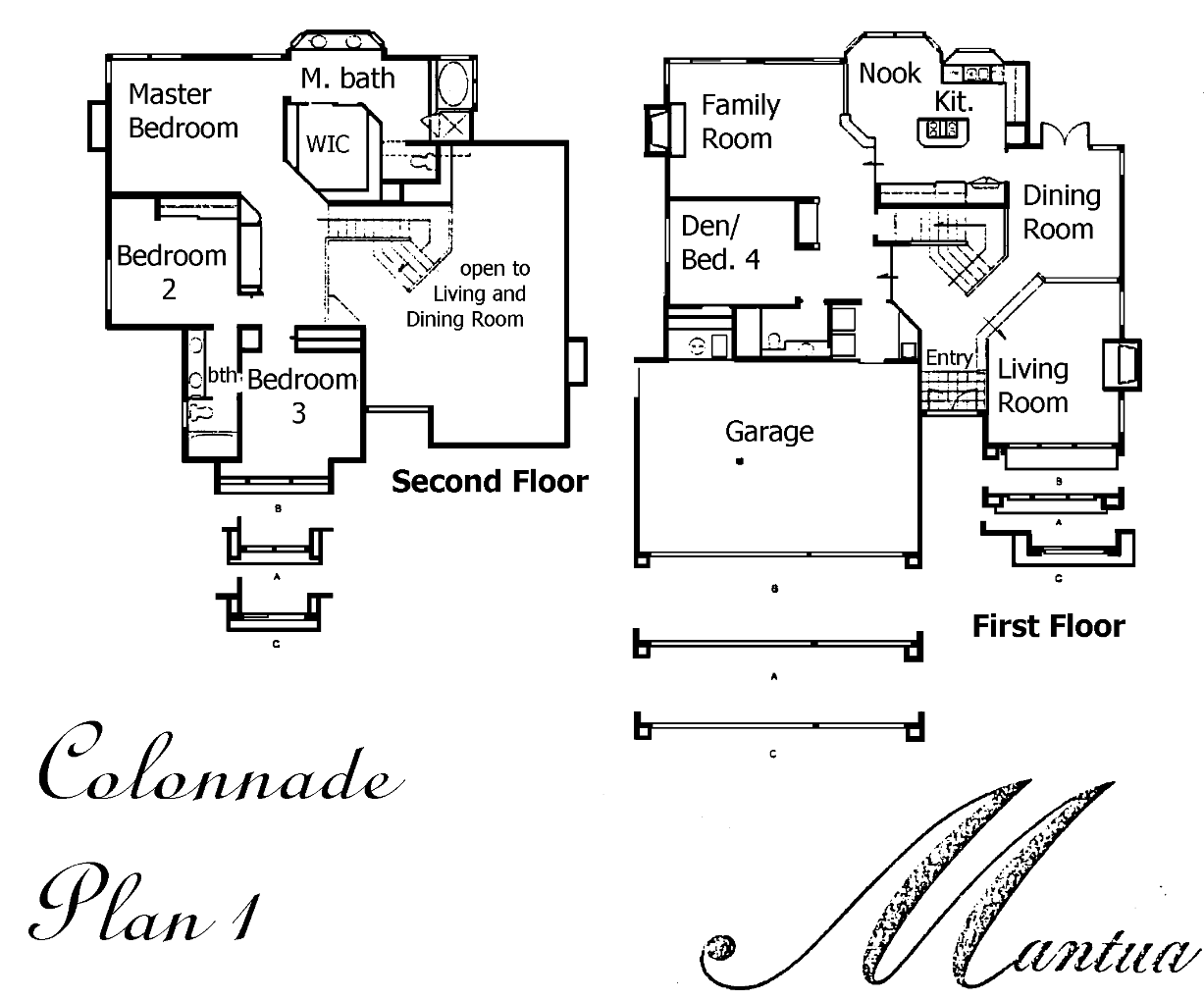
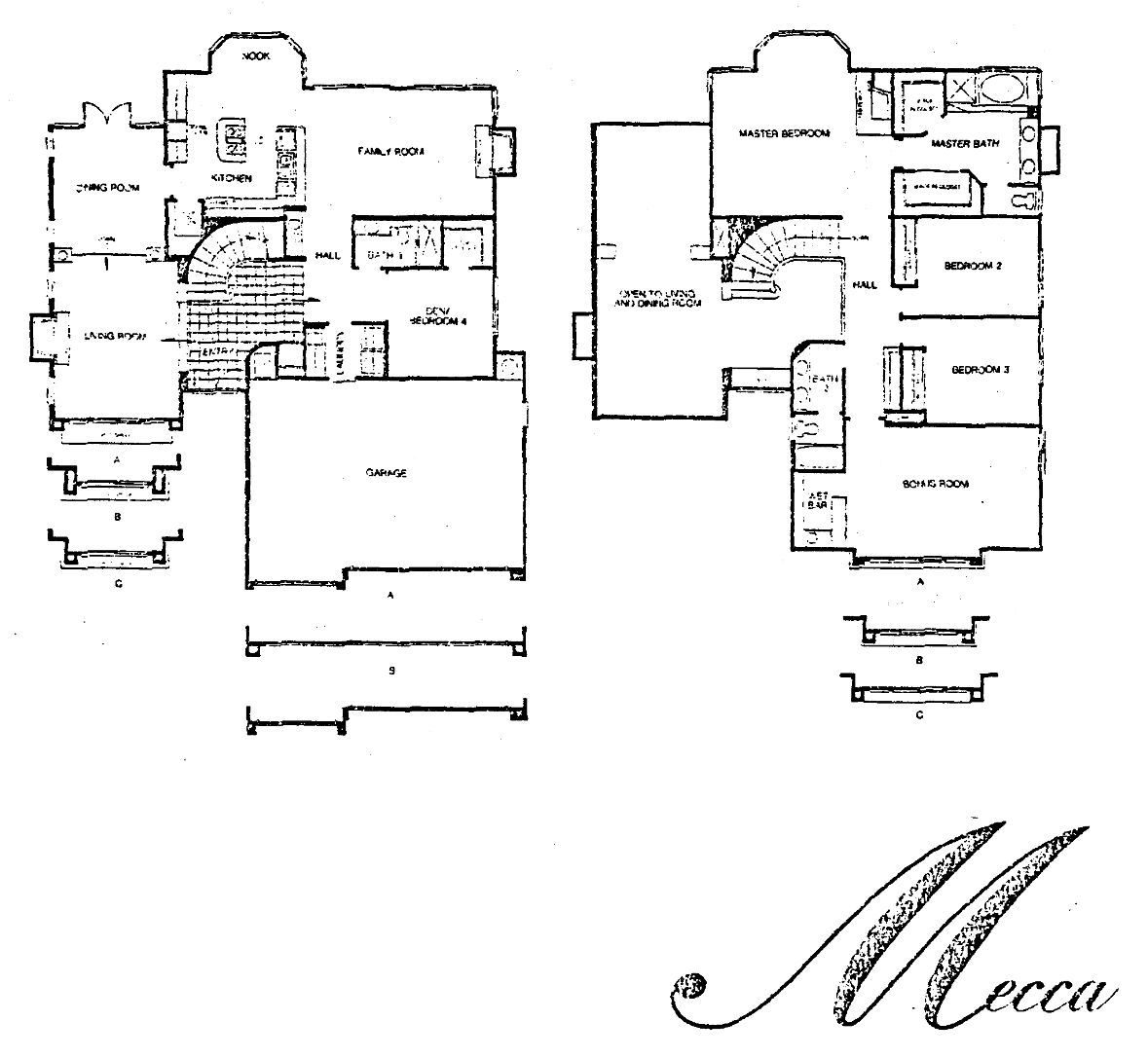
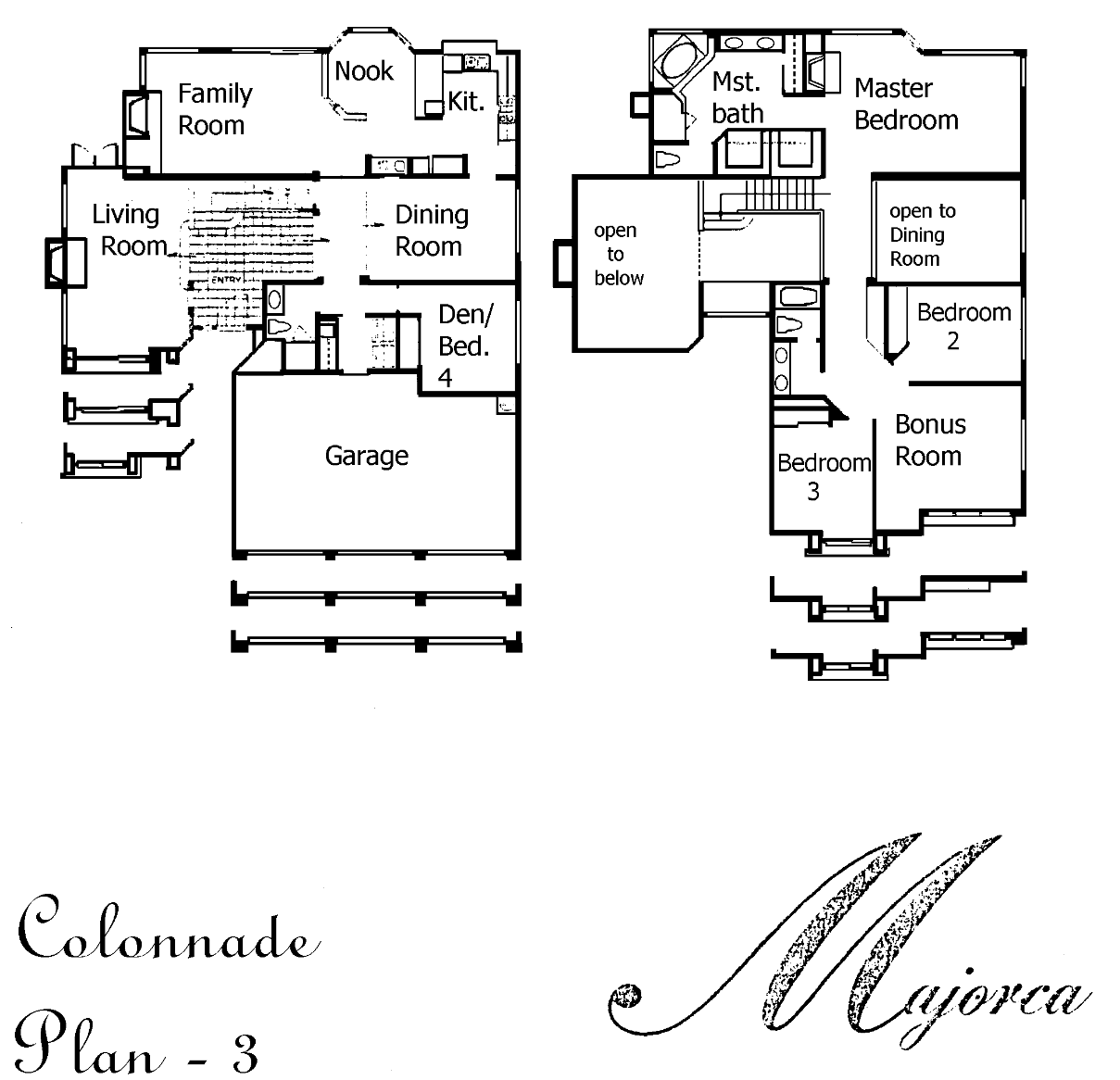
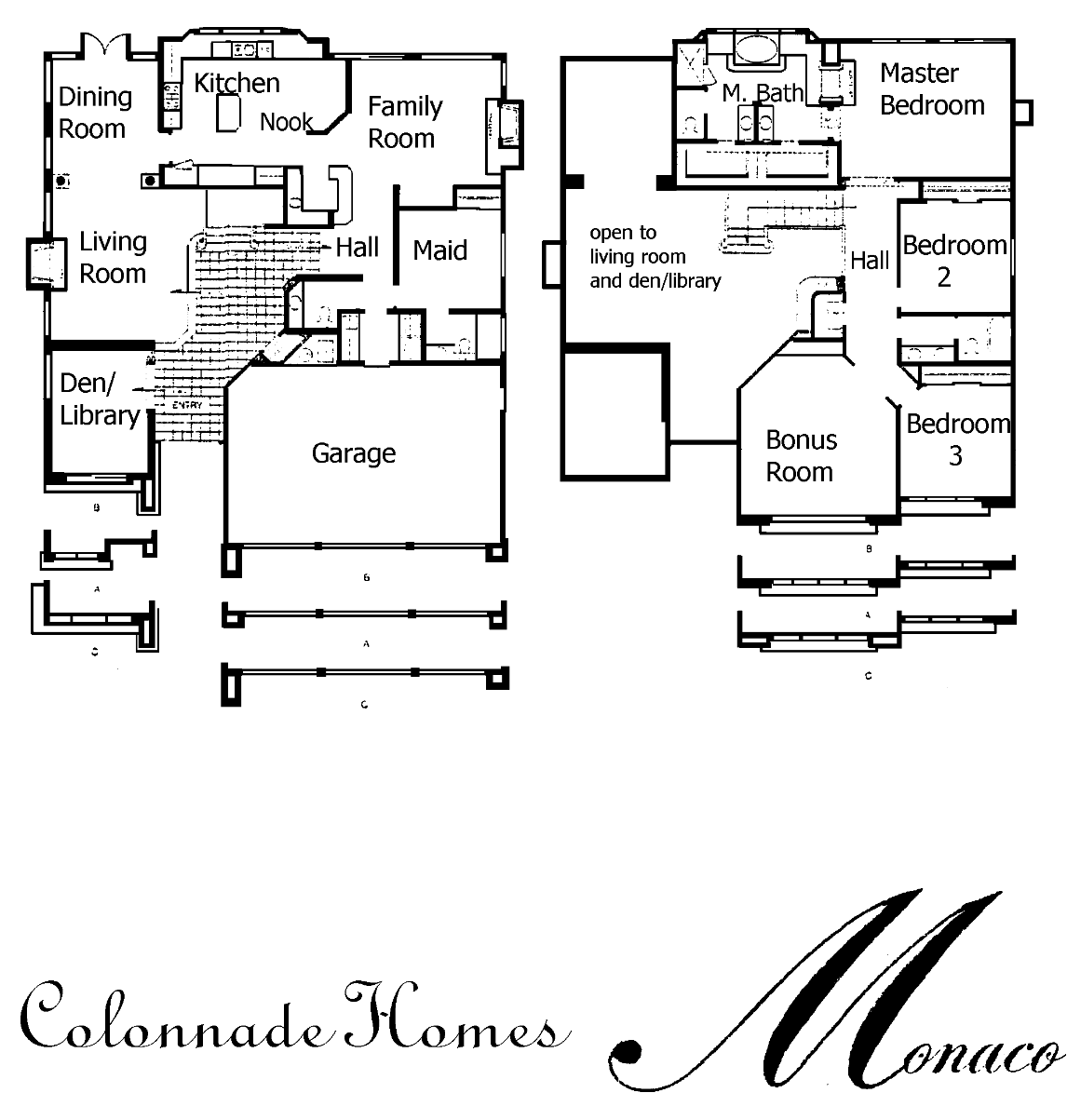
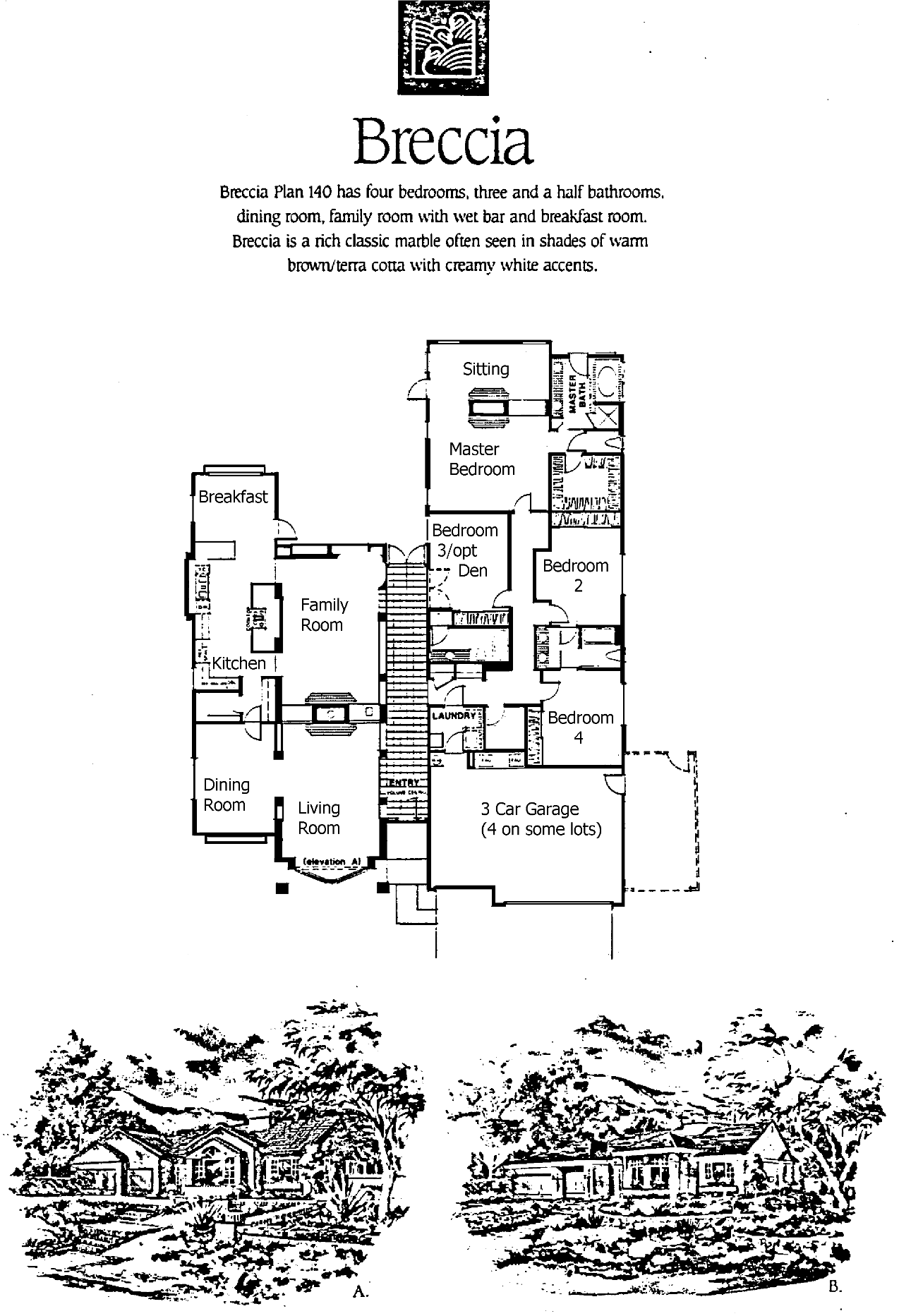
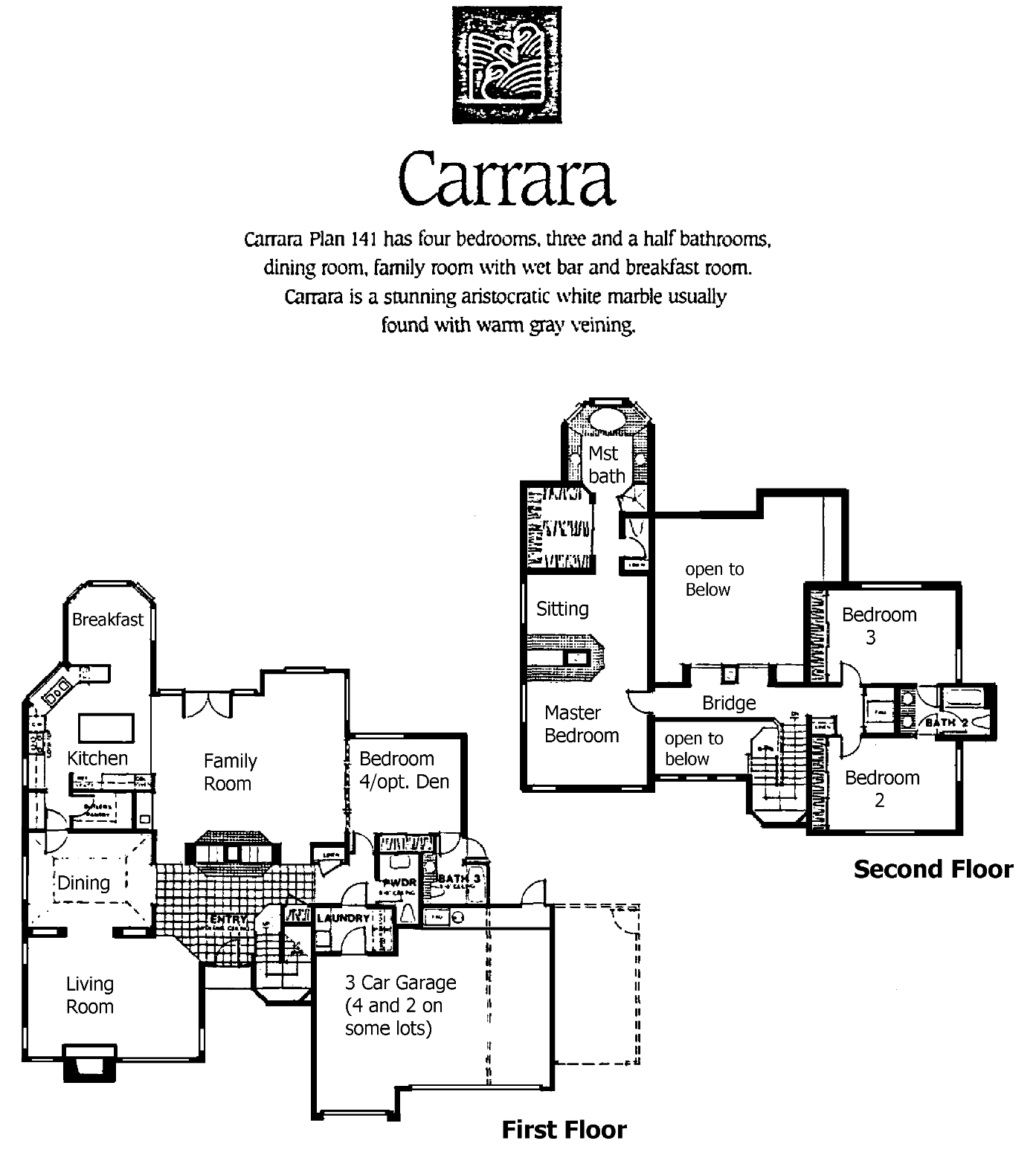
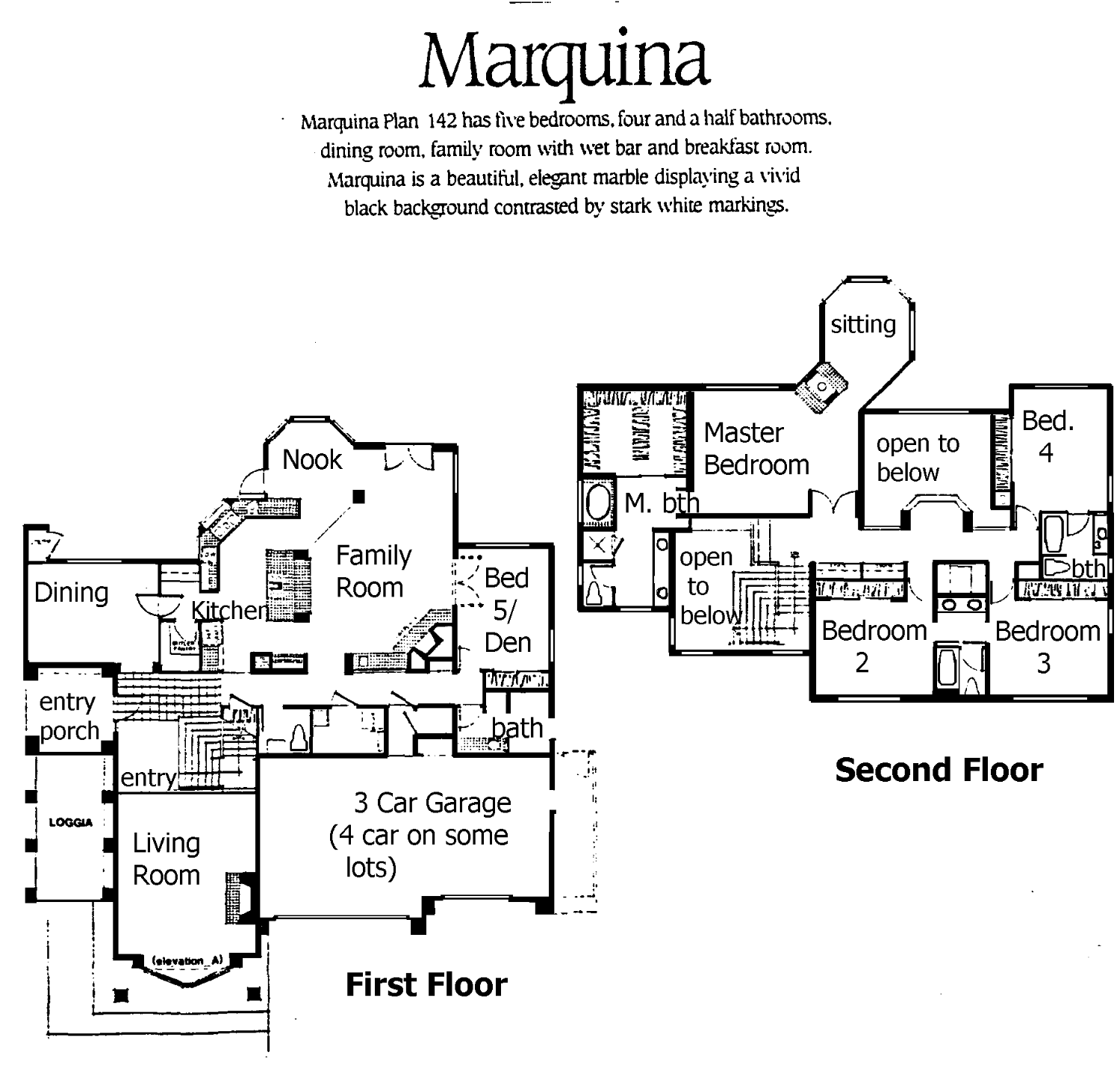
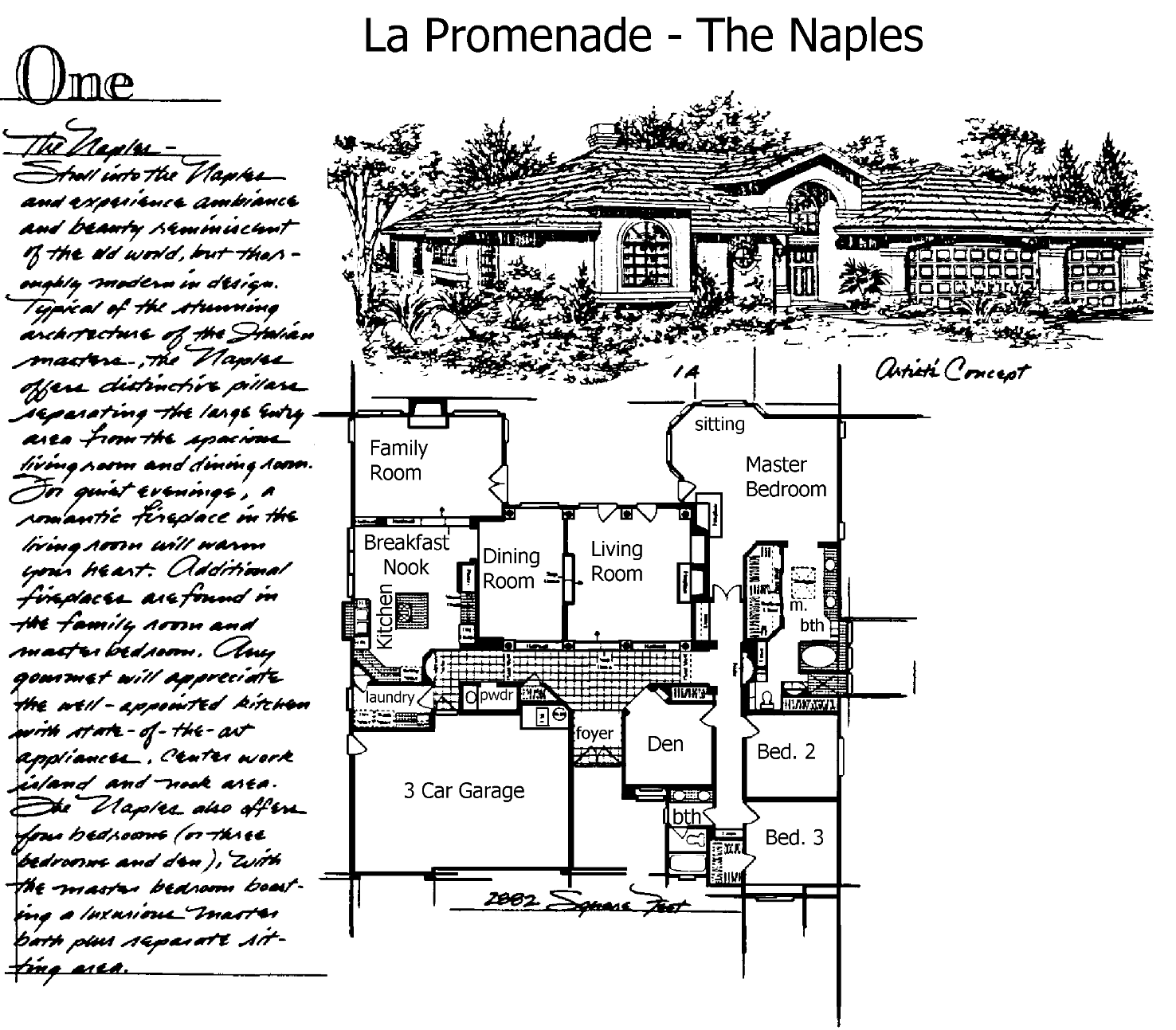
Because five builders worked the same tract, a Three Springs listing can be any of the nineteen plans held in the Conejo Simi Moorpark Association of Realtors plan archive, and the plan matters more than the street. That archive is what survives rather than a complete builder record, so other plans, elevations and options may well have been offered in the tract. The drawings are marketing plans, not construction documents: most were printed without room dimensions, front elevations varied by lot, and many homes have been expanded since, so a specific house should always be measured rather than assumed from the plan. Single-level living turns up in more than one series: La Promenade’s Naples, Hillsboro’s Plan Two, Griffin’s Breccia and Oakmont Hills’ Camberley are all drawn on one floor, so a buyer who wants no stairs is not limited to a single builder or a single street. MLS records show the same $270-a-year association across all five series.
Colonnade Homes (MLS tract 752): Mantua, Mecca, Majorca, Monaco
Colonnade built the biggest piece of Three Springs, and its homes are the ones most often found on Three Springs Drive, Grandoaks Drive, Sandycreek Drive, Timberridge Court, Peachwood Place and Sandpiper Court, with more scattered along Kirsten Lee Drive. All four Colonnade plans are two-story, and all four share a signature: a curved staircase in a two-story entry, a den that can be the fourth bedroom downstairs, and a bonus room upstairs.
Drawings on file for the tract. Other plans, elevations and options may have been offered.
Griffin Homes (MLS tract 735): Breccia, Carrara, Marquina
Griffin’s section is concentrated along Kirsten Lee Drive, Denver Springs Drive, Barrett Drive and Wellbrook Drive. Griffin named its three plans after marble, and the brochure copy explains why: Breccia is “a rich classic marble in shades of warm brown and terra cotta,” Carrara “an aristocratic white marble with warm gray veining,” and Marquina “a vivid black background contrasted by stark white markings.” All three share the same core: formal living and dining rooms at the front, a family room with a wet bar opening to the kitchen and breakfast room, a downstairs bedroom that could be ordered as a den, and a three-car garage (four-car on some lots).
Drawings on file for the tract. Other plans, elevations and options may have been offered.
La Promenade (MLS tract 768): Naples, Madrid, Seville
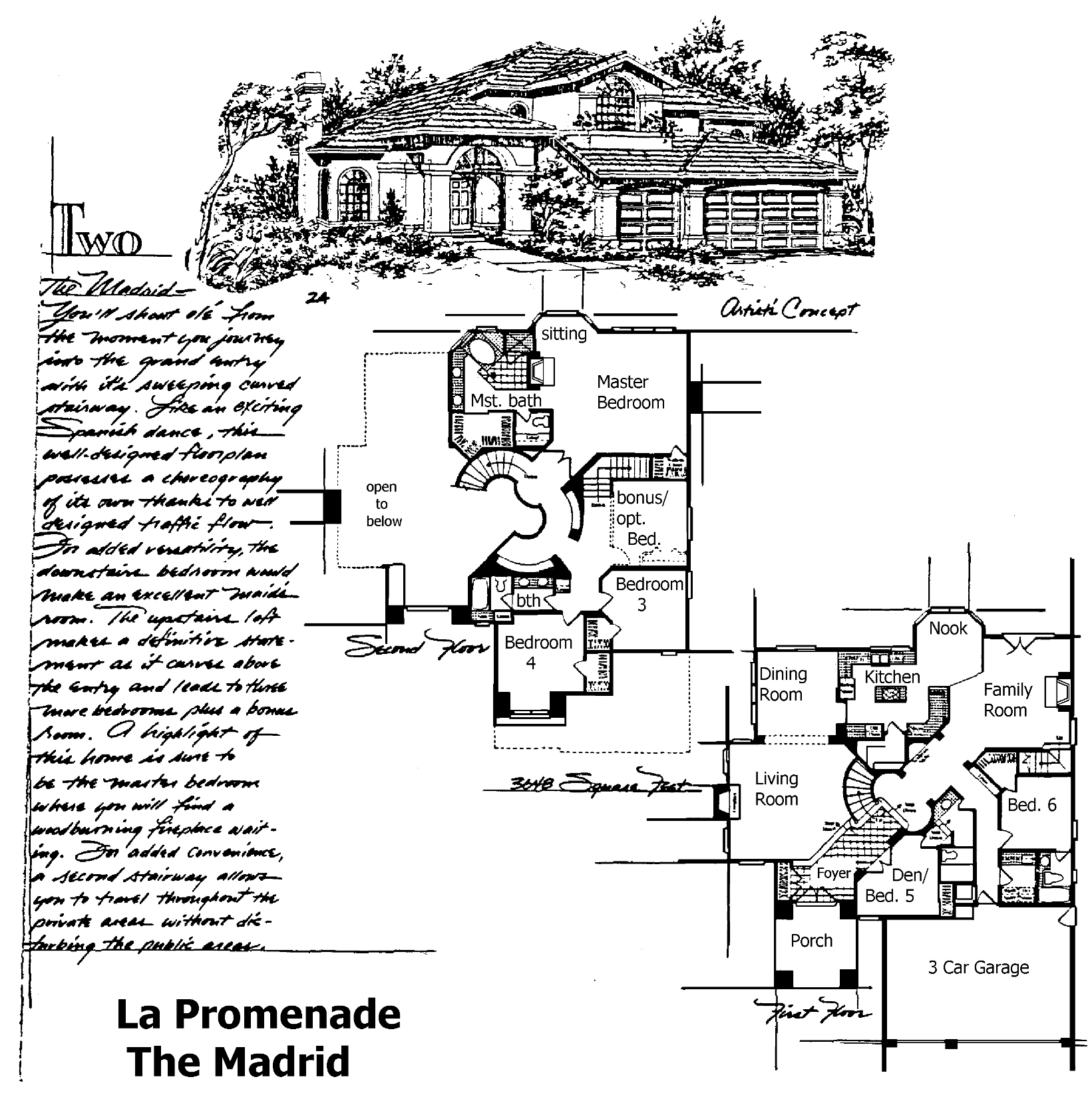
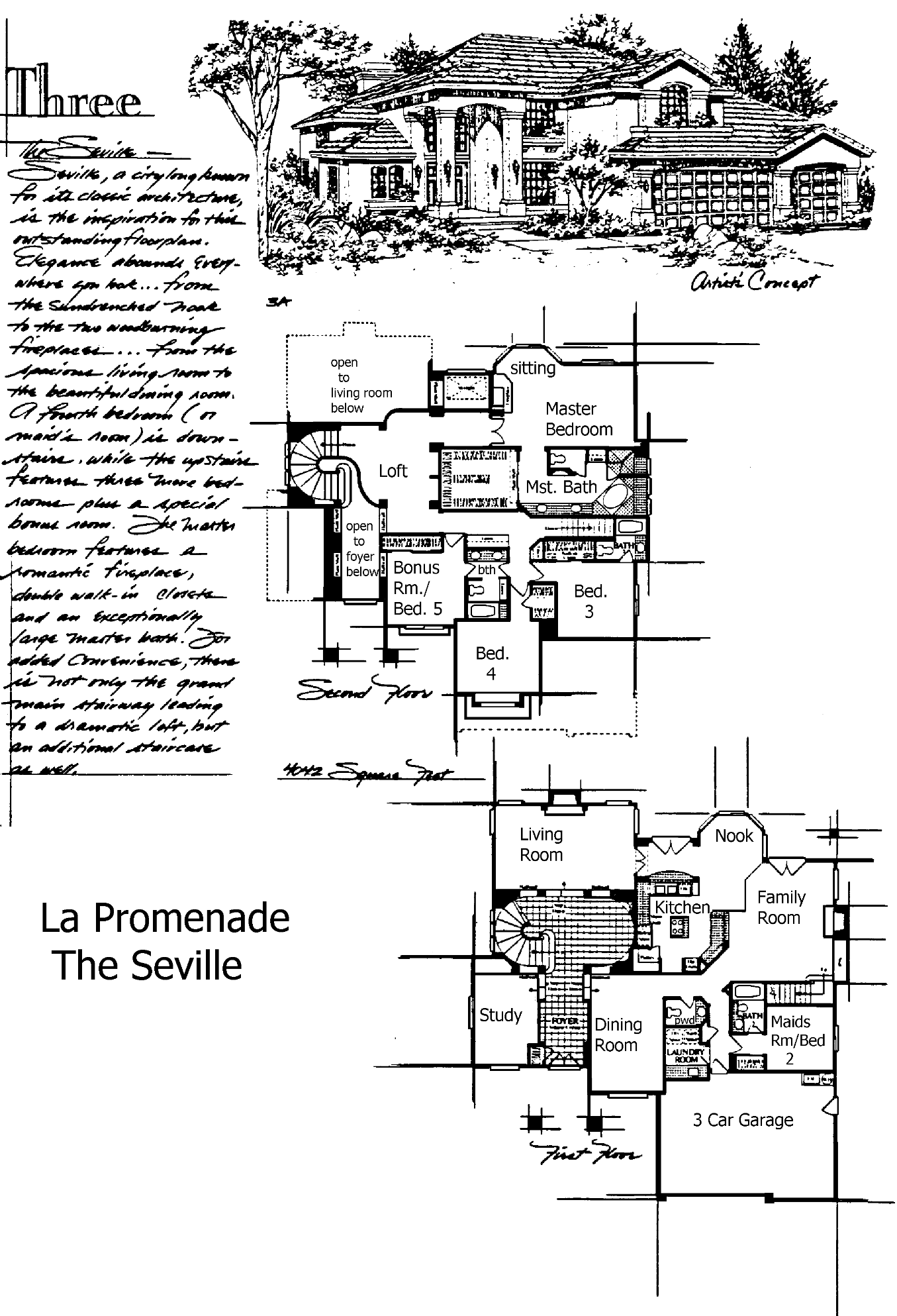
La Promenade homes sit on parts of Kirsten Lee Drive, Wellbrook Drive and Southshore Place, and they are the most Mediterranean of the four series: arched windows, columned entries and, in the two-story plans, sweeping curved staircases. The brochure sheets were hand-lettered, which tells you something about how the series was marketed. La Promenade is also the only builder whose brochures printed square footage.
Drawings on file for the tract. Other plans, elevations and options may have been offered.
Hillsboro (MLS tract 769): Plans One through Four
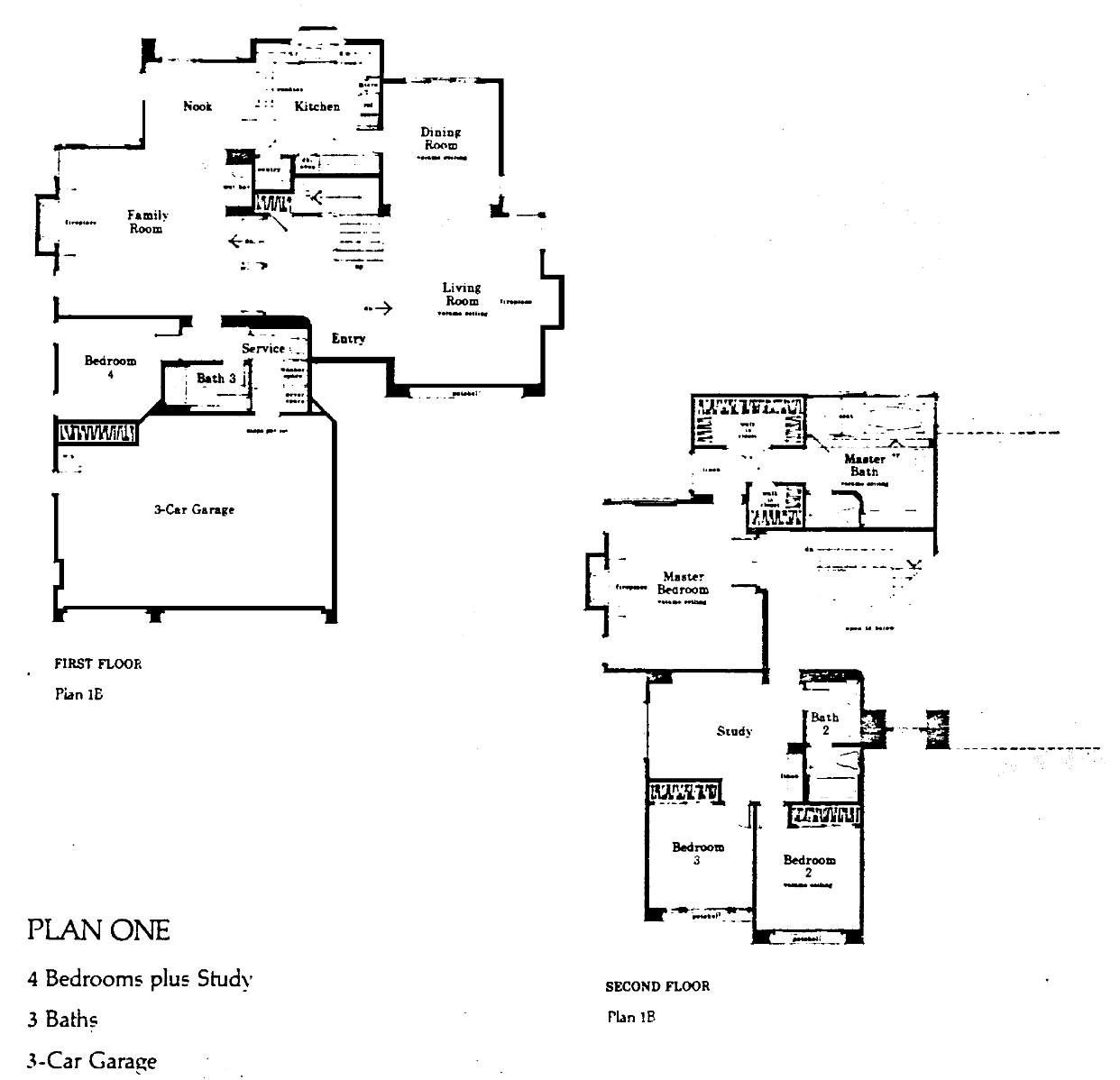
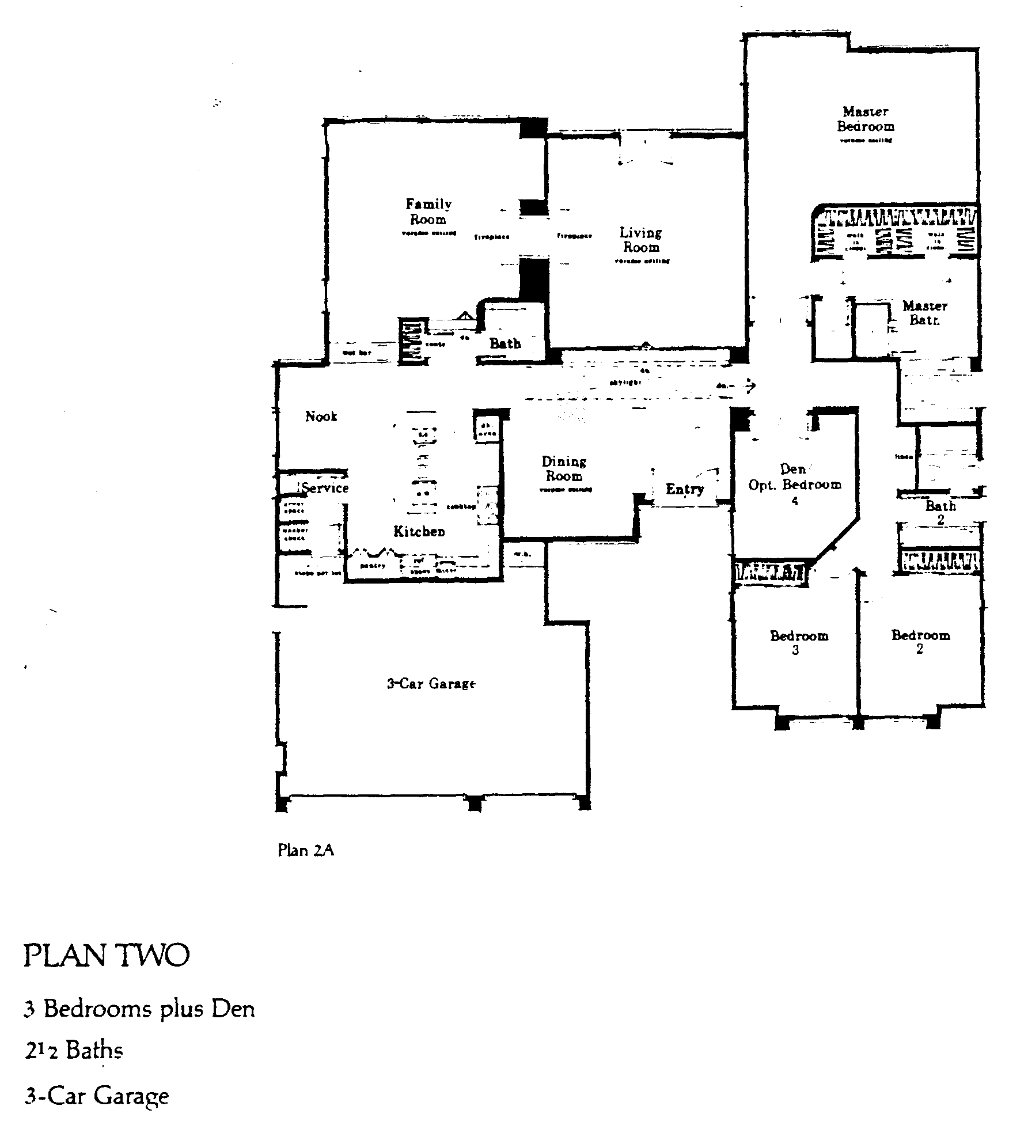
The Hillsboro homes are found along Memory Lane and Ranchgrove Drive in the eastern part of the neighborhood. The plans were numbered rather than named and offered in A and B versions with different front elevations.
Drawings on file for the tract. Other plans, elevations and options may have been offered.
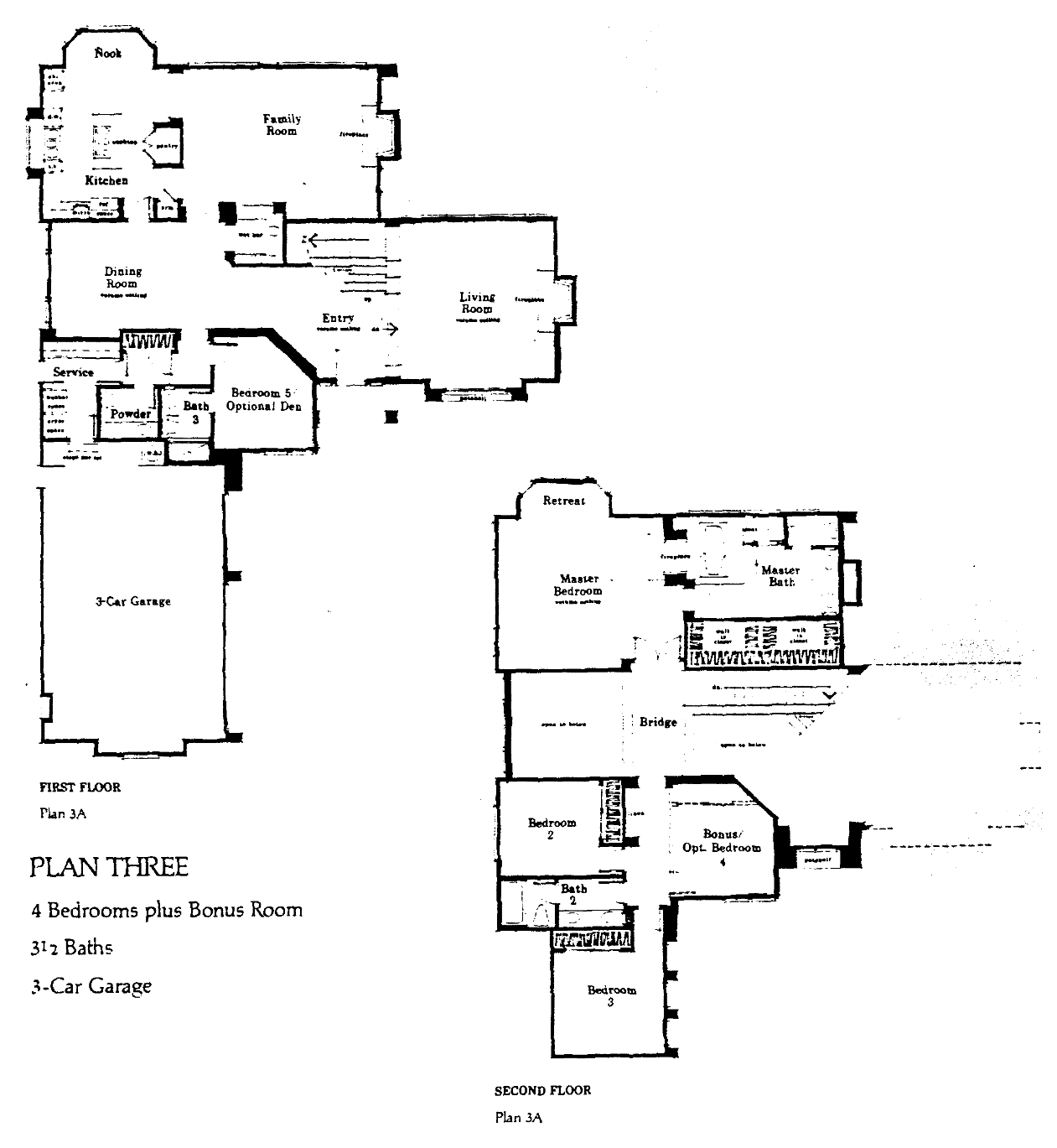
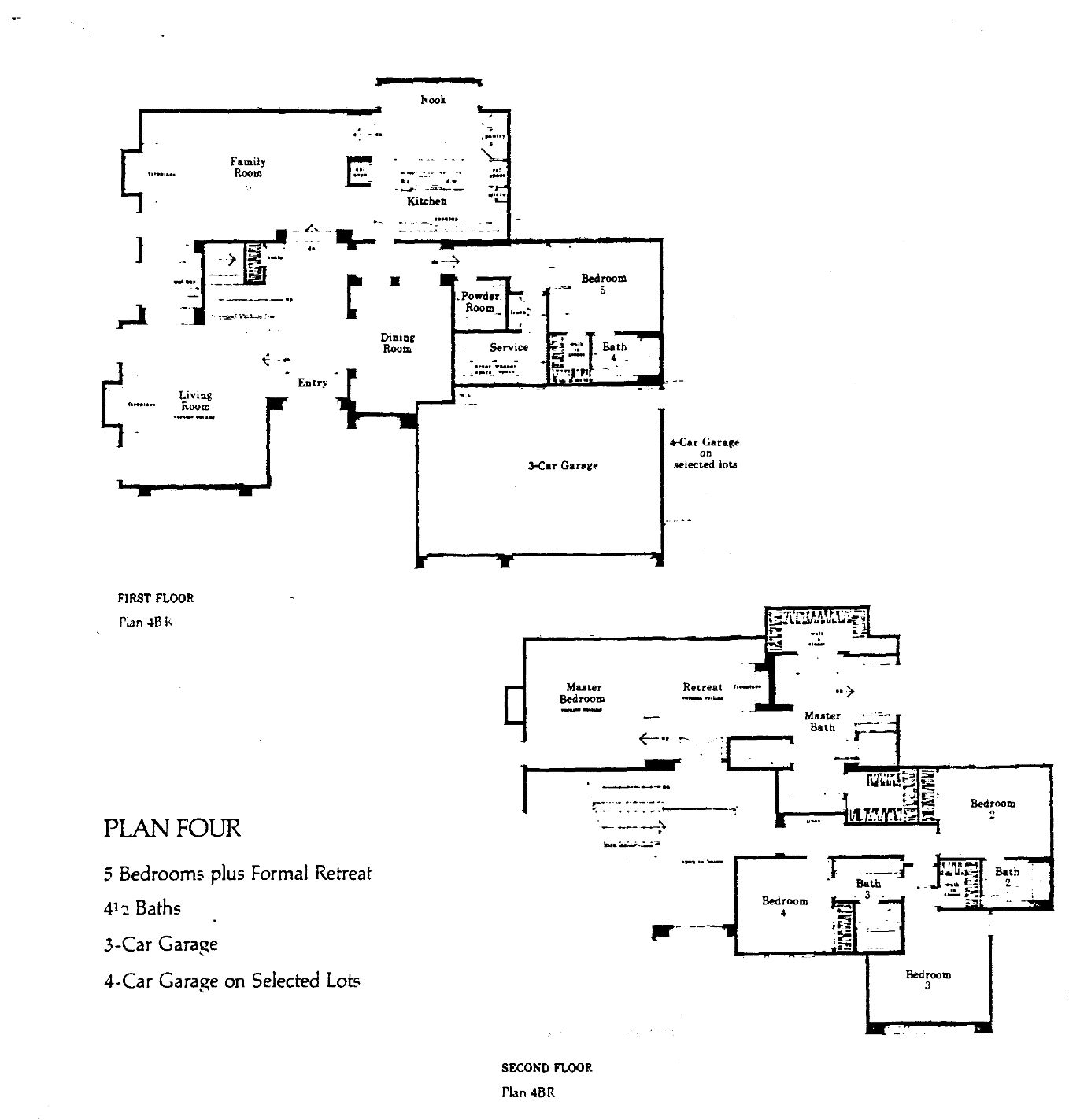
Oakmont Hills (MLS tract 734): Atherton, Belvedere, Camberley, Stonehaven, Tamarron
The fifth series is the one most easily missed, because the MLS files it as “Oakmount 3Springs-734” while the Conejo Simi Moorpark plan archive files the same tract as Oakmont Hills. It sits on the eastern side of Three Springs and takes in Bowman Knoll Drive, Jean Lane, Sandpiper Court, the Fallview Road and Woodburn Avenue frontage and the eastern end of Three Springs Drive — about 71 addresses recorded under that tract in the county files. The plans on file for the tract are named Atherton, Belvedere, Camberley, Stonehaven and Tamarron. The drawings are below.
Drawings on file for the tract. Other plans, elevations and options may have been offered.
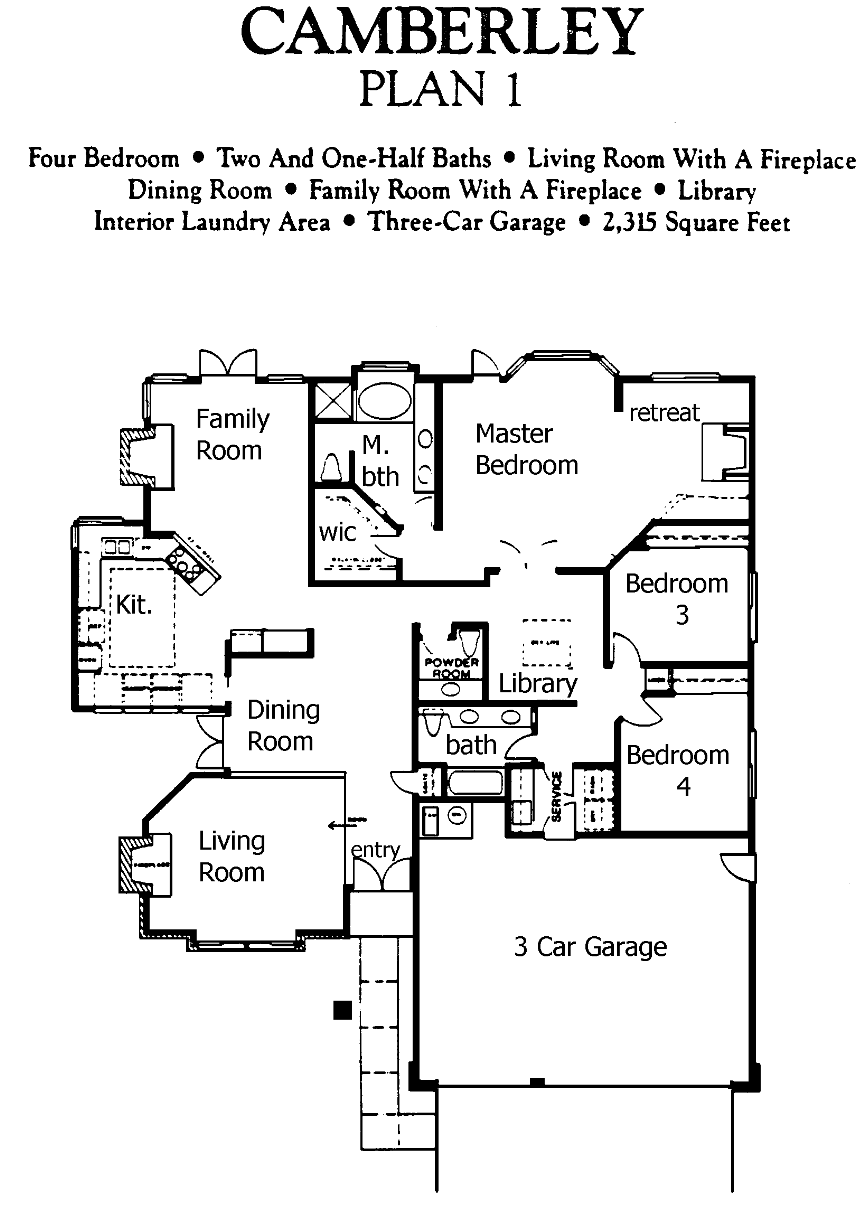
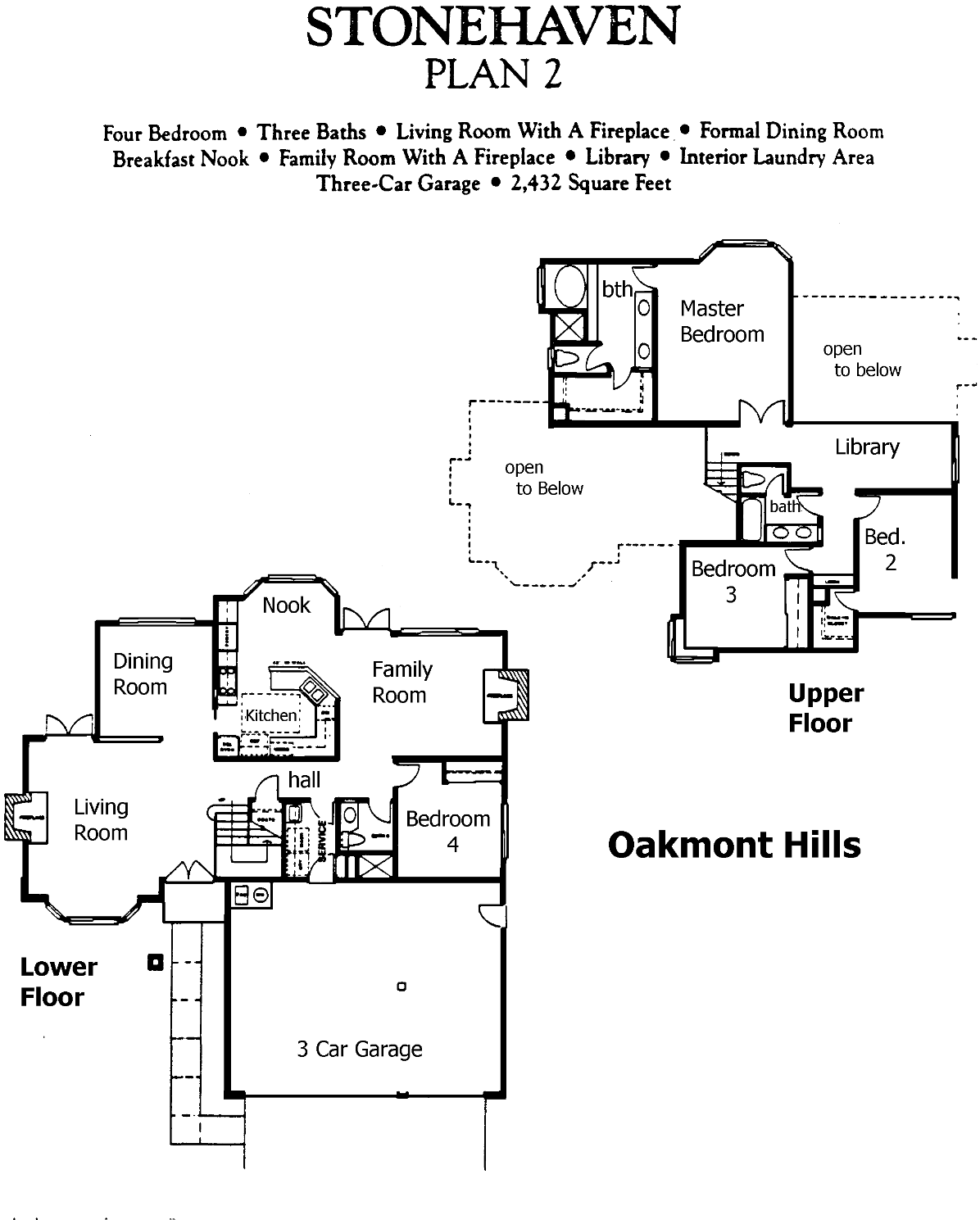
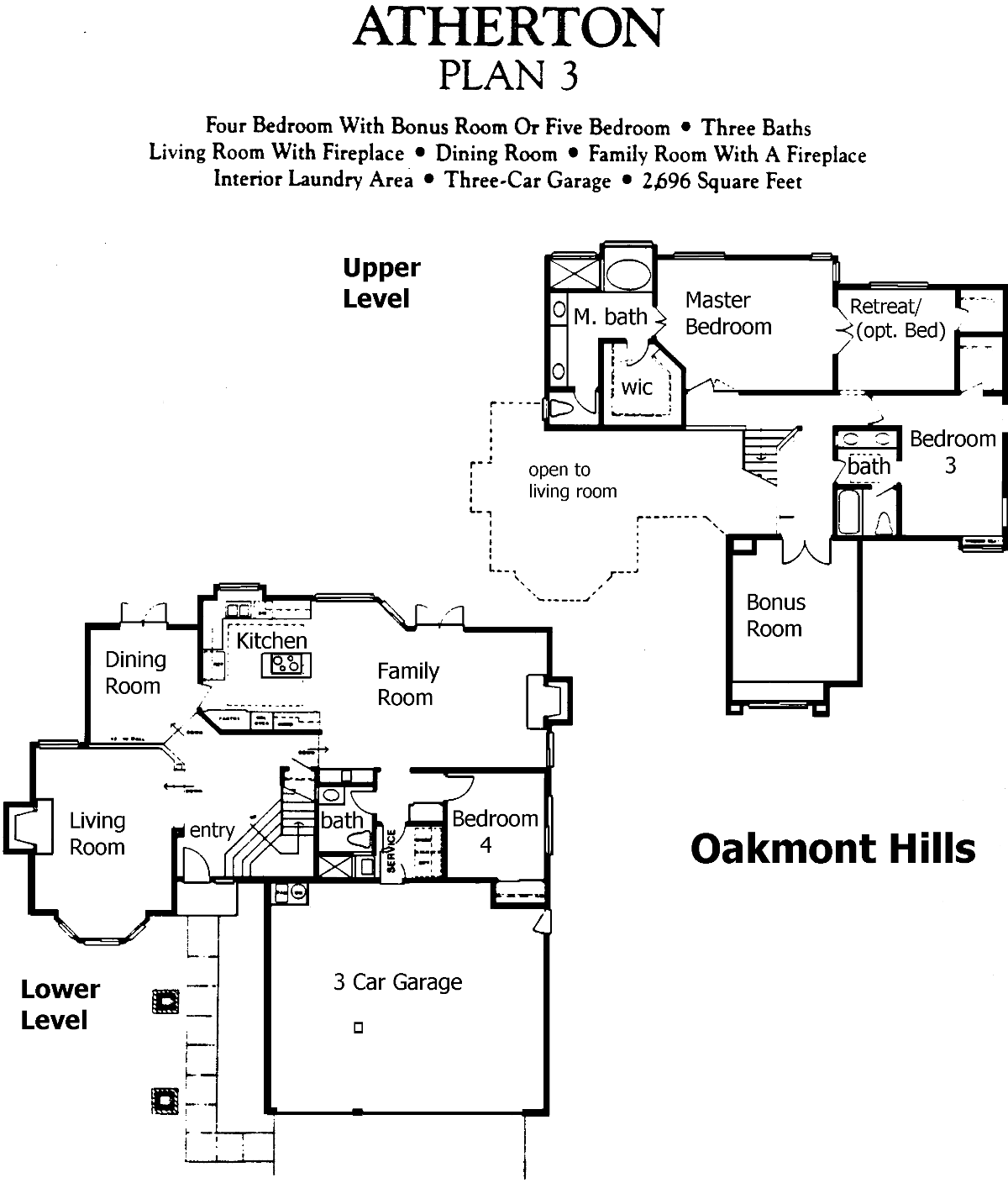
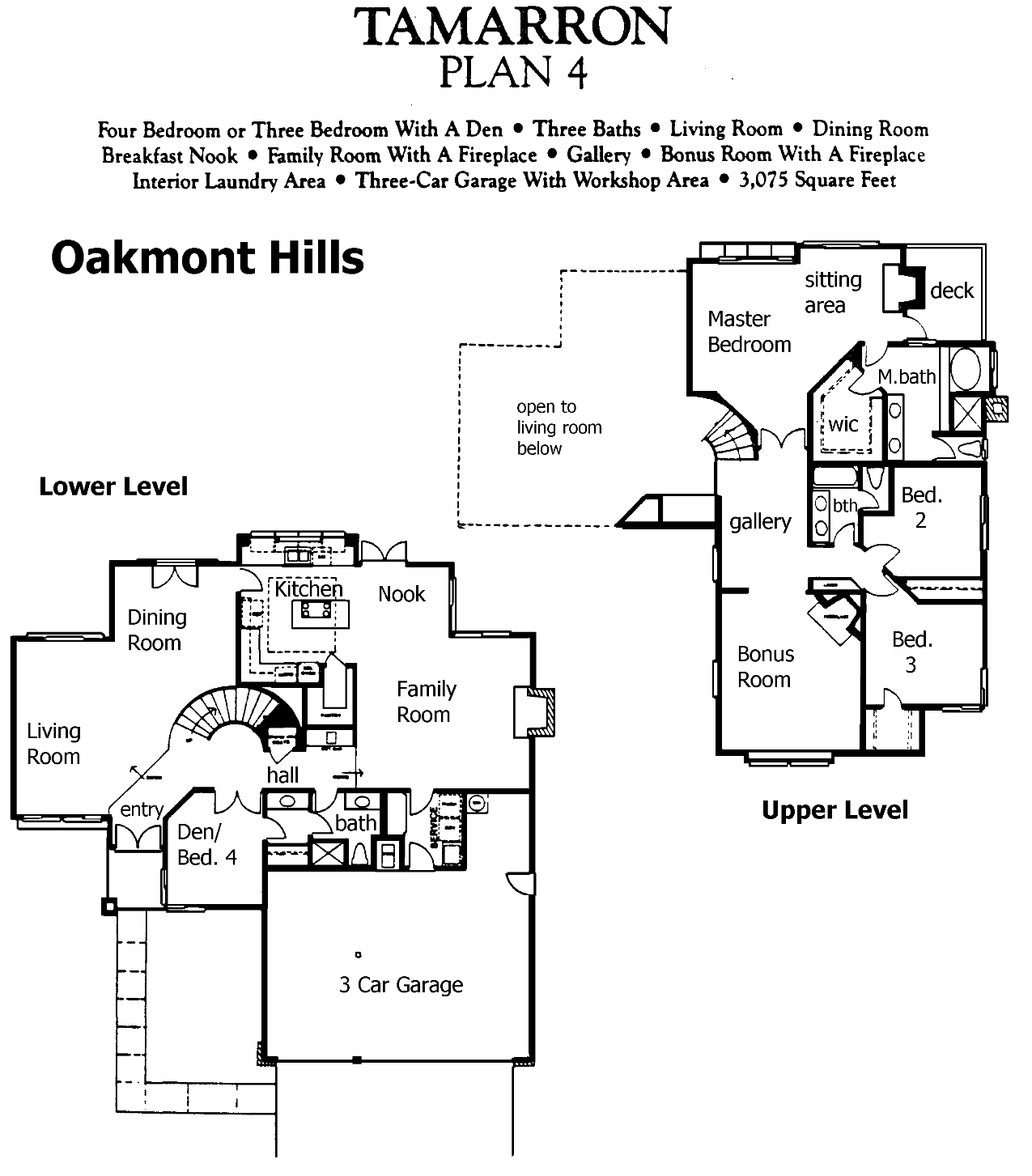
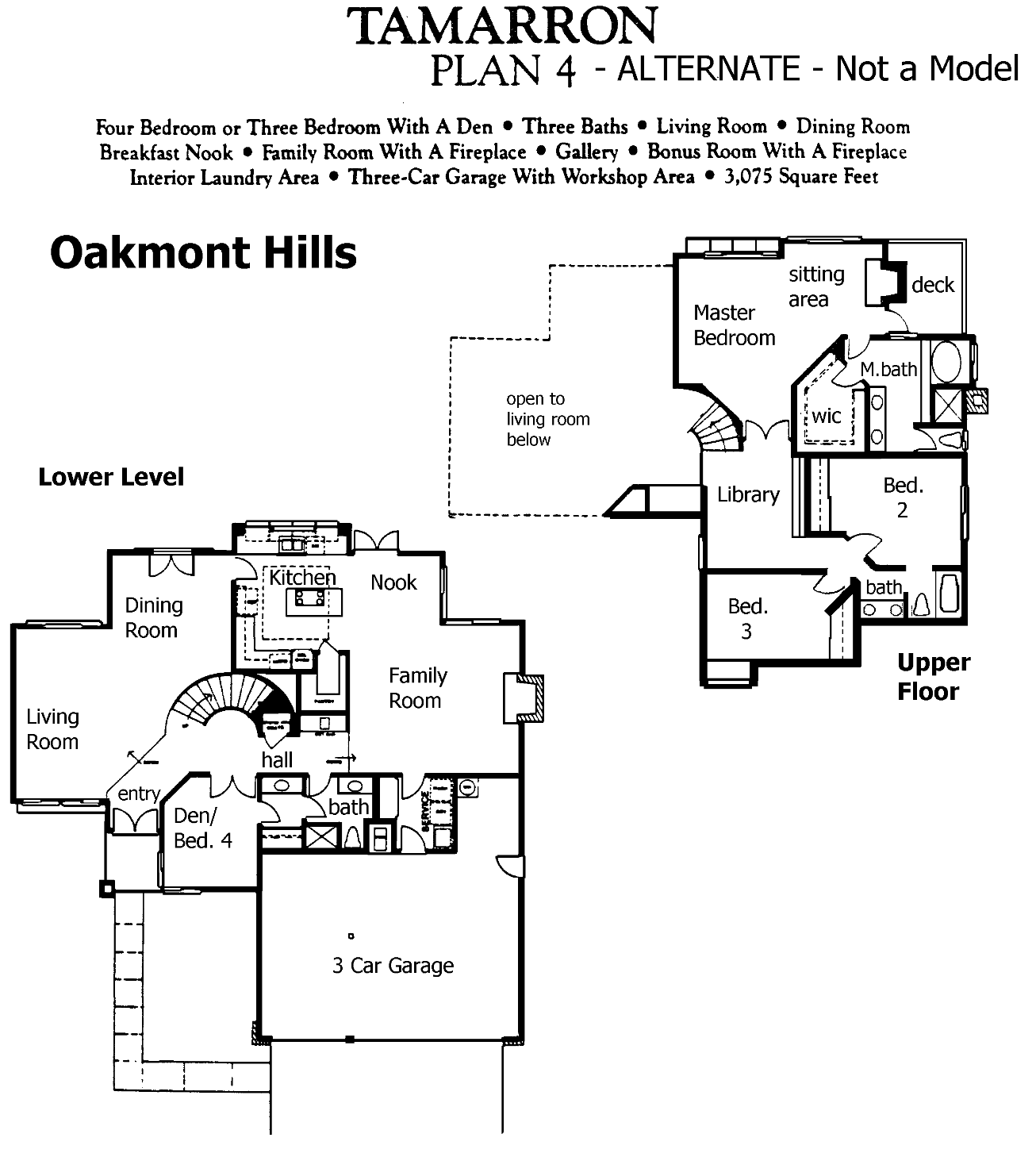
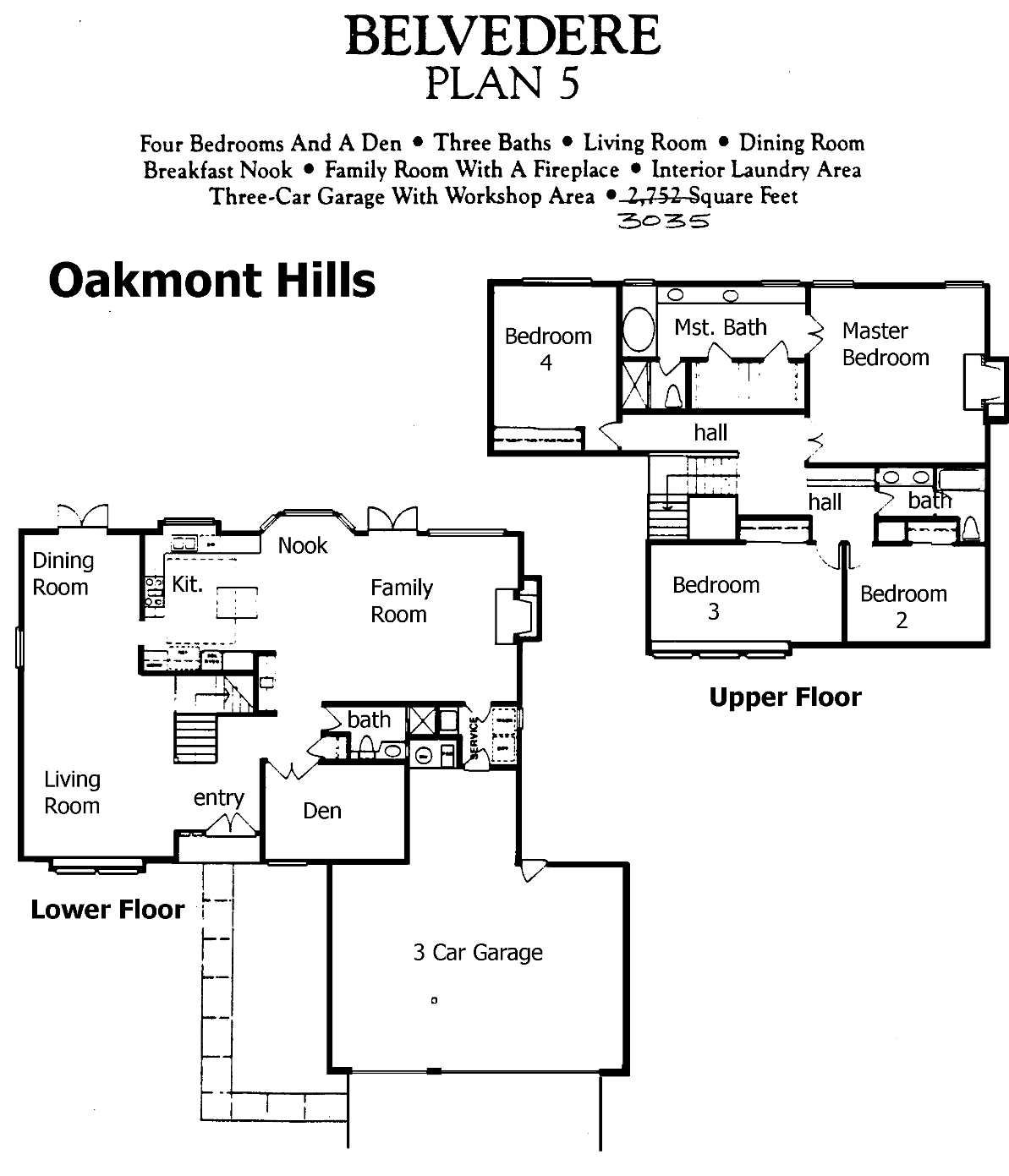
What the plans mean on the ground: county records put the median Three Springs home at about 3,500 square feet, with the single-story plans (Griffin’s Breccia, La Promenade’s Naples, Hillsboro’s Plan Two) and the smaller two-stories in the 2,800 to 3,100 range, the mid-size Colonnade and Griffin plans in the middle, and the Monaco, Marquina, Seville and Hillsboro Plan Four homes at 3,900 square feet and up. Several homes have been pushed past 5,000 square feet, and at least one custom rebuild exceeds 7,000. Two things to know about the original construction. First, ceilings are tall and the entries are dramatic for the era, typically a two-story foyer and an open or curved staircase that renovators today tend to keep. Second, each of the plans on file was drawn with the kitchen separated from the family room by a wall, a nook or a wet-bar partition, which is the wall most owners take down to create the great room buyers now expect. A Three Springs listing described as “open concept” is almost always a remodel, not the original plan, and it is worth asking whether the work was permitted.
Lots, pools, views and what to look for
Lot size is the single biggest driver of value inside Three Springs after square footage. A 3,500 square foot home on a 9,500 square foot interior lot and the same plan on a 20,000 square foot view lot can be $400,000 to $600,000 apart in the same year. Many of the homes have pools, and the tract’s late-80s grading left many rear yards with a flat pad plus an upslope, so “usable” yard is worth measuring rather than assuming from the lot square footage.
Because almost everything was built in a two-year window, the mechanical timeline is predictable. Original tile roofs are now 35 years old and most have had at least underlayment work; original HVAC and water heaters are long gone; and the 1980s windows have been replaced in the majority of homes, though not all. Slab foundations on compacted fill are normal here, so a foundation and drainage inspection is standard practice on the hillside lots, particularly where the yard drains toward the house rather than away from it.
Views: the upper cul-de-sacs and the high end of Kirsten Lee Drive, the southernmost street in the tract, have the strongest ones. If a listing says “views” and the address is on the flat interior, expect treetops and a slice of hills rather than the panorama the photos may imply.
Why people move to Three Springs
The first reason is the house. Three Springs was the last large single-family tract built inside the City of Westlake Village, and it was built for a different buyer than the 1960s and 1970s neighborhoods around the lake: fourteen plans from four builders, almost all of them 2,800 to 4,300 square feet, with two-story entries, a downstairs bedroom or den, a bonus room, a real primary suite and a three-car garage. A family that needs five bedrooms and a home office does not have to add a wing to get them here.
The second is the lot. A median parcel of about 14,000 square feet, with the hillside cul-de-sacs approaching an acre, is double what First Neighborhood, Foxmoor or Village Homes offer, and it is the reason so many Three Springs homes have a pool, a lawn and a view all at once. The 2018 rebuild of the three Triunfo Canyon Road entrances, with stone pilasters and drought-tolerant planting, gave the tract a front door to match.
The third is what the association does not cost. At about $270 a year, with no pool, clubhouse or gate to maintain, Three Springs has among the lowest carrying costs of any Westlake Village tract with an architectural committee, and no Mello-Roos assessments have been typical on its tax bills. The fourth is the Las Virgenes Unified assignment to White Oak, Lindero Canyon and Agoura High School, which is a specific draw for buyers who have already decided on that district and find that the LA County side of Westlake Village has few large-lot, late-model options. The fifth is the setting: Three Springs Park in the middle of the tract, the Santa Monica Mountains open space at the top of the streets, and the lake, The Landing and the freeway a few minutes down the hill. And the sixth is predictability. Because the whole neighborhood went up in about two years, a buyer knows what the systems are, what the plans are and what the comps are, which makes Three Springs one of the easiest tracts in the Conejo Valley to value accurately.
Living in Three Springs
The Three Springs HOA: dues, rules and monthly costs
Three Springs has a homeowners association, but it is a light one by Westlake Village standards. Dues run on the order of a few hundred dollars a year, not per month, and there are no community pools, clubhouses or gates to fund. What the association does is maintain the common landscaping at the entries and slopes and run an architectural review committee, which is the piece that matters for a second-story addition, a new roof color or a significant front-yard change. Plan on submitting drawings and allowing a few weeks for approval.
Mello-Roos assessments do not typically appear on Three Springs tax bills, but the direct assessments on the county tax bill should be confirmed for any specific parcel before buying. Otherwise property taxes are the standard Los Angeles County rate. Because the neighborhood is inside the City of Westlake Village, trash, street maintenance and the park are city services.
Schools: Three Springs is Las Virgenes, not Conejo
This is the county-line detail that trips people up. Three Springs is on the Los Angeles County side of Westlake Village, which means it is served by the Las Virgenes Unified School District: White Oak Elementary (on the east side of the lake in First Neighborhood), Lindero Canyon Middle School and Agoura High School. The Ventura County side of Westlake Village, including the Foxmoor Hills and Southshore Hills streets immediately west and north of Three Springs, is Conejo Valley Unified. Two different districts within a few blocks of each other. Every address should be verified with the district before a purchase; Gary does this on every transaction.
Parks, trails and everyday life in Three Springs
Three Springs Park is the neighborhood’s front yard: courts, a playground, open turf and the place where the tract’s kids grow up. Beyond it, the Santa Monica Mountains open space above the tract and the Triunfo Canyon trail corridor are reachable on foot from the upper streets, and the lake, the Landing and Westlake Village Community Park are a few minutes away by car or a longer walk downhill.
Shopping is at the Westlake Plaza and Village centers along Agoura Road and Westlake Boulevard, and the 101 is about five minutes away via Westlake Boulevard or Lindero Canyon Road, which puts Woodland Hills about twenty minutes east in normal traffic and Thousand Oaks ten minutes west.
Commuting from Three Springs: freeway access and the daily drive
Every trip out of Three Springs starts on Triunfo Canyon Road, which runs along the south side of the lake between Westlake Boulevard on the west and Lindero Canyon Road on the east, and the tract’s three entrances all open onto it. That gives residents a choice of two US-101 interchanges: west on Triunfo Canyon to Westlake Boulevard and north to the freeway, or east to Lindero Canyon Road and north past The Landing and the Westlake Village civic area to the Lindero interchange. Off-peak, either is on the order of five minutes; the Kanan Road interchange in Agoura Hills is a few minutes farther east along Agoura Road. Thousand Oaks Boulevard and Agoura Road run parallel to the freeway on either side and are the surface-street alternatives when the 101 backs up, which it does eastbound in the morning and westbound in the late afternoon. In normal traffic Woodland Hills is roughly twenty minutes east and central Thousand Oaks about ten minutes west; at rush hour the eastbound run to the San Fernando Valley can take considerably longer, and that commute is the honest trade-off of living at the western edge of Los Angeles County.
Groceries are a short drive in either direction. Gelson’s at 2734 Townsgate Road in the Westlake Plaza and the Vons at 2725 Agoura Road sit together near the Westlake Boulevard interchange; a Ralphs is at 3963 East Thousand Oaks Boulevard in the North Ranch Mall and a Trader Joe’s is nearby at 3835 East Thousand Oaks Boulevard. The Landing, at 32107 to 32133 Lindero Canyon Road on the lake shore, is the neighborhood’s closest cluster of restaurants and the home of the Westlake Yacht Club. The Promenade at Westlake, at 140 Promenade Way in Thousand Oaks, has the Cinépolis cinema and the larger restaurants, and its owner lists a Whole Foods as coming; the existing Whole Foods is at 740 North Moorpark Road in Thousand Oaks. The Oaks mall on Hillcrest Drive in Thousand Oaks is the department-store option, about fifteen minutes west off-peak.
Public transit is thin, as it is everywhere in the Conejo Valley. The practical option for a downtown Los Angeles commuter is LADOT’s Commuter Express 423, a weekday peak-hour bus that runs from the Thousand Oaks Transportation Center at 265 South Rancho Road and the Caltrans park-and-ride at Kanan Road in Agoura Hills to downtown and USC, with fares of $1.50 to $4.25 per trip by zone. Metrolink’s Ventura County Line does not come through Westlake Village; the nearest stations are Moorpark and Simi Valley, each a drive north on Highway 23, so the train is a realistic choice only for someone bound for Burbank or Union Station who is willing to drive to the station first.
The school run is a drive, not a walk. White Oak Elementary is on the east side of the lake in First Neighborhood, reached along Triunfo Canyon to Lindero Canyon Road, and Lindero Canyon Middle and Agoura High School are both in Agoura Hills, so the morning pattern for most Three Springs families is east on Triunfo Canyon and then north, in the same direction as the commuters. Malibu is the weekend drive: Westlake Boulevard continues south of Potrero Road as Decker Canyon Road, Highway 23, a steep and winding route to Pacific Coast Highway, while Kanan Dume Road from Agoura Hills is the wider and more commonly used way over the mountains. Either is on the order of half an hour or more to the coast outside of beach-traffic hours.
Three Springs home prices and the market
Three Springs home prices and the current market
The figures in this section were current when this guide was last reviewed. The sale record in the facts above and the listings below are drawn live from the MLS each time the page loads.
In the two years through August 2026, 22 homes in the tract sold through the MLS, at prices from $1,635,000 to $2,775,000 and a median of $2,145,000, with the smallest original-condition homes at the bottom and large, fully renovated view properties at the top. On a price-per-square-foot basis the tract typically trades between roughly $550 and $750, with renovated homes on big lots at the top of that band.
Turnover is moderate: 22 MLS sales in the two years through August 2026 across about 465 homes, roughly 11 a year, which is enough to establish clear comps but not so much that buyers can be choosy about a specific floor plan in a specific month. Well-priced, updated homes usually sell in the first two weeks; original-condition homes on interior lots take longer and often sell to buyers planning a full remodel.
Figures are drawn from Los Angeles County public records and MLS closings and are rounded. They are a snapshot, not a valuation; contact Gary for a current read on any specific property.
Renting in Three Springs: leases and rental prices
Three Springs is a neighborhood people buy into rather than rent in, and the lease market reflects that. With about 465 homes and owners who tend to stay for decades, only a few houses come up for lease in a typical year, and they are usually the property of an owner who has relocated for work and wants to keep the house rather than an investor who bought it to rent. There is no lease packet for this page, so the figures below come from public rental listings and should be read as a range, not a rate sheet.
In September 2026, two Three Springs houses were advertised for lease on public sites: a four-bedroom, four-bath home of about 3,560 square feet on Kirsten Lee Drive at $8,800 a month, and a four-bedroom, four-bath home of about 3,720 square feet on Yellowwood Drive at $9,000. Older listings on Three Springs Drive, since taken down, had asked around $5,800 to $5,900 for homes of roughly 2,300 to 3,500 square feet, which gives a sense of how far rents for the tract’s larger plans have moved. As a working range, a 3,000 to 3,700 square foot Three Springs house in good condition tends to ask somewhere between about $7,000 and $9,500 a month, with the largest renovated view homes above that and original-condition homes below. For comparison, the late-1960s tracts on the flat land nearer the lake, including First Neighborhood and Foxmoor, were listing 2,200 to 2,800 square foot homes at roughly $5,200 to $8,000 at the same time.
Practicalities for landlords and tenants: nearly every Three Springs lease is unfurnished and runs twelve months, with pets negotiated house by house. California law now caps security deposits at one month’s rent for most landlords, with a narrow exception for small owners who hold only a couple of properties, so the two-month deposits that used to be standard on homes at this price point are no longer routine. Tenants are typically relocating families rather than singles: executives at the Thousand Oaks and Westlake Village employers along the 101 corridor, Amgen among them, who want a house in the Las Virgenes district for a year or two before they buy. Whether the association has any rental restrictions was not verified for this page, and the CC&Rs should be read before a house is put on the lease market. Gary Jacobs has handled leases in the tract, including on Ranchgrove Drive, and can price a specific house against the handful of comparable leases in a given year.
What inspectors find in Three Springs homes
Because almost the whole tract was finished between 1988 and 1990, Three Springs homes share a mechanical profile, and an inspector who has worked the neighborhood knows what to look for. What follows is common in homes of this era; each house varies, and a licensed inspector must confirm the condition of any specific property. None of it should be read as a claim about a particular address.
Plumbing is the first item. Copper supply lines were standard in Southern California tracts of the late 1980s, and thirty-five-year-old copper can develop pinhole leaks, particularly on hot-water lines and at slab penetrations, so an inspector will look for repair couplings, water stains under sinks and evidence of past slab leaks. Some late-1980s tracts in the region were plumbed with polybutylene, a gray plastic pipe that insurers and inspectors treat as a defect; it was not confirmed for any of the four Three Springs builders, but a buyer should ask the inspector to identify the supply material. Drain lines are ABS plastic rather than cast iron, which is good news, but a sewer-lateral camera is still worth the cost on a lot with mature trees. Original water heaters and furnaces are long gone from most homes, but the attic ducting that serves the second-floor systems is often original, and an inspector will check it for disconnected runs and crushed flex duct.
Electrical panels from this period are generally not the Zinsco and Federal Pacific units that plague the 1960s and 1970s tracts around the lake, but a panel that was ample in 1989 may have no spare capacity for an EV charger, a heat pump and a pool heater at once, and inspectors routinely note panels at or near capacity. Windows are the next thing: the builders used aluminum-framed sliders and fixed glass, and while most homes have had them replaced with vinyl or fiberglass units, some still carry original frames with failed seals. Roofs are concrete tile, and the tile itself outlasts the felt underlayment beneath it; many Three Springs roofs have had the underlayment replaced, and an inspector will want to see the paperwork or the evidence. The 1980s prefabricated metal fireplaces in the family rooms and primary suites also deserve a look, since their fireboxes and flues have a finite life.
The site matters as much as the house. Three Springs was graded from rolling ground into cut-and-fill pads, and the lots on the southern and western edges have slopes above or below the house. Inspectors check that yard drainage carries water away from the slab, that area drains are clear and connected, that retaining walls are not leaning or weeping, and that the slope behind the house shows no signs of creep. On homes with pools, the equipment age, the plaster condition and the deck for settlement are standard items. Finally, additions: a great many Three Springs kitchens have had the wall to the family room removed, bonus rooms have been split into bedrooms, and a few garages have been converted. The city and Los Angeles County permit records should be pulled for any work that is not obviously original, and a buyer should also ask early in escrow about the parcel’s fire-hazard zoning and get an insurance quote, since the tract backs to the Santa Monica Mountains open space and the 2018 Woolsey Fire burned across those mountains south of Westlake Village.
Remodels that add value in Three Springs
The single highest-return project in Three Springs is the one nearly everyone does eventually: taking down the wall between the kitchen and the family room. Every one of the fourteen original plans separated the two with a wall, a nook or a wet-bar partition, and the difference between a Colonnade Majorca with that wall in place and the same plan with an island kitchen open to the family room is, in practice, the difference between the lower and upper halves of the tract’s price band. Because the wall is usually load-bearing at the two-story plans, the work needs a beam, an engineer and a permit, which is why buyers should ask for the permit on any listing described as open concept.
After the kitchen, the projects that show up in the sales record are primary-suite work and room conversions. The late-1980s primary baths were large for their time but built around a soaking tub, a small shower and a double vanity, and a rebuilt bath with a walk-in shower and a proper closet is what buyers at this price expect. Upstairs bonus rooms in the Colonnade, Griffin and Hillsboro plans get converted to a fifth bedroom or split into two, and downstairs dens become full guest suites with the addition of a shower to the adjacent bath. Second-story additions are uncommon in Three Springs because almost every house already has one; the additions that do happen are on the single-level plans, which are scarce enough that owners tend to expand them rather than sell, and on the largest lots, where several homes have grown past 5,000 square feet and at least one custom rebuild exceeds 7,000.
The lots also make Three Springs one of the better candidates in Westlake Village for an accessory dwelling unit. State law requires the city to allow ADUs in every residential zone, and Westlake Village approves them through a zoning clearance without discretionary review, with the building permit issued by Los Angeles County. A detached unit of up to about 800 square feet is generally permitted by right and larger units are possible under the city’s standards, and a junior ADU of up to 500 square feet can be carved out of the house itself. A flat pad of 14,000 square feet or more, which is the median lot here, usually has room; the hillside lots with a small pad and a large upslope often do not. The homeowners association’s architectural review still applies to the exterior, and while California law prevents an association from prohibiting ADUs outright, it can impose reasonable design conditions, so drawings should go to the committee before they go to the county.
What the sales record suggests, with the caveat that condition was not verified house by house for this page: a 2,936 square foot home on Southshore Place closed at about $2.45 million in June 2026, roughly $830 per foot, well above the tract’s usual $550 to $750, which is the kind of number a finished single-level plan on a good lot produces. A 3,849 square foot home on Kirsten Lee Drive with a remodeled kitchen, a pebble-finish pool and a 0.61-acre lot closed at $1.93 million in April 2025, about $500 per foot. The two together make the point that in Three Springs the per-foot premium for renovation is largest on the mid-size and single-level plans and smallest on the biggest houses, where the buyer pool thins and the lot’s usable area matters more than its total.
Buying and selling in Three Springs
How Three Springs compares with nearby neighborhoods
The tracts around Three Springs are, almost without exception, older and smaller, and the comparison is mostly one of house size against everything else. First Neighborhood, across the lake to the northeast, was the first Westlake Village tract, built in 1966 to 1968 with Colony Park plans of about 1,750 to 2,650 square feet on lots near 7,500 square feet; it shares the Las Virgenes schools with Three Springs and has White Oak Elementary inside it, and its property owners association runs a heated pool, greenbelts and a community center for dues of about $170 a quarter. Its 2024 to 2026 median sale, around $1.7 million, is roughly $450,000 below Three Springs, and the difference is house: a First Neighborhood buyer gets a walkable, flat, park-laced neighborhood and a school within the tract, a Three Springs buyer gets a thousand more square feet and twice the lot.
Immediately west and north, across the county line in the City of Thousand Oaks, are Foxmoor and Foxmoor Hills. Foxmoor is a 1968 to 1969 tract of about 270 homes on flat 7,000 square foot lots wrapped around Westlake Elementary, with a clubhouse, community pool and greenbelt paid for by dues of about $230 to $240 a quarter, and a median sale near $1.55 million. Foxmoor Hills, on the slope north of Potrero Valley Creek, is the closest physical analogue to Three Springs: 1969 to 1971 homes on hillside lots with a median of about 12,600 square feet, an association that does little more than landscaping and architectural review for about $220 a year, and a median sale near $1.725 million. The instructive number is price per foot. Foxmoor Hills typically trades at about $650 to $700 per square foot and Three Springs at about $550 to $750, which means that on a per-foot basis the newer, larger Three Springs house is often the cheaper one; the total is higher only because there is so much more of it. Both Foxmoor tracts are in Conejo Valley Unified, which for some buyers decides the question before price does.
Southshore Hills, the 1970 to 1976 tract on the hillside immediately west of Three Springs across the county line, is the nearest neighbor and the one buyers most often tour on the same afternoon. Its 139 homes sit on lots of a similar size, a median near 14,800 square feet, but the houses are a generation older and about a third smaller, with a median of roughly 2,300 square feet; its recent median sale of about $1.84 million lands between Foxmoor Hills and Three Springs, and, being in the City of Thousand Oaks, it is Conejo Valley Unified rather than Las Virgenes. Westlake Island, the guard-gated island in the lake, is the other direction entirely: 1967 to 1981 homes on waterfront lots of about 5,400 square feet, two associations whose combined dues ran about $850 a quarter on a 2026 listing, and a median sale around $3.05 million. Buyers deciding between the island and Three Springs are choosing between a dock and a yard, and between a gate and a $270-a-year association. Village Homes, along Triunfo Canyon Road west of Westlake Boulevard, rounds out the set with 1969 to 1978 homes, a pool, tennis courts and a greenbelt, and a median sale near $1.46 million; it is where many Three Springs buyers lived before they moved up.
What to weigh before buying in Three Springs
Three Springs is a two-story neighborhood. The three single-level plans, Griffin’s Breccia, La Promenade’s Naples and Hillsboro’s Plan Two, are a small minority and command a premium when they surface, so a buyer who needs one level should expect to wait and to pay for it. The two-story plans put every bedroom but one upstairs, which suits families with children and suits fewer people twenty years later.
The houses are now more than thirty-five years old, and a Three Springs home that has not been systematically updated will need roof underlayment, windows, a panel with capacity for modern loads and probably a kitchen, on top of the copper-pipe and hillside-drainage checks described above. The hillside lots that carry the views also carry the slopes, and slope maintenance, retaining walls and drainage are ongoing costs rather than one-time ones. The tract backs to the same mountain open space the 2018 Woolsey Fire moved through south of Westlake Village, and fire insurance availability and cost should be confirmed early in escrow, not at the end.
The association is light in cost but not in activity. A residents’ group, Friends of Three Springs, has been campaigning to replace bylaws and CC&Rs that the association’s attorneys described as old enough to be a liability; a recent bylaws vote drew 226 yes votes of 258 cast, about 88 percent, but fell fifteen votes short of the threshold the old rules require, and the association has spent roughly $31,800 on the effort. None of this affects a buyer’s daily life, but anyone who intends to build, add a second story or put up an ADU should read the current governing documents and the architectural guidelines before writing an offer, and should budget a few weeks for committee approval.
Then the geography. Three Springs has no lake frontage and no docks; the water is a drive or a long walk away. The elementary school is across the lake, the middle and high schools are in Agoura Hills, and none is walkable. Triunfo Canyon Road is the only way in or out, which is quiet but means every trip funnels to the same two interchanges, and the eastbound 101 at rush hour is the daily reality for anyone working in the San Fernando Valley or beyond. Finally, the county line: a Three Springs buyer is in Los Angeles County for property tax administration, building permits and services, and in Las Virgenes Unified for schools, while a house a few hundred yards west is in Ventura County and Conejo Valley Unified. Every address should be verified with the district and the county before an offer is written.
Who buys in Three Springs
The core Three Springs buyer is the move-up family: people who started in a 2,200 square foot house in First Neighborhood, Village Homes or Foxmoor, have two or three children and a parent who visits for a month at a time, and need the downstairs bedroom, the bonus room and the yard. They usually arrive with a specific plan in mind, a Colonnade Monaco or a Griffin Marquina, and a specific street, and they are the reason turnover is only about eleven homes a year: they stay.
The second group is relocating families with a district already chosen. The Las Virgenes schools draw buyers from the Valley and from out of state, and Three Springs is one of the few places on the Los Angeles County side of Westlake Village where a late-model house on a third of an acre exists at all. They often lease first, which is where the tract’s handful of rentals goes each year, and buy the following spring.
The third group is remodelers and rebuilders. Because the plans are sound, the lots are large and the mechanical timeline is predictable, an original-condition Three Springs house on a view lot is one of the most reliable renovation projects in the Conejo Valley, and the buyers who take those on are often contractors, designers or families who have done it once before. The fourth, smaller group is buyers looking at North Ranch or Westlake Island who decide that a gate or a dock is not worth the better part of a million dollars more, and who find in Three Springs the same house size at a lower number. And there is a steady trickle of single-level seekers, empty-nesters and buyers with a parent moving in, who wait for a Breccia, a Naples or a Hillsboro Plan Two and move fast when one lists.
Gary’s track record in Three Springs
Gary Jacobs has sold and leased homes in Three Springs for years. Two examples: 2683 Grandoaks Drive, a 1990 home of 3,516 square feet on a large view lot, which Gary sold in October 2022 for $2,460,000; and 32461 Timberridge Court, a 1987 home of 3,107 square feet that he sold in October 2017 for $1,025,000, which gives a sense of how far the tract moved in five years. He has also handled leases on Ranchgrove Drive and elsewhere in the tract. For any Three Springs house, Gary can identify the plan, walk through what the last several comparable sales actually looked like inside, and estimate what a renovation there is likely to return.
Buying or selling in Three Springs: practical notes
Buyers: prioritize lot and orientation over finishes. Finishes can be changed; a 9,000 square foot flat lot cannot be turned into a 20,000 square foot view lot. Ask for the HOA architectural file on any additions. Check the school district boundary for the specific parcel.
Sellers: the tract has a clear pricing ladder (original, partially updated, fully renovated), and buyers here know it. Presenting a partially updated home as “fully remodeled” costs credibility and days on market. The kitchens and primary baths carry the most weight; a modest pre-sale refresh of those two rooms, plus paint and landscaping, is usually the highest-return preparation in Three Springs.
History and builder
The history of Three Springs: how the tract was built
Three Springs was one of the last large single-family neighborhoods built inside the city limits of Westlake Village. The master-planned community had been growing outward from the lake since the late 1960s, and by the mid-1980s the flat land near the water was gone. What remained was the rolling ground south of the lake, above Triunfo Canyon Road, climbing toward the Santa Monica Mountains and the Ventura County line. Between roughly 1987 and 1991 that ground was graded into two subdivision maps and sold off in phases to several builders, each of which put up its own series of plans: Colonnade Homes (the largest share, sold in the MLS as “Colonnade Three Springs”), Griffin Homes (“Griffin Three Springs”), La Promenade and Hillsboro. In county records more than 400 of the roughly 465 homes carry a 1988 or 1989 completion date, which shows how fast the tract went up once grading was finished.
The timing mattered. All five builders were designing for the late-1980s buyer, and that buyer wanted more house than the 1960s and 1970s tracts around the lake offered: bigger kitchens with a nook opening to a family room, a formal living and dining room up front, a downstairs bedroom or den, a large primary suite upstairs with a sitting area or retreat, a bonus room, and a three-car garage. Lots were laid out with the same generosity. Instead of the 6,000 to 8,000 square foot parcels typical of First Neighborhood or Foxmoor, Three Springs lots run from around 9,000 square feet up to nearly an acre on some of the hillside cul-de-sacs, with a median right around 14,000 square feet. That combination, late-80s floor plans on early-70s-sized lots, is the reason the neighborhood has aged so well.
The name comes from Three Springs Drive, the spine road that loops through the tract, and from Three Springs Park, the city-operated neighborhood park at 3022 Three Springs Drive with basketball courts and a children’s play area. The neighborhood’s three entrances off Triunfo Canyon Road were rebuilt in 2018 with stone pilasters, faux gates, new lighting and drought-tolerant planting, a $179,000 project the homeowners association funded with a $50,000 contribution from the city’s beautification fund.
Questions buyers ask about Three Springs
How much does a house in Three Springs Westlake Village cost in 2026?
In the two years through August 2026, 22 Three Springs homes sold through the MLS, at prices from $1,635,000 to $2,775,000 and a median of $2,145,000, with the smallest original-condition homes at the bottom and large renovated view properties at the top. On a per-square-foot basis the tract typically trades between roughly $550 and $750, and a renovated single-level plan on a good lot can go higher; a 2,936 square foot home on Southshore Place closed at about $2.45 million in June 2026. Figures are rounded from public records and are a snapshot, not a valuation.
How big are the homes and lots in Three Springs?
County records put the median Three Springs home at about 3,500 square feet, with most between 2,800 and 4,300 square feet and four or five bedrooms; several homes have been expanded past 5,000 square feet and one custom rebuild exceeds 7,000. Lots run from roughly 9,000 to 42,000 square feet with a median of about 14,000, or a third of an acre, which is about double the lots in First Neighborhood, Foxmoor or Village Homes. The western half of the tract (county tract 34835) runs slightly larger in both house and lot than the eastern half (tract 42801).
Who built Three Springs and what are the floor plans?
Four builders developed Three Springs between about 1987 and 1991, with more than 400 of the roughly 465 homes completed in 1988 or 1989: Colonnade Homes (the Mantua, Mecca, Majorca and Monaco plans), Griffin Homes (Breccia, Carrara and Marquina), La Promenade (Naples, Madrid and Seville) and Hillsboro (Plans One through Four). Fourteen original plans in all, mostly two-story with a two-story entry, a downstairs bedroom or den, a bonus room and a three-car garage; the Breccia, Naples and Hillsboro Plan Two are the single-level exceptions. Gary Jacobs has the original drawings for all four series.
What are the Three Springs HOA dues and what do they cover?
The Three Springs Homeowners Association covers 481 homes and has shown about $270 per year in recent listings, billed annually rather than monthly. The dues pay for the common landscaping at the three Triunfo Canyon Road entrances and slopes and for an architectural review committee; there is no community pool, clubhouse or gate. Mello-Roos assessments have not been typical on Three Springs tax bills, but buyers should confirm the current dues and the parcel’s direct assessments in the escrow disclosures.
Which school district is Three Springs in?
Three Springs is on the Los Angeles County side of Westlake Village and is served by the Las Virgenes Unified School District: White Oak Elementary in First Neighborhood on the east side of the lake, Lindero Canyon Middle School and Agoura High School, both in Agoura Hills. The Southshore Hills and Foxmoor Hills streets immediately west and north are across the county line in the City of Thousand Oaks and belong to Conejo Valley Unified. None of the three schools is walkable from Three Springs, and every address should be verified with the district before a purchase.
What should a buyer check in a Three Springs home built in 1988 or 1989?
Common items in homes of this era, which a licensed inspector must confirm house by house, include original copper supply lines with possible pinhole leaks, original attic ducting, aluminum-framed windows where they have not been replaced, concrete tile roofs whose felt underlayment is at the end of its life, electrical panels without spare capacity for an EV charger or heat pump, and 1980s prefabricated fireplaces. On the hillside lots, yard drainage, retaining walls and slope condition matter as much as the house, and pool equipment and any kitchen wall removals or bonus-room conversions should be checked against city and Los Angeles County permit records. Fire insurance availability and cost should be confirmed early in escrow.
Can a Three Springs house be rented, and what do leases go for?
Only a few Three Springs homes lease in a typical year, usually because an owner has relocated for work. In September 2026 two houses of about 3,560 and 3,720 square feet were advertised at $8,800 and $9,000 a month, and a 3,000 to 3,700 square foot house in good condition generally asks somewhere between about $7,000 and $9,500, unfurnished on a twelve-month term. Any association rules on rentals were not verified for this page and should be read in the CC&Rs before a house is offered for lease.
How does Three Springs compare with Foxmoor Hills or First Neighborhood?
Three Springs homes are about twenty years newer and roughly a thousand square feet larger than either. Foxmoor Hills, across the county line, has similar hillside lots with a median near 12,600 square feet, an association of about $220 a year, Conejo Valley Unified schools and a median sale near $1.725 million; First Neighborhood, across the lake, has 1966 to 1968 homes on 7,500 square foot lots, a community pool for about $170 a quarter, the same Las Virgenes schools as Three Springs and a median near $1.7 million. Three Springs’ median of about $2.15 million buys the larger house, and on a price-per-foot basis it is often the cheaper of the three.
Nearby Westlake Village neighborhoods
Thinking about Three Springs? Gary Jacobs has the original floor plans for all four builders, the sales history for every street, and a current read on what is coming to market before it is public.
Talk with Gary Jacobs → | Back to the Westlake Village guide