Village Homes, Westlake Village CA: HOA & Schools
Westlake Village Neighborhood Guide
Village Homes
1969–1978 in three phases · about 654 homes with a pool, clubhouse, tennis and a 1¼-mile greenbelt
2244 Silver Spring Drive, sold by Gary Jacobs
Village Homes is the large planned neighborhood on the Ventura County side of Westlake Village that fills the valley floor west of Westlake Boulevard along Triunfo Canyon Road, wrapped around Triunfo Community Park and Evenstar Park. Built in three waves between 1969 and 1978, it is about 654 single-family homes with a heavy share of single-story plans, a lit greenbelt of more than a mile and a quarter under old oaks, a 25-yard community pool, a clubhouse and tennis, all for association dues that still run under $100 a month. This guide covers how Village Homes came to be, the eleven original floor plans, which streets belong to which phase (and which nearby streets belong to other tracts), the Village Homes Property Owners Association and what it costs, schools, the parks, and where prices have landed.
Highlighted area is the approximate footprint of the Village Homes tract, drawn from the parcels in county records. Labels mark the other Westlake Village neighborhoods; click one to open its guide.
Not gatedVillage Homes is not a gated community.
Guard-gated communities in Westlake Village: Country Club EstatesSherwood Country ClubSycamore CanyonTrentwoodWestlake Island
Gated communities nearby: Majestic OaksHidden Valley EstatesBridgehavenWestlake CoveWestlake Pointe
Homes for sale and recently sold in Village Homes
These listings are drawn to the outline of the Village Homes tract shown on the map above, so they cover Village Homes and nothing from the tracts next door. They come from the CSMAR multiple listing service and update as agents post them. A section can legitimately come back empty: in a tract this size, weeks can pass with nothing for sale.
For sale in Village Homes now
Every active listing inside the tract.
Loading…
In escrow in Village Homes
Under contract but not yet closed, which is the earliest read on where prices are heading.
Loading…
Sold in Village Homes, last two years
Closed sales with price, size and year built.
Loading…
Where Village Homes is
The history of Village Homes: how the tract was built
Village Homes was part of the first decade of Westlake Village. In 1963 the American-Hawaiian Steamship Company, controlled by shipping magnate Daniel K. Ludwig, bought the 12,000-acre Albertson Ranch on the Los Angeles–Ventura county line for about $32 million and, with Prudential Insurance as its partner, hired A. C. Martin and Associates to master-plan a “city in the country” for some 70,000 people. The plan organized the ranch into residential neighborhoods separated by greenbelts, kept the mature oaks where it could, put the utilities underground and built a man-made lake as the focal point; the lake and its dam across Triunfo Creek went in between 1965 and 1969, and the first tracts on both sides of the county line were selling before the water had finished rising. Foxmoor, First Neighborhood and Village Homes are all products of those first years.
The ground Village Homes occupies is the valley that Triunfo Canyon Road follows west from Westlake Boulevard, a broad, mostly flat floor with the hills of the future Los Robles open space to the north and the slopes that became Foxmoor Hills to the south. County records label the lots as Tract 1967 in two units and zone them RPD, Thousand Oaks’ residential-planned-development category at about four homes to the acre, which is the legal footprint of what the marketing called a planned unit development: modest private lots, a shared greenbelt threaded between the streets, and a recreation center owned by all the owners in common. The first unit, along Triunfo Canyon Road and the cul-de-sacs off it, was built out in 1969. The second unit followed in two stages, one on the flat ground around the future Evenstar Park in 1973 and one on the higher ground to the north and west in 1976, 1977 and 1978, with plans that grew larger and more two-story as the decade went on. The tract was sold on the Conejo board as tract 726, and the name Village Homes has stuck through fifty years of listings.
The political geography was settled before the last phase was finished. The Ventura County portions of the master plan, 8,544 acres in all, were annexed into the City of Thousand Oaks in 1968 and 1972, so every Village Homes house has been inside Thousand Oaks city limits since it was built. The Los Angeles County third of the plan incorporated as the City of Westlake Village in 1981, and because California does not allow a city to straddle two counties, the Ventura side kept its Westlake Village mailing addresses while taking its police contract, building department and city services from Thousand Oaks. A Village Homes owner therefore pays Ventura County property taxes, pulls a permit from Thousand Oaks and sends a child to a Conejo Valley Unified school, all with a Westlake Village 91361 address on the mailbox. The Conejo Recreation and Park District, not the city, owns the two public parks in and beside the tract; it acquired the Evenstar Park site in 1971 and developed it in 1975, in step with the second phase of homes around it.
Gary Jacobs has been selling and leasing in Village Homes since the 2000s and keeps the original plan sheets for tract 726 on file, which matters in a neighborhood where three building phases, two county tract units and a handful of adjoining tract codes all trade under one name.
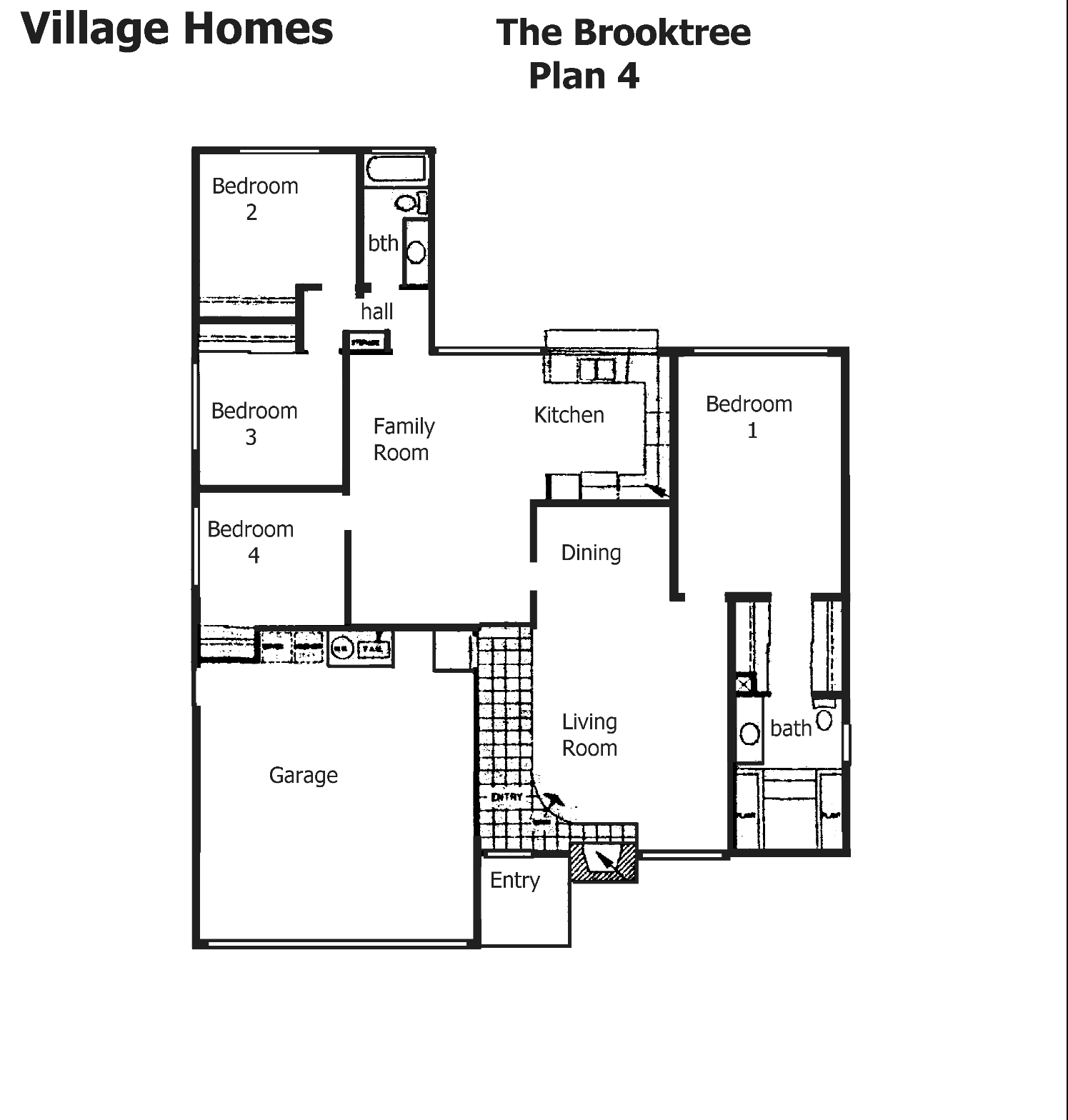
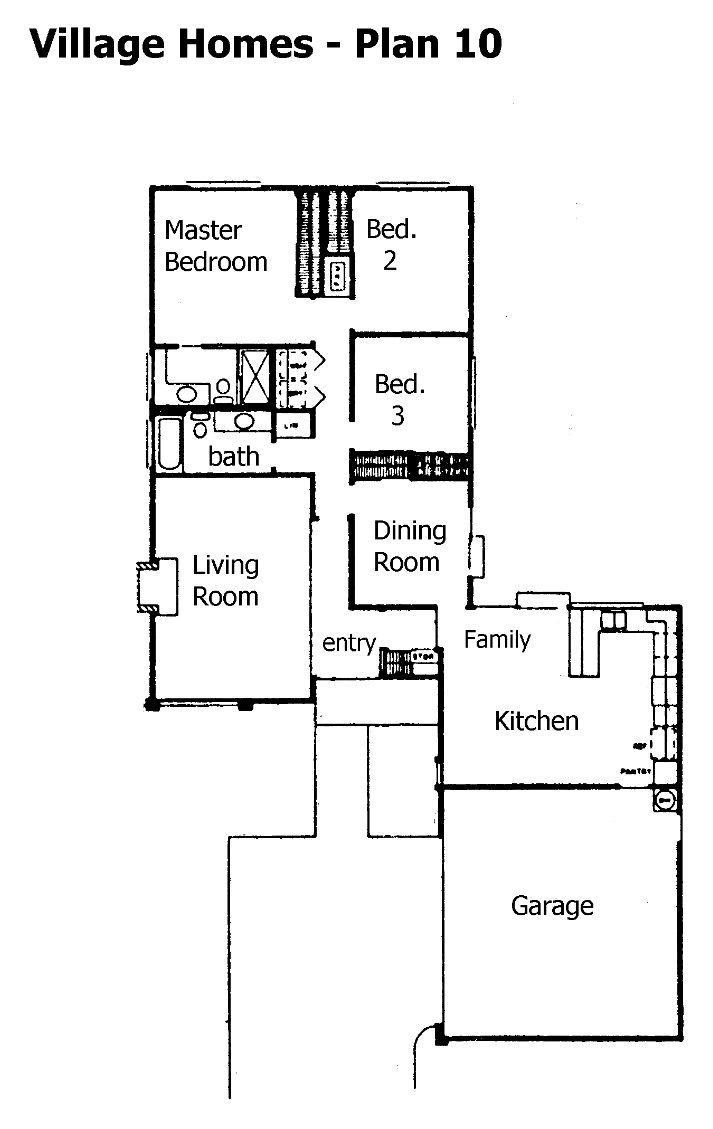
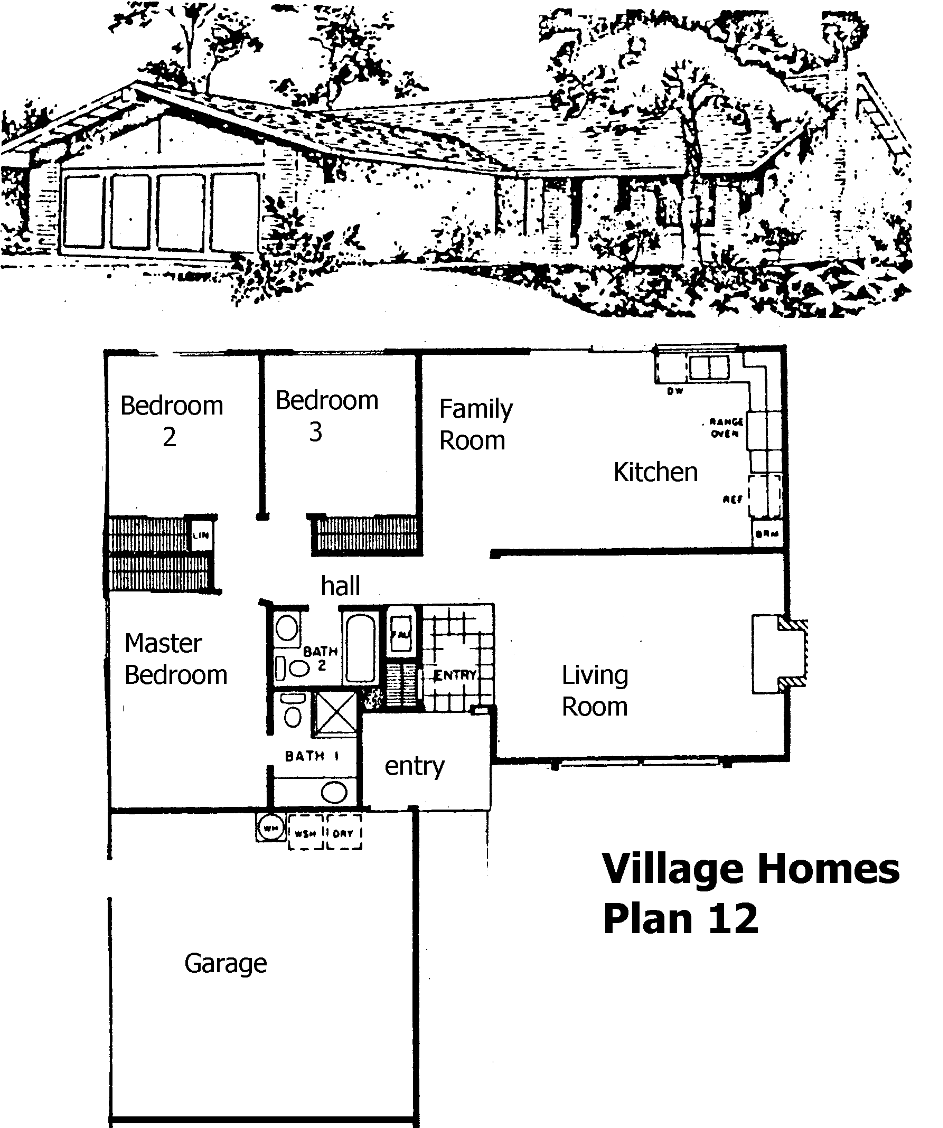
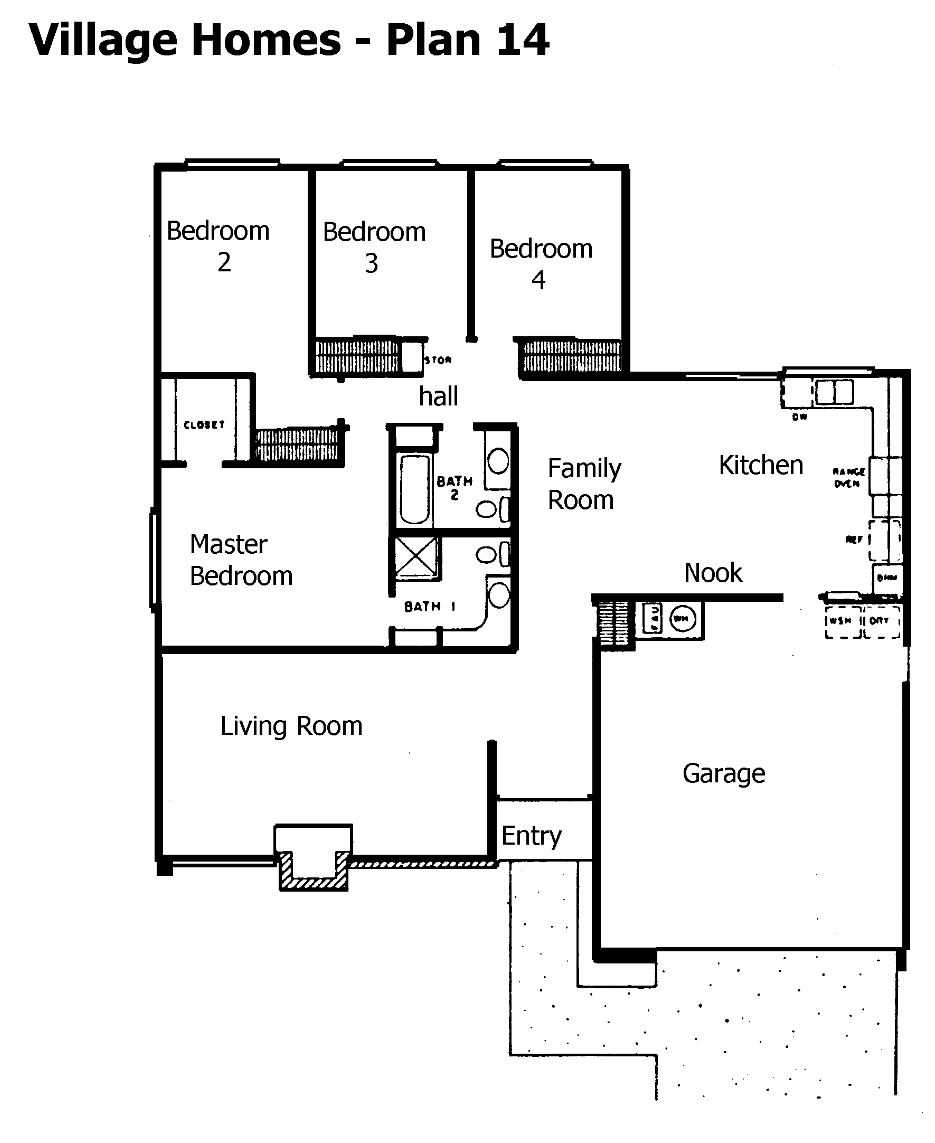
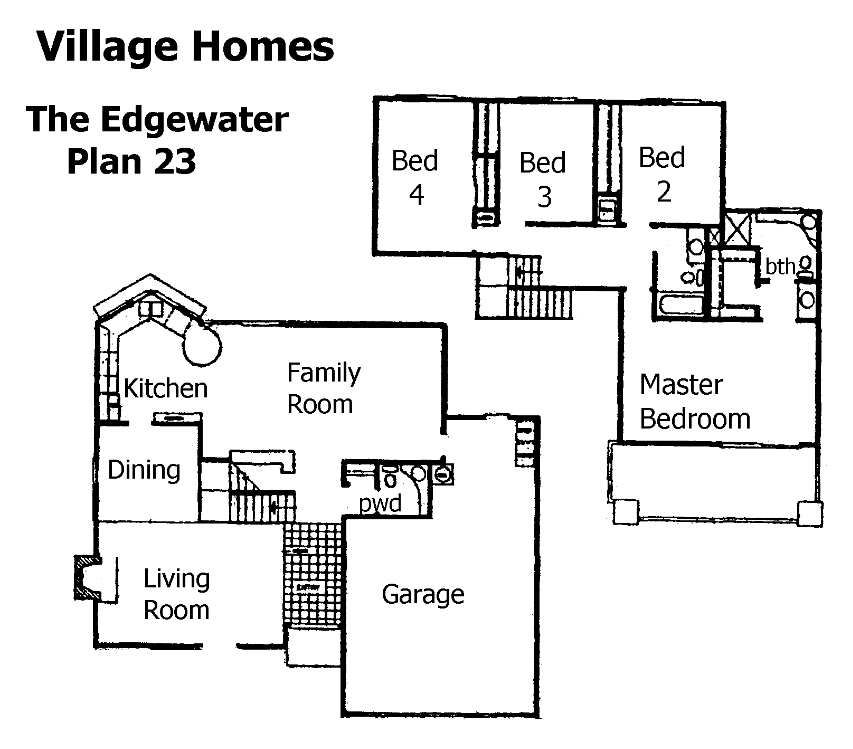
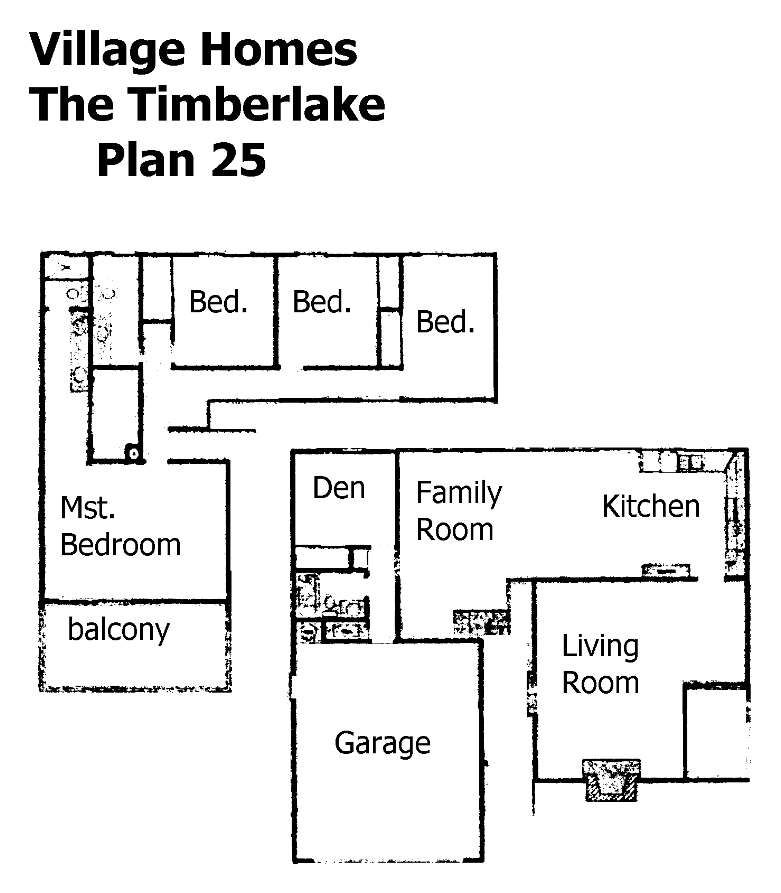
Village Homes original floor plans, with the builder drawings
The Conejo Simi Moorpark Association of Realtors plan archive holds eleven sheets for tract 726, in two naming systems that track the phases. Four carry names: Brooktree, Edgewater, Timberlake and Woodglen. Seven carry numbers: Plan 10, Plan 12, Plan 14, Plan 26, Plan 27, Plan 29 and Plan 30. Between them they cover the range that county records show on the ground, from about 1,260 square feet at the small end of the 1973 phase to about 3,100 square feet at the top of the 1976–78 phase, with two to five bedrooms. What they share is the vocabulary of the period’s better tract building in the Conejo Valley: attached two- and three-car garages, living rooms with vaulted, beamed ceilings and clerestory windows on the single-story plans, family rooms opening through sliders to the back yard, and brick or stone fireplaces. The 1969 single-story plans in the 1,780- and 2,002-square-foot sizes appear over and over on the Barrow, Bradbury, Freeport, Winston and Ashford cul-de-sacs, and a 2,614-square-foot two-story is the common large plan of that phase on Finrod and Elfstone. The 1973 phase brought smaller footprints, 1,550 to about 2,500 square feet, on Tamarack, Nettlebrook, Rosebay, Sandpiper, Sorrelwood and Dunlin. The 1976–78 phase is where the 2,396-, 2,824- and 3,128-square-foot two-story plans on Silver Spring, Knollcrest, Ranch House and Rim Crest come from.

Drawings on file for the tract. Other plans, elevations and options may have been offered.
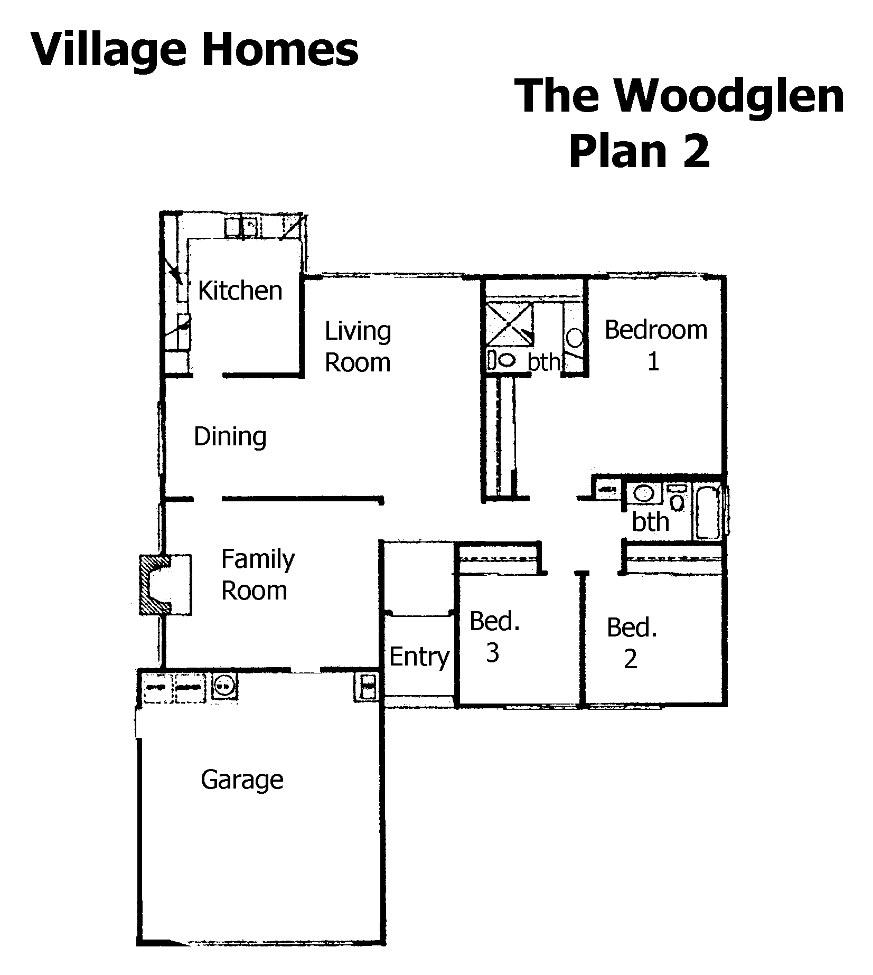


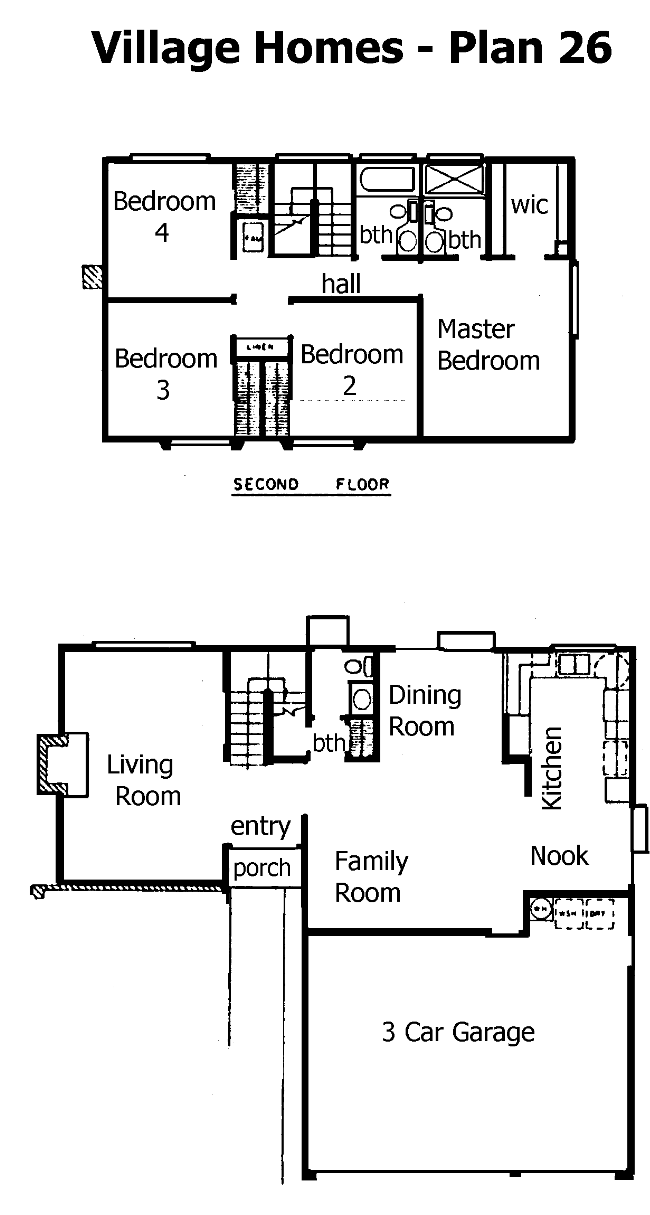

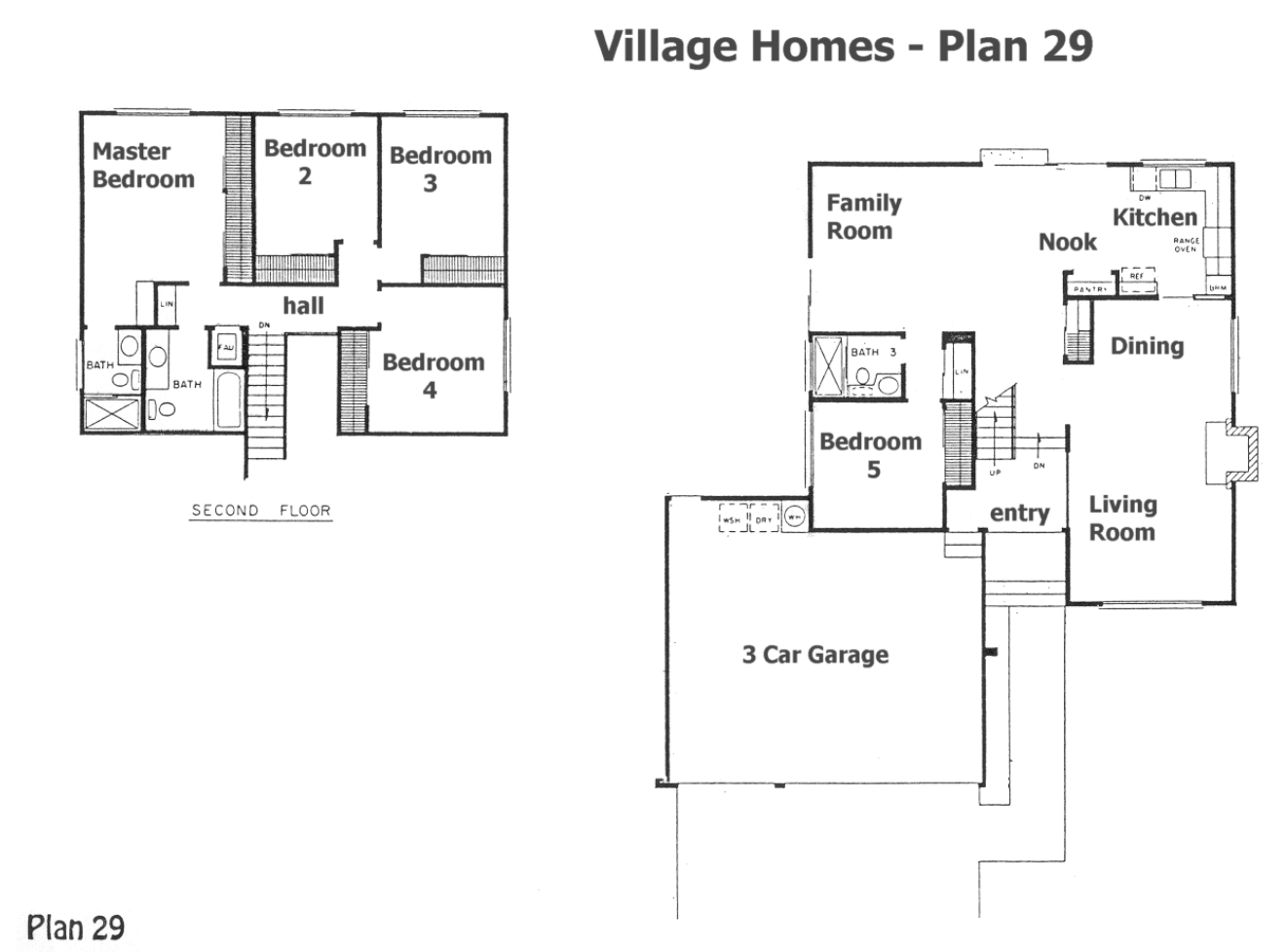
What the plans mean on the ground today: county records put the median Village Homes house at about 2,200 square feet, with the tenth-to-ninetieth percentile running from roughly 1,750 to 3,130 and a long tail of larger homes that are either expanded plans or the later customs. That spread is wider than Foxmoor’s because the tract was built across a decade with three generations of plans, so a buyer comparing a 1,780-square-foot 1969 ranch on Winston Court with a 3,128-square-foot 1976 two-story on Silver Spring Drive is comparing two different products that happen to share an association. Over fifty years the common remodels have been the ones the plans invite: kitchens opened to the family room, the vaulted living rooms left alone because they are the reason people buy, primary suites pushed out into the side yard, and on the 1969 single-story plans an occasional second story. Listings on the 1969 cul-de-sacs in 2025 and 2026 describe fully redone kitchens, new HVAC and oak floors, and those homes have been closing at the top of the tract for their size. Buyers should ask for the Thousand Oaks permit history on any home that measures more than a couple of hundred square feet over its original plan, and should expect original galvanized supply lines, aluminum sliders and older electrical panels on homes that have not been updated systematically. Gary can identify which of the eleven plans a given address started as and what has been added since.
Village Homes streets and how the tract is laid out
The spine of Village Homes is Triunfo Canyon Road, which leaves Westlake Boulevard at the shopping centers and runs west for about a mile through the middle of the tract before climbing toward the trailhead. The 1969 phase is the row of cul-de-sacs opening off the south side of that road and the homes fronting the road itself: Barrow Court, Elfstone Court, Bradbury Court, Finrod Court, Twinfoot Court, Winston Court, Freeport Court and Ashford Court, with addresses in the 1000 and 1100 blocks. Redfin’s subdivision field reads “Village Homes-726” on closings on Barrow, Elfstone, Finrod, Twinfoot, Winston, Ashford and Triunfo Canyon Road, and county records place Freeport and Bradbury in the first unit of Tract 1967. The Tolkien and English place names are typical of the period’s tract marketing and are a quick way to spot a first-phase house.
The 1973 phase lies north of Triunfo Canyon Road on the flat ground around Evenstar Park: Tamarack Street, Nettlebrook Street and Rosebay Street with the short Sandpiper Circle, Sorrelwood Court and Dunlin Court off them, addresses mostly in the 800 through 2000 blocks. Closings on Tamarack, Nettlebrook, Rosebay, Sorrelwood and Dunlin all carry the Village Homes name and Village Homes association dues. The 1976–78 phase fills the higher ground north and west: Evenstar Avenue, which runs past the clubhouse and the park, Silver Spring Drive, Blue Spring and Gold Spring, Knollcrest Place, Ranch House Road and Rim Crest Drive and Circle, with the 2,400- to 3,100-square-foot two-story plans and, on the northern edge, canyon and mountain views. Stormcroft Court, a 1969 cul-de-sac whose listings reference the Village Homes pool and clubhouse, also trades as part of the neighborhood.
A few street names that appear in county summaries of the area belong, wholly or partly, to other tracts, and it matters for dues, lot size and comparables. Galesmore Court, though it dates to 1969 and sits next to the first-phase cul-de-sacs, is recorded as Foxmoor Hills, MLS tract 709, with its own association and dues of only about $135 a year. Brightstone Court, Lindengrove Street and Basswood Court, built in 1975 through 1978 on the north edge, are recorded as Westshore Knolls, MLS tract 730, and Rim Crest carries the Foxridge tract code 740 on some listings; those Westshore Knolls and Foxridge closings nevertheless show Village Homes Property Owners Association dues, so they appear to be inside the association even though the tract number differs, and a buyer should confirm from the title report rather than the listing. Hartglen Avenue is split: the 1977 homes in the 850–900 block are second-unit Village Homes lots, while the 700 block and the upper end of Tamarack Street are Majestic Oaks, a gated enclave of custom homes built in 2008 and 2009 with a separate association. Gary’s advice on any address near an edge is the same: pull the tract and the association from the preliminary title report before writing the offer.
The lots are modest and fairly consistent, about 6,100 to 11,300 square feet with a median near 7,400, a little larger than Foxmoor’s and large enough that a great many owners have fit a pool and spa. Most of the tract is flat. The distinctions that move price are position: a lot backing the greenbelt has a lit oak-shaded path and no rear neighbor; a lot at the north or west edge of the third phase has a hillside behind it and a view; a lot fronting Triunfo Canyon Road hears the traffic; a cul-de-sac lot in the first phase gets a quiet street and a walk to the pool.
Why people move to Village Homes
The single-story plans. Village Homes has more original one-level homes than almost any other Westlake Village tract, on the 1969 cul-de-sacs south of Triunfo Canyon Road and the 1973 streets around Evenstar Park, and they come with vaulted, beamed living rooms and clerestory light rather than low ceilings. For a downsizer or a buyer who does not want stairs, this is the neighborhood’s first argument.
The greenbelt and the parks. More than a mile and a quarter of association-owned path under old oaks, lit at night, plus a four-acre public park in the middle of the tract and a full community park with fields, lighted courts and a trailhead on its edge. The lots are 7,400 square feet, but the neighborhood lives like it has acreage.
The recreation center. A 25-yard pool with a kiddie pool, a spa, a clubhouse residents can rent and tennis on site, with a manager keeping office hours three mornings a week a block from the pool, for dues that were $275 to $280 a quarter in 2026.

Walkability. The shopping at Westlake Boulevard and Triunfo Canyon Road is a few blocks from the first-phase cul-de-sacs, and the Triunfo Canyon Trail to the Los Robles ridge starts inside the neighborhood. Few Conejo Valley tracts put groceries and a ridge hike within the same walk.
The value. At roughly $550 to $750 per square foot for the 1970s homes, Village Homes delivers a Westlake Village address, Conejo Valley Unified schools, a pool and clubhouse and two parks for well under the price per foot of the lake tracts and with lower dues than most gated neighborhoods in the city.
Living in Village Homes
The greenbelt, the pool and the two parks
The defining feature of Village Homes is the amount of shared open ground. The association owns and maintains a greenbelt that its website describes as running more than a mile and a quarter through the neighborhood, with paths that pass under canopies of native old-growth oaks and are lit at night. Because it was designed as part of the tract rather than added later, the greenbelt runs behind back yards and between cul-de-sacs, so many homes have a rear gate onto a path and most of the neighborhood can reach the pool, the parks or the school without using a through street. The rules are the ordinary ones: dogs on leash, owners clean up.

The recreation center is on Evenstar Avenue in the middle of the tract. The clubhouse at 1040 Evenstar Avenue doubles as the management office and the meeting room for the board, and residents can rent it for private functions under a published rate sheet. Next to it is a 25-yard main pool with an attached shallow kiddie pool, surrounded by lawn, picnic tables and lounge chairs; listings also cite a spa. Tennis is on site, with reservation rules posted by the association; the website refers to a tennis court and listings to courts, so a player should confirm the count. The pool runs on a seasonal schedule that the association posts each fall and winter.
Two public parks complete the picture, and both belong to the Conejo Recreation and Park District. Evenstar Park, at 1021 Evenstar Avenue directly across from the clubhouse, is four acres of turf with a playground, a softball backstop and picnic tables, acquired in 1971 and developed in 1975; the private Carden Conejo school sits beside it. Triunfo Community Park, at 980 Aranmoor Avenue on the west edge of the tract, is the larger facility: a baseball field, a softball field, two soccer fields, a lighted basketball court, three lighted tennis courts on a first-come basis, a sand volleyball court, ten picnic tables, two restrooms, 92 parking stalls and a playground rebuilt in 2022 with a monarch-butterfly climber. Its irrigation was switched to reclaimed water in 2017. The park is also the trailhead for the Triunfo Canyon Trail, which climbs to the Los Robles Trail in the Conejo Open Space, so a Village Homes resident can walk from a front door to a ridge trail without getting in a car. The practical result is that a neighborhood of 7,400-square-foot lots functions as if the lots were much larger.
Majestic Oaks, the gated enclave inside the map
Buyers scanning listings for Village Homes will occasionally see a 4,400- to 4,600-square-foot home built in 2008 or 2009 on a third of an acre or more, priced far above the tract, with a Hartglen Avenue or Tamarack Street address. Those homes are Majestic Oaks, a small gated community of custom homes on the northwest edge of the neighborhood that was built on land left over from the original phases. It has its own association, listed on MLS as Majestic Oak HOA, with controlled-access gates and dues that listings put at roughly $400 to $433 a month, and its homes are not members of the Village Homes association or users of its pool. Gary Jacobs leased 1869 Tamarack Street, a 4,600-square-foot Majestic Oaks home built in 2009, in October 2022 at $9,000 a month; the same house sold in November 2023 for $2,110,000, and a neighbor at 789 Hartglen Avenue, 4,492 square feet on about two-thirds of an acre, sold in June 2025 for $2,485,000. The 4,400-square-foot Tamarack Street listing at $3,499,000 in September 2026 appears to be another. The enclave explains most of the $3 million-plus closings that show up in Village Homes sales summaries, and it is why the top of the neighborhood’s price range should be read separately from the 1970s tract.
The Village Homes HOA: dues, rules and monthly costs
Every home in the tract belongs to the Village Homes Property Owners Association, which owns the greenbelt, the clubhouse, the pool and the tennis facility and maintains them year-round. The association is professionally managed by The Emmons Company, the Thousand Oaks firm that also manages Foxmoor and the Westlake Lake Management Association. Unusually, the manager keeps hours in the neighborhood: a representative is at the clubhouse office, 1040 Evenstar Avenue, on Monday, Wednesday and Friday mornings from 9 to 1, at (805) 497-4491. The head office is at One Boardwalk, Suite 102, Thousand Oaks, (805) 413-1170. The association publishes its meeting minutes, governing documents and a newsletter, the Village Voice, on its website, villageinwestlake.com, which is the place to read the pool schedule, the tennis rules and the clubhouse rental agreement before escrow.
Dues are billed quarterly and have risen steadily, as they have for every association that funds a pool and landscaping. Closings in 2015 through 2017 on Elfstone, Evenstar, Nettlebrook, Rim Crest and Basswood reported $192 per quarter, though at least one 2017 listing reported about $270; closings in 2019 through 2021 on Winston, Twinfoot, Sorrelwood, Knollcrest and Tamarack reported $228 to $230; closings in 2024 through February 2026 on Triunfo Canyon Road, Barrow, Finrod, Rosebay and Ranch House reported $260; and a May 2026 closing on Ashford Court reported $275 per quarter, or about $92 a month; August 2026 closings reported $275 to $280 per quarter, up to about $93 a month. That is still among the lowest dues in Westlake Village for a neighborhood with a pool, and the only number a buyer should rely on is the one in the escrow disclosure package.
Two governance notes. In 2026 the board put a restated set of CC&Rs and bylaws to a homeowner vote, with the annual election held at the clubhouse on July 14; as of early July, 239 ballots had been returned on the bylaws and 233 on the CC&Rs, about 34 percent of the membership, which incidentally implies an association of roughly 690 homes, larger than the 654 homes in the core tract. A buyer in late 2026 or 2027 should ask whether the restatement passed, because the answer changes the rulebook on rentals, architectural review and enforcement. Second, as in nearly every Westlake Village association, exterior changes are subject to architectural review, so anyone planning a second story, a new roof or a front-yard redesign should read the standards first and ask the seller for any open violation notices. There is no gate; the streets are public and maintained by the City of Thousand Oaks, and Triunfo Canyon Road is a through road. Mello-Roos and other special-district assessments are not typical of 1970s Ventura County tracts, but the direct assessments on any parcel’s tax bill should be confirmed in escrow.
Schools serving Village Homes: district, elementary, middle and high
Village Homes is on the Ventura County side of Westlake Village, so it is in the Conejo Valley Unified School District, not Las Virgenes. The assigned schools shown on recent MLS listings throughout the tract, from Barrow Court in the first phase to Ranch House Road in the third, are Westlake Elementary, Colina Middle School and Westlake High School, and the association’s own website lists the same three. Westlake Elementary, at 1571 East Potrero Road inside the Foxmoor tract, is about eight-tenths of a mile to a mile from most Village Homes doors, across Westlake Boulevard; state records show about 505 students in kindergarten through fifth grade on a year-round calendar. Colina Middle School is at 1500 East Hillcrest Drive in Thousand Oaks, about two miles away, and Westlake High School, at 100 North Lakeview Canyon Road, is about a mile and a half away by road with roughly 2,000 students and a long record of strong state rankings. Families should verify the assignment for the specific parcel with Conejo Valley Unified before making an offer, because boundaries change and the district, not a listing, is the authority; Gary does this on every transaction here.
The private option is inside the neighborhood. Carden Conejo, at 975 Evenstar Avenue next to Evenstar Park, is an independent, non-sectarian school for preschool through sixth grade with about 200 students, close enough that some Village Homes families walk. Oaks Christian School in Westlake Village is the larger private option nearby.
Parks, trails and everyday life in Village Homes
Village Homes is the rare Westlake Village neighborhood where daily errands are walkable. Triunfo Canyon Road meets Westlake Boulevard at the east end of the tract, and the shopping centers at that corner and along the boulevard hold grocery stores, pharmacies, banks and restaurants; the association’s website makes a point of the walkability, and residents in the 1969 cul-de-sacs nearest the boulevard are within a few blocks of all of it. Westlake Plaza and the west arm of Westlake Lake are a short drive up the boulevard, and The Landing on the north shore is the lakefront dinner destination. The 101 Freeway is about two miles north via Westlake Boulevard, and the same road, as Highway 23, runs south over the hills toward the Malibu coast. The office parks along Agoura Road and Lindero Canyon Road put many residents within a ten-minute commute.
For recreation the neighborhood has an unusual amount within its own boundary: the association’s greenbelt and pool, Evenstar Park’s four acres, and Triunfo Community Park’s fields, courts and playground, all described above. The Triunfo Canyon Trail leaves from the park and climbs to the Los Robles Trail, the long east-west ridge route across the Conejo Valley, so hikers and mountain bikers can start from home. Across the boulevard, Foxmoor’s creekside greenbelt and the Lake Eleanor and Southshore Hills open-space areas add more trail. On the Los Angeles County side of the line, Berniece Bennett Park and the Westlake Village Community Park are a few minutes away by car.
Commuting from Village Homes: freeway access and the daily drive
Village Homes runs on Triunfo Canyon Road, which meets Westlake Boulevard at the east end of the tract; nearly every trip starts there. The US-101 interchange at Westlake Boulevard is a straight run north, roughly five minutes off-peak from the 1969 cul-de-sacs and a few minutes more from Rim Crest or Ranch House Road. When the Westlake Boulevard ramps stack up on weekday mornings, Agoura Road connects west to the Hampshire Road interchange and east to Lindero Canyon Road, and residents use whichever is moving. From the freeway, Warner Center and the west San Fernando Valley are on the order of 20 to 25 minutes off-peak and considerably more in the commute; downtown Los Angeles is roughly 40 miles and an hour or more at rush hour. Amgen’s campus in Thousand Oaks and the office parks along Agoura Road, Townsgate Road and Lindero Canyon Road are within about ten to fifteen minutes on surface streets, which is why a good share of the tract never touches the freeway on a workday.
Errands are close, and some are on foot. The centers at Westlake Boulevard and Triunfo Canyon Road and along the boulevard north to Agoura Road hold the pharmacies, banks and restaurants the association’s website has in mind when it calls the neighborhood walkable. For groceries, the Vons at 2725 Agoura Road is the nearest full supermarket; Gelson’s at 2734 Townsgate Road is across the freeway near Westlake Plaza; and Trader Joe’s at 3835 East Thousand Oaks Boulevard and the Ralphs at North Ranch Mall, 3963 East Thousand Oaks Boulevard, are a few minutes farther along the boulevard on the north side. The Promenade at Westlake and The Landing on the lake’s north shore are five to ten minutes east, and The Oaks mall in Thousand Oaks is a short freeway hop west.
The school run is a drive for most families: Westlake Elementary is under a mile away but across Westlake Boulevard, reached by turning south on the boulevard and east on Potrero Road; Westlake High School is on Lakeview Canyon Road off Agoura Road, about a mile and a half; Colina Middle School is north of the freeway on East Hillcrest Drive. Carden Conejo, on Evenstar Avenue inside the tract, is the one school some children walk to. Transit is thin, as everywhere in Westlake Village: VCTC’s Highway 101 and East County routes run from the Thousand Oaks Transportation Center on Rancho Road, not from the neighborhood, and the nearest Metrolink stations on the Ventura County Line are Moorpark, with free parking at 300 High Street, and Simi Valley, each roughly a 20-to-35-minute drive; in practice Village Homes commuters drive. The compensation is the coast: Westlake Boulevard, signed as Highway 23, continues south past Potrero Road over the Santa Monica Mountains to Mulholland Highway and Decker Canyon Road down to Pacific Coast Highway, and Kanan Road from Agoura Hills reaches the beach at Point Dume; either route is roughly half an hour to forty-five minutes on a clear morning.
Village Homes home prices and the market
Village Homes home prices and the current market
The figures in this section were current when this guide was last reviewed. The sale record in the facts above and the listings below are drawn live from the MLS each time the page loads.
Village Homes is one of the two large entry points to detached, non-gated Westlake Village on the Ventura County side, and because it has three phases and a custom enclave on its edge, its price range is wider than Foxmoor’s. In the two years through August 2026, 23 homes in the tract sold through the MLS, at prices from $1,120,000 to $2,365,000 and a median of $1,405,000; the working range for a 1970s Village Homes house is roughly $1.3 million to $1.8 million. Recent closings sort by phase and condition. Among 1969 single-story plans, 1042 Barrow Court, a 2,002-square-foot four-bedroom with a remodeled kitchen and new HVAC, closed in November 2025 at $1,465,000, and 1017 Ashford Court, the same plan with a pool and beamed ceilings, closed in May 2026 at $1,505,000. A 2,614-square-foot 1969 two-story at 1052 Finrod Court closed in August 2025 at $1,370,000, about $524 a foot. In the 1973 phase, 2085 Rosebay Street, a 1,550-square-foot single-story with a remodeled kitchen and an entertainer’s yard, closed in May 2025 at $1,475,405, which shows how much the market pays for a finished small house on a cul-de-sac. On Triunfo Canyon Road, a 2,195-square-foot 1971 home with pool and spa closed in May 2024 at $1,555,000, about $708 a foot. At the top of the tract, 958 Ranch House Road, a 2,396-square-foot 1976 two-story that was bought for $1,050,000 in April 2021, rebuilt in a contemporary style and resold for $1,700,000 that December, closed again in February 2026 at $1,792,750.
The longer arc is what sellers should notice. 1020 Elfstone Court, a 2,657-square-foot 1969 two-story on the greenbelt, sold for $915,000 in January 2016; 1106 Evenstar Avenue and 1936 Nettlebrook Street both closed in the high $800,000s in 2017; Gary Jacobs sold 2244 Silver Spring Drive, a 3,128-square-foot two-story with pool and spa, in January 2017 for $1,052,500, and the same house resold in November 2020 for $1,350,000; 1030 Winston Court and 964 Dunlin Court, 1,780 and 1,673 square feet, closed around $855,000 in 2019 and 2020; 1995 Tamarack Street, a 2,339-square-foot corner lot across from Triunfo Park, closed at $1,330,000 in October 2021 after selling for $792,000 in 2005. Roughly speaking, the neighborhood has gone up by half since 2019 and has more than doubled since 2015. Turnover is moderate: 23 MLS sales in two years across about 654 homes is a bit under 2 percent a year, so there are usually a few homes to choose from. In early September 2026 four were active, from a 1,913-square-foot single-story on Stormcroft Court at $1,375,000 to a 2,824-square-foot two-story on Silver Spring Drive at $1,700,000 and a 3,250-square-foot five-bedroom on Ranch House Road at $2,099,000, plus the Majestic Oaks custom on Tamarack at $3,499,000.
The rental market tracks the sale market. Gary leased 2244 Silver Spring Drive four times between 2008 and 2013 at $3,600 to $4,200 a month; in 2025 and 2026, asking rents for 1,780- to 2,500-square-foot Village Homes houses ran about $5,000 to $6,500 a month, with a 1,780-square-foot Winston Court home offered at $5,100 and a remodeled 2,002-square-foot Ashford Court home at $6,500.
Figures are drawn from public records and MLS closings and are rounded. They are a snapshot, not a valuation; contact Gary for a current read on any specific property.
Renting in Village Homes: leases and rental prices
Village Homes is a small but steady rental market, and the public listings give a fair picture of it. In 2025 and 2026 asking rents for the 1970s houses ran from about $5,000 to $6,500 a month by size and finish. A 1,724-square-foot three-bedroom single-story at 1081 Triunfo Canyon Road was offered in June 2026 at $5,490, trimmed to $5,190 and taken off the market in August, with the association dues, a gardener and pest control included and a deposit of one month’s rent. A 2,491-square-foot four-bedroom at 1165 Triunfo Canyon Road came on in August 2026 at $6,200 and was at $5,795 by month’s end. The 1,780-square-foot 1969 plan on Winston Court was offered at $5,100, a remodeled 2,002-square-foot Ashford Court home at $6,500, and the 2,614-square-foot five-bedroom on Finrod Court was listed at $7,000 in June 2024 before its owners sold instead. For calibration, Gary Jacobs leased 2244 Silver Spring Drive, a 3,128-square-foot two-story with a pool, four times between 2008 and 2013 at $3,600 to $4,200, so rents here have risen by roughly half in a little over a decade, in step with prices.
Houses lease less often than they sell. In a tract of about 654 homes where 23 sold through the MLS in two years, only two to four are usually on the rental market in a season, most of them single-story plans in original or lightly updated condition or a home an owner is holding through a move. The listings are ordinary unfurnished houses on twelve-month terms; the likely tenants are families who want a year inside the Conejo Valley Unified attendance area before buying, and relocating employees of Amgen and the office parks along Agoura Road and Townsgate Road who want a yard rather than an apartment. Furnished and short corporate arrangements do not show up in the tract’s public rental record.
The association’s rules matter to landlords. The board’s July 2024 letter on the proposed restated CC&Rs says rentals of less than 30 days are not allowed, that leases must be filed with The Emmons Company as soon as they are signed, with the tenant’s contact information, and that the board chose not to cap the number of homes that may be rented. Whether the restatement was adopted in the 2026 vote should be confirmed with the office on Evenstar Avenue; either way, an investor should assume short-term rentals are off the table. On the figures above, rents gross roughly 4 to 5 percent of value before expenses, which is typical of Westlake Village and means most owners here rent for a season of life rather than as a business.
What inspectors find in Village Homes houses
Village Homes was built between 1969 and 1978, and its inspection reports read like those of every good Conejo Valley tract of that decade. What follows is common in homes of this era; each house varies, and only a licensed inspector, with a plumber, an electrician and a sewer camera where warranted, can say what is true of a particular address.
Plumbing comes first. The 1969 and 1973 phases were plumbed with galvanized steel supply lines, and where those have not been replaced the symptoms are low pressure at the far fixtures and rust-tinted water after a vacation; many owners have repiped in copper or PEX, and the disclosure or a look at the water-heater connections usually settles it. Drains run to cast iron or early ABS, and the sewer lateral is fifty years old under the mature oaks that give the greenbelt its character, so root intrusion is common enough that Gary recommends a camera inspection on every purchase here. Panels of the period include Zinsco and Federal Pacific brands that inspectors and insurers now flag, and a share of late-1960s and early-1970s Southern California tract homes were wired with aluminum branch circuits; buyers should budget for a new 200-amp panel if the original is still in place, particularly if they plan an electric-vehicle charger or a heat pump.
The envelope and systems tell the rest. Original single-pane aluminum sliders survive on some homes and have been swapped for dual-pane units on most; the association exempts like-for-like window replacement from architectural review. Roofs are a Village Homes particular: the association requires concrete or lightweight concrete tile and prohibits composition and asphalt, so the shake roofs of the 1970s have been replaced with tile, and an inspector will want to know that the framing was evaluated for the added weight and that the underlayment, which wears out before the tile above it, is not the original layer. Homes sit on slabs on mostly flat ground, so foundation trouble is uncommon, but moisture at the slab edge and the drainage around a pool deck deserve attention; the hillside-edge lots of the 1976–78 phase on Rim Crest, Ranch House and Silver Spring, and any lot backing the open space, add retaining walls, slope drains and the association’s brush-clearance program to the list. Furnaces and ducting are in the attic, where older flex duct and thin tract-era insulation are the norm on unrenovated homes; pool equipment is often on its third or fourth generation; and because the plans invite garage conversions and additions, the City of Thousand Oaks permit history should be pulled for any house measuring more than a couple of hundred square feet over its original plan. None of this is a reason to avoid a house in Village Homes. It is a list of what the price should already reflect.
Remodels that add value in Village Homes
The sales record in Village Homes is unusually clear on what remodeling returns, because the tract sells original and remodeled versions of the same plans within months of each other. In August 2025 the 2,614-square-foot 1969 two-story at 1052 Finrod Court, offered as-is, closed at $1,370,000, about $524 a foot, after coming to market at $1,850,000. Three months earlier the 1,550-square-foot 1973 single-story at 2085 Rosebay Street, renovated in 2023 with a new kitchen, baths and yard, closed at $1,475,405, about $952 a foot, on a home that had sold for $880,000 in 2018. Between those poles, the 2,002-square-foot 1969 plans with remodeled kitchens on Barrow Court and Ashford Court closed at roughly $730 to $750 a foot, and the rebuilt 1976 two-story at 958 Ranch House Road, bought for $1,050,000 in 2021 and redone in a contemporary style, resold at $1,700,000 that December and $1,792,750 in 2026. Hedged for lot, street and timing, a thorough remodel here has been recovering its cost and then some, and a small finished house has been outselling a large original one.
The projects that pay are the ones the eleven plans invite: on the single-story Woodglen, Brooktree and numbered plans, removing the wall between kitchen and family room, leaving the vaulted, beamed living room alone, and reworking the bedroom wing so the primary bedroom gains a real bath and closet, sometimes by pushing into the side yard; on the two-story Edgewater, Timberlake and Plan 26 through 29 homes, the kitchen, the primary bath and the connection between family room and yard. Buyers should know that the association’s architectural guidelines, revised in September 2025, limit new additions to single story and allow a second story only over the existing footprint of the original plan and within its ridge height, so the pop-top additions seen in other Westlake Village tracts are constrained here. Front-yard changes, fences, roofing and exterior colors go through the committee, which answers within four weeks; solar panels and rear-yard work not visible from the street do not need approval.
Accessory dwelling units are the open question. California law requires cities to allow an ADU of at least 800 square feet with four-foot side and rear setbacks on a single-family lot, and a junior ADU of up to 500 square feet within the house, and it bars an association from effectively prohibiting them, though reasonable restrictions are allowed; the City of Thousand Oaks runs an ADU program with pre-reviewed plans, a 30-day minimum rental term and owner occupancy for a JADU. In Village Homes the constraint is the lot. On a 7,400-square-foot parcel that already has a pool, a detached unit is a tight fit, and the practical ADU is a garage conversion or a JADU carved from a bedroom wing, which is why the board’s 2024 letter says ADUs will be strictly controlled while complying with state and local law. Anyone counting on ADU income should run the site plan past the city and the association before closing. Gary can say before an offer is written whether a given Village Homes house is a remodel candidate or a finished product.
Buying and selling in Village Homes
How Village Homes compares with nearby neighborhoods
The neighborhood a Village Homes buyer most often weighs is Foxmoor, directly across Westlake Boulevard. The two are siblings: both began as 1968–69 Ventura County tracts of the Westlake Village master plan with a greenbelt, a pool, a clubhouse, Emmons management and the Westlake Elementary, Colina and Westlake High feeder pattern. Foxmoor is smaller, about 270 homes built in a single phase with a median house near 2,460 square feet on a slightly smaller lot, and it has the elementary school inside the tract; its 2024–2026 median was about $1.55 million, typical closings ran $600 to $650 a foot, and dues were around $230 to $240 a quarter. Village Homes has more single-story plans, a wider spread of sizes because of its three phases, a larger recreation center with a 25-yard pool and tennis, two public parks and the trailhead, and a slightly lower median, about $1.4 million, that reflects a broader mix of product rather than a discount for the same house.
Foxmoor Hills, the hillside tract immediately south, built in 1969–71, is the step up in lot and view: a median lot of about 12,600 square feet against 7,400, mostly two-story homes with a median near 2,490 square feet, and a 2024–2026 median of about $1.725 million at roughly $650 to $700 a foot. It has no pool or clubhouse; the trade is a greenbelt-and-park association with dues of about $220 a year, the same schools, and sloping streets and driveways across much of the tract. Buyers who want a flat lot, a community pool and a one-level plan choose Village Homes; buyers who want a view and a third of an acre pay the premium for Foxmoor Hills.
Across the county line, First Neighborhood is the closest analogue in the City of Westlake Village: a 1966–68 planned tract of about 664 homes with a heated pool, greenbelts, parks and a community center, a median house of about 2,370 square feet on a 7,500-square-foot lot and dues near $170 a quarter. Its 2024–2026 median was around $1.7 million, and renovated homes often clear $800 a foot, a premium over Village Homes that buys Las Virgenes schools, White Oak Elementary inside the tract, and a walk to the lake and The Landing. Three Springs, in the hills above Triunfo Canyon Road on the Los Angeles County side, is a different generation: 1988–90 homes of 2,800 to 4,300 square feet on lots with a median near a third of an acre, a median price around $2.15 million at $550 to $750 a foot, dues of about $270 a year and Las Virgenes schools. A Village Homes owner trading up for size and a view typically looks at Three Springs or Foxmoor Hills; a First Neighborhood or Three Springs owner trading down to one level and a pool community on the Ventura County side looks at Village Homes. Gary works in all four and keeps the comparables current.
What to weigh before buying in Village Homes
Triunfo Canyon Road. It is the only way in and out of the western part of the tract and the route to the park and the trailhead, and homes fronting it, which include some of the 1969 phase, hear the traffic and see the weekend park visitors. The cul-de-sacs and the northern streets are noticeably quieter, and prices reflect that.
The houses are from 1969 to 1978. Homes that have not been systematically updated will have original galvanized plumbing, aluminum sliders, older electrical panels and, in some cases, original roofs under a replacement layer. A sewer camera and a close look at the panel and the supply lines are worth the cost, and buyers should budget for systems on any home sold as original.
The lots are modest. A median of about 7,400 square feet fits a pool, and the greenbelt does a lot of the work, but a buyer who wants a half-acre with a view should look at Three Springs or Majestic Oaks and pay accordingly.
The names and the tract codes. Foxmoor Hills, Westshore Knolls, Foxridge and Majestic Oaks all touch or overlap the map of Village Homes, with different dues, different lot sizes and in one case a gate, and third-party listing sites mix them freely. None of this is a problem; it is a set of details to confirm from the title report rather than assume.
The county line. Village Homes is in Thousand Oaks, not the City of Westlake Village, so permits, city services and the property-tax bill come from a different place than the address suggests, and the school district is Conejo Valley Unified rather than Las Virgenes. Buyers who specifically want Las Virgenes schools or City of Westlake Village services need to be on the other side of the county line.
The school walk crosses Westlake Boulevard. Westlake Elementary is under a mile away, but unlike Foxmoor, where it is inside the tract, Village Homes children cross a state highway to reach it, and most families drive.
Who buys in Village Homes
Single-level buyers and downsizers. The 1969 and 1973 single-story plans, on flat cul-de-sac lots with a community pool, a clubhouse and a lit path, are the best supply of one-level living in Westlake Village at this price, and they suit owners leaving larger two-story homes in North Ranch, Three Springs or the lake tracts who want to stay in the area without paying gated-community dues.
Families targeting Conejo Valley Unified with room to run. The greenbelt, Evenstar Park and Triunfo Community Park give children a great deal of ground to cover without crossing a through street, and the Westlake Elementary, Colina and Westlake High feeder pattern is the same as Foxmoor’s.
Hikers, cyclists and tennis players. With the Triunfo Canyon trailhead in the neighborhood, three lighted public courts next door and the association’s own tennis and pool, Village Homes is one of the most active neighborhoods in the city for people who want to use their weekends outdoors from the front door.
Remodelers and rebuilders. The plans are sound, the price per foot is moderate, and the closings on Ranch House Road and the 1969 cul-de-sacs show that a thorough remodel is rewarded on resale. The tract has also seen a handful of full custom rebuilds.
Buyers who should probably look elsewhere: those who need a large lot, a boat dock, a guard gate or Las Virgenes schools. For them, Majestic Oaks next door, the lakefront streets of First Neighborhood, Westlake Island or the Los Angeles County side of the line are better fits.
Gary’s track record in Village Homes
Gary Jacobs has handled one Village Homes property through most of its recent history. He leased 2244 Silver Spring Drive, a 3,128-square-foot 1976 two-story with a pool and spa on the tract’s northern edge, in February 2008 at $4,100 a month, in March 2009 at $3,600, in April 2010 at $4,200 and in February 2013 at $4,150, and then sold it in January 2017 for $1,052,500. It is the house pictured throughout this guide, and the arc of those five transactions, through the 2008 downturn, the recovery and the 2017 sale, is a useful marker for how the neighborhood has moved; the same house resold in November 2020 for $1,350,000, and comparable third-phase homes were closing at $1.7 to $1.8 million by early 2026. On the neighborhood’s edge, Gary leased 1869 Tamarack Street, a 4,600-square-foot custom built in 2009 in the gated Majestic Oaks enclave, in October 2022 at $9,000 a month. Gary also works regularly in Foxmoor across the boulevard and in the hillside tracts above Triunfo Canyon Road, which is what gives him a current read on how Village Homes compares with the alternatives a buyer is likely to be weighing. For any Village Homes address, Gary can identify the original plan and phase, pull the sales history for the street, sort the greenbelt and view lots from the interior lots, confirm which tract and association a given house belongs to, and put a buyer or seller in touch with the association office on Evenstar Avenue before the disclosure package arrives.
Buying or selling in Village Homes: practical notes
Buyers: decide early which phase suits the household, because a 1969 single-story on a cul-de-sac, a 1973 small plan by Evenstar Park and a 1976 two-story with a hillside behind it are three different products at three different price points under one name. Confirm the tract and the association from the preliminary title report, since Foxmoor Hills, Westshore Knolls, Foxridge and Majestic Oaks all border or overlap the map. Order the association documents and ask whether the 2026 CC&R restatement was adopted, and read the architectural standards before writing an offer that assumes a second story or an exterior change. Have the inspection include a sewer camera and a look at the plumbing supply lines and the electrical panel. Verify the school assignment with Conejo Valley Unified for the specific parcel. If the house fronts Triunfo Canyon Road, visit on a weekend afternoon when the park is busy.
Sellers: the neighborhood sells on the plan, the yard and the amenities, in that order, so the listing should name the plan and phase, state the square footage from the county record, show the vaulted living room and the back yard, and mention the greenbelt, the pool and the trailhead by name. Being current with the association and having the CC&Rs, budget and any architectural approvals for past work in hand before listing shortens escrow. Price against the right comparables: a remodeled 1973 single-story on Rosebay is not a comp for an original 1976 two-story on Knollcrest even at a similar price, and the Majestic Oaks customs are not comps for anything in the 1970s tract. Gary keeps that sorting for every street in Village Homes.
Questions buyers ask about Village Homes
How much do homes in Village Homes cost?
In the two years through August 2026, 23 homes in Village Homes in Westlake Village sold through the MLS, at prices from $1,120,000 to $2,365,000 and a median of $1,405,000. The working range for a 1970s Village Homes house is roughly $1.3 million to $1.8 million; 1969 single-story plans of about 2,000 square feet closed at $1,465,000 and $1,505,000 in late 2025 and May 2026, and a rebuilt 2,396-square-foot two-story on Ranch House Road closed at $1,792,750 in February 2026. Closings above $2 million are mostly the newer custom homes in the gated Majestic Oaks enclave on the tract’s edge.
How big are Village Homes houses and lots, and what are the floor plans?
County records show a median Village Homes house of about 2,200 square feet, with most between about 1,750 and 3,130 square feet and two to six bedrooms; the largest homes, 4,400 to 5,500 square feet, are later customs. Lots run from about 6,100 to 11,300 square feet with a median near 7,400 and are mostly flat. The tract was sold as MLS tract 726 in three phases, 1969, 1973 and 1976–78, from eleven original plans: Brooktree, Edgewater, Timberlake and Woodglen, plus Plans 10, 12, 14, 26, 27, 29 and 30. Single-story plans dominate the first two phases and larger two-story plans the third.
What are the HOA dues in Village Homes and what do they cover?
Village Homes belongs to the Village Homes Property Owners Association, which owns and maintains the greenbelt of more than a mile and a quarter, the clubhouse at 1040 Evenstar Avenue, the 25-yard pool and kiddie pool, a spa and the tennis facility. Dues are billed quarterly: about $192 on 2015–2017 closings, $230 in 2019–2021, $260 in 2024 through early 2026 and $275 on a May 2026 closing, rising to $275 to $280 on August 2026 closings. The association is managed by The Emmons Company, with office hours at the clubhouse Monday, Wednesday and Friday mornings, (805) 497-4491, and a head office in Thousand Oaks at (805) 413-1170; buyers should confirm the current amount in the escrow disclosures.
Which school district serves Village Homes?
Village Homes is on the Ventura County side of Westlake Village, in the City of Thousand Oaks, and is served by the Conejo Valley Unified School District. Recent listings throughout the tract and the association’s own website show Westlake Elementary at 1571 East Potrero Road, about a mile away across Westlake Boulevard, followed by Colina Middle School and Westlake High School. Carden Conejo, a private preschool-through-sixth-grade school, sits inside the neighborhood at 975 Evenstar Avenue. Attendance boundaries should be verified with the district for the specific parcel.
When was Village Homes built, and what should buyers check?
Village Homes was built in three phases: the cul-de-sacs off Triunfo Canyon Road in 1969, the streets around Evenstar Park in 1973, and the northern and western streets in 1976 through 1978, with a few later custom homes. Buyers of homes that have not been systematically updated should expect original-era galvanized plumbing, aluminum windows and electrical panels, should include a sewer-line camera in the inspection, and should pull permit history from the City of Thousand Oaks for any addition. Because several other tracts border the neighborhood, buyers should also confirm the tract and association from the title report.
Is Village Homes gated, and what parks and trails are nearby?
Village Homes is not gated; its streets are public and Triunfo Canyon Road runs through it. The gated homes nearby are Majestic Oaks, a separate custom enclave on Hartglen Avenue and upper Tamarack Street with its own association. What Village Homes has instead is an association greenbelt of more than a mile and a quarter under old oaks, lit at night, plus two public parks: four-acre Evenstar Park in the middle of the tract and Triunfo Community Park on its west edge, with ballfields, soccer fields, three lighted tennis courts, a lighted basketball court, a 2022 playground and the trailhead for the Triunfo Canyon Trail up to the Los Robles Trail.
Which buyers tend to choose Village Homes?
Village Homes suits single-level buyers and downsizers who want one of the tract’s many 1969 and 1973 single-story plans on a flat lot with a community pool and low dues, families targeting Conejo Valley Unified who want parks and a greenbelt within walking distance, hikers and tennis players who want a trailhead and lighted courts next door, and remodelers who want a sound 1970s plan at a moderate price per foot. It is a poor fit for buyers who need a large lot, a boat dock, a guard gate or Las Virgenes schools.
How does Village Homes compare with Foxmoor, and what do homes rent for?
Foxmoor, across Westlake Boulevard, was built in 1968–69 with Westlake Elementary inside the tract and a creekside greenbelt, on slightly smaller lots with slightly lower dues; Village Homes was built over a decade, has a higher share of single-story homes, a larger recreation center with a 25-yard pool and tennis, two public parks and a trailhead, and a wider price range because of its third phase and the Majestic Oaks customs on its edge. Both are in Conejo Valley Unified with the same feeder pattern. Asking rents for 1,780- to 2,500-square-foot Village Homes houses ran about $5,000 to $6,500 a month in 2025 and 2026.
Nearby Westlake Village neighborhoods
Thinking about Village Homes? Gary Jacobs has the original floor plans, the sales history for every street, and a current read on what is coming to market before it is public.
Talk with Gary Jacobs → | Back to the Westlake Village guide