
Living in Granada Hills: A 2026 Guide to Balboa Highlands Eichlers, Knollwood, Granada Hills Charter and O’Melveny Park
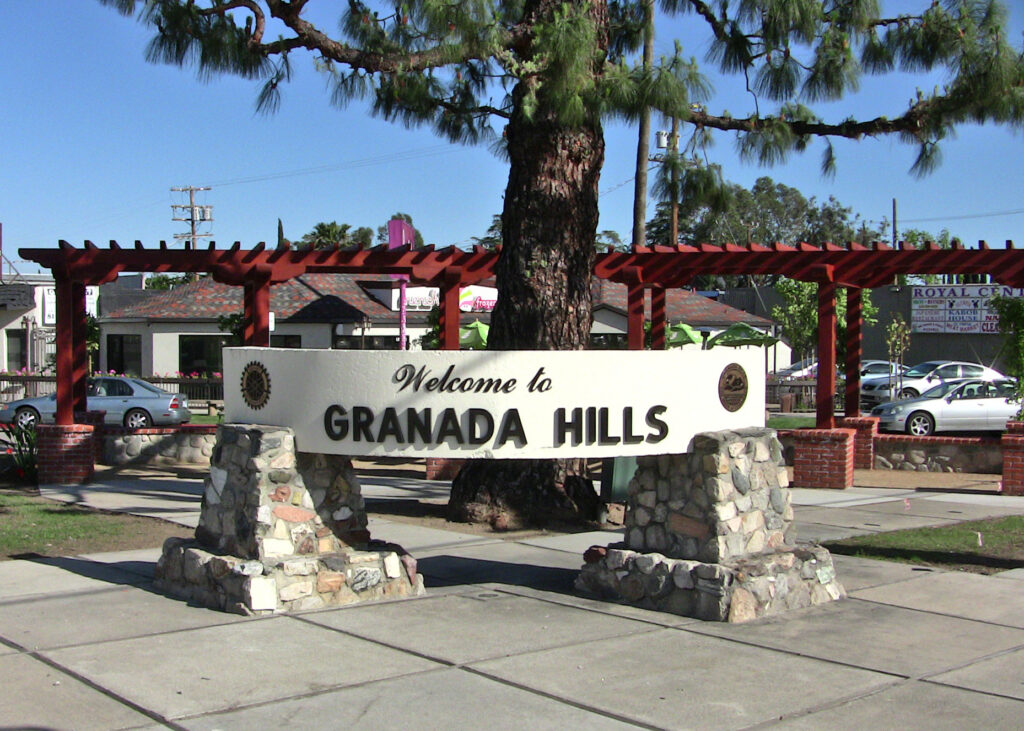
Granada Hills sits at the top of the San Fernando Valley, where the flat grid finally runs into the Santa Susana Mountains. It is one of the Valley's larger postwar suburbs, and it has a few things that set it apart from its neighbors: a tract of Joseph Eichler homes in the foothills, a neighborhood built around a public golf course, one of the best-known public charter high schools in California, and the second-largest city park in Los Angeles. This guide covers the neighborhoods within Granada Hills, the schools, the parks, fire and earthquake history, the commute, and how it compares with Porter Ranch next door.
A little history
Granada Hills was founded in 1926 as Granada, Spanish for pomegranate, and the "Hills" was added about fifteen years later. Before that, much of the land was the Sunshine Ranch, a dairy and orchard operation that grew apricots, oranges, walnuts and beans. Citrus trees from those days, or descended from them, still turn up in many backyards. The Valley's first oil well was drilled in 1876 near the northern end of what is now Zelzah Avenue.
Like much of the north Valley, Granada Hills grew fast after World War II, as ranch-house tracts replaced the orchards. The neighborhood calls itself "The Valley's Most Neighborly Town," and in 1963 the Granada Hills Little League won the Little League World Series. One of its best-known streets is White Oak Avenue, lined with 101 deodar cedars that were declared a Los Angeles Historic-Cultural Monument in 1966. The street appears in the flying-bicycle scenes of E.T. the Extra-Terrestrial.
Granada Hills is a neighborhood of the City of Los Angeles, ZIP code 91344, with two neighborhood councils, Granada Hills North and Granada Hills South. It borders Porter Ranch to the west, Northridge and North Hills to the south, and Mission Hills and Sylmar to the east.
The neighborhoods within Granada Hills
Balboa Highlands: the Eichler tract
In the early 1960s, developer Joseph Eichler built Balboa Highlands in the northern foothills. The homes were built between 1962 and 1964, with designs by A. Quincy Jones, Frederick Emmons and Claude Oakland: post-and-beam construction, walls of glass facing private yards, open-plan interiors and, in many houses, a central atrium. The Los Angeles City Council adopted the Balboa Highlands Historic Preservation Overlay Zone in 2010.
The HPOZ matters for buyers. Exterior changes visible from the street, including windows, doors, roofing, additions and many façade details, go through review by the city's preservation staff and the HPOZ board. Many owners see this as protection for the look and value of the tract, but it does add time and design limits to remodels. Eichler-specific inspection items include:
- Radiant heating. Original systems run hot water through pipes in the concrete slab. Leaks and failures are common in older systems, and many owners have switched to other heating.
- Flat and low-slope roofs. These need regular maintenance and the right roofing material.
- Glass. Original single-pane glass is energy-inefficient, and replacing it in an HPOZ requires approval.
Just outside the tract, on Darla Street, are homes by other builders with Eichler-style features, which locals sometimes call "Like-lers."
Knollwood
Knollwood is the area around the Knollwood golf course at 12024 Balboa Boulevard. The 18-hole course opened to the public in November 1958, operated by Los Angeles County Parks and Recreation under a lease-option arrangement that the county said would save the land from subdivision. The surrounding homes are largely single-story mid-century houses, and some back directly to the fairways. Golf-course lots can come with long green views, but also stray balls and some foot traffic, so look at which hole a lot faces before you fall for it.
The flats and the foothills
South of the 118, Granada Hills is mostly a grid of postwar ranch houses on standard Valley lots, many of them expanded or remodeled. North of the 118, the streets begin to climb, with larger lots, more custom homes and views across the Valley. The hillside streets also bring higher fire risk, which is covered below.
Schools
Granada Hills Charter
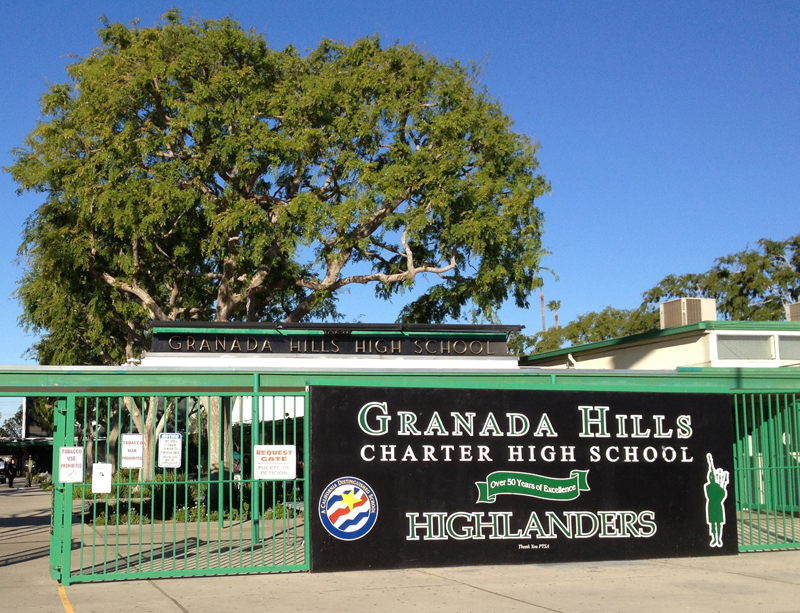
Granada Hills Charter, on Zelzah Avenue, is the school many buyers mention first. In 2003 the Los Angeles Board of Education approved its conversion to charter status, making it the largest school in the United States to convert at the time. It is an International Baccalaureate World School, offers a large slate of AP and IB courses, and its Academic Decathlon team has won the U.S. national championship several times since 2011. The school expanded to K–12 in 2020 and runs a separate K–8 campus. Its stadium is named for alumnus John Elway.
Because it is a charter, enrollment does not work like a traditional LAUSD school assignment. Admissions rules, lottery dates and any priority for local residents are set by the school and can change. If Granada Hills Charter is a main reason you are buying, check its current enrollment policy directly before you make an offer.
Kennedy High and other options
John F. Kennedy High School, on Gothic Avenue, is the other public high school in Granada Hills, and its alumni include actor Cuba Gooding Jr. Granada Hills has roughly 14 public and 10 private schools in all. For a specific address, check LAUSD's Resident School Identifier, and remember that LAUSD magnet applications are due in the fall for the following year.
O'Melveny Park and the outdoors
O'Melveny Park covers about 672 acres in the Santa Susana Mountains, making it the second-largest city park in Los Angeles after Griffith Park. The land was once the C. J. Ranch, bought in 1941 by John O'Melveny, son of the founder of the O'Melveny & Myers law firm, and used for citrus, cattle and bulldog breeding. In the early 1970s O'Melveny arranged for part of the land to be sold to the city below market value and donated the rest, and the park bears the family name.
The main entrance is off Sesnon Boulevard, west of Balboa. A popular loop climbs to Mission Point, the high point, with wide views over the Valley, then drops into Bee Canyon and follows the canyon floor back to the picnic area. The full loop is about five miles with roughly 1,500 feet of climbing, and there is little shade, so early mornings are the best time to go, especially in summer.
Closer to home, the Granada Hills Recreation Center (Petit Park) has sports and arts programs, and Zelzah Park has a bridle path and a play area. The Van Norman Reservoir complex, the southern end of the Los Angeles Aqueduct, also sits within Granada Hills.
Fire and earthquake history
Fire is a real consideration in Los Angeles foothill neighborhoods, including Granada Hills. Much of the hillside area near O'Melveny Park and the Santa Susanas is mapped as a Very High Fire Hazard Severity Zone. The 2019 Saddleridge Fire burned into the hills above Granada Hills and Porter Ranch, and in January 2025 a small fire in O'Melveny Park, the Archer Fire, burned about 19 acres before it was stopped without damage to buildings. Homes in these zones have annual brush-clearance requirements, and insurance has become harder and more expensive to place. Buyers should get insurance quotes early in escrow, ideally before removing contingencies.
Granada Hills also has earthquake history. The 1971 Sylmar earthquake badly damaged the Lower Van Norman Dam, and tens of thousands of residents downstream were evacuated until the reservoir was drawn down. The 1994 Northridge earthquake also damaged homes across the area. As with most mid-century Valley houses, it is worth checking foundation bolting and any earthquake repairs during inspections.
Getting around
The 118 (Ronald Reagan Freeway) runs east-west through Granada Hills, connecting west to Simi Valley and east to the 210. The 405 and 5 meet near the neighborhood's eastern edge, which makes the Sepulveda Pass and the Westside, or Santa Clarita to the north, reasonably direct. Balboa Boulevard and Zelzah Avenue are the main north-south surface streets, and Metrolink stops in nearby Northridge and Chatsworth.
Granada Hills vs. Porter Ranch and other neighbors
| Neighborhood | Typical housing | What buyers often weigh |
|---|---|---|
| Granada Hills | Mid-century ranch homes, Eichlers, Knollwood golf-course area | Granada Hills Charter, O'Melveny Park, often no HOA |
| Porter Ranch | Newer master-planned and gated communities, plus older tracts | Newer homes; some HOA dues and special tax assessments |
| Northridge | Ranch homes, some horse-zoned areas | CSUN, larger lots in places |
| North Hills | 1950s tract homes, apartments | Lower entry prices, 405 access |
The biggest practical difference between Granada Hills and Porter Ranch is often the monthly cost beyond the mortgage. Some newer Porter Ranch communities carry HOA dues and, in places, special tax assessments, so read the property tax bill and HOA documents closely. Granada Hills buyers usually trade newer construction for mid-century homes, often on larger lots with no HOA. For more, see the San Fernando Valley housing market comparison.
Tips for buyers
- Confirm the school plan. If Granada Hills Charter matters to you, check its current enrollment rules and dates before you buy.
- Get insurance quotes early, especially north of the 118.
- Read the HPOZ guidelines before buying in Balboa Highlands if you plan exterior changes.
- Check the permit history. Mid-century homes often have additions and garage conversions that may not be permitted.
Tips for sellers
- Market the pocket. An Eichler, a Knollwood golf-course home and a ranch house near the Charter campus tend to attract different buyers.
- Have your fire-zone paperwork ready. Recent brush-clearance compliance and roof or vent upgrades can reassure buyers and insurers.
- Price from the right comparables. Start with a home valuation based on recent closed sales in your pocket.
Browse current Granada Hills listings, or visit the Granada Hills area page for live market numbers.
Frequently asked questions
Is Granada Hills part of the City of Los Angeles?
Yes. Granada Hills is a City of Los Angeles neighborhood, ZIP code 91344, with city services and permits and two neighborhood councils.
Do I have to live in Granada Hills to attend Granada Hills Charter?
Enrollment at a charter school follows the school's own admissions process, which can include lotteries and priorities that change over time. Check the school's current enrollment policy directly rather than assuming an address guarantees a seat.
Can I remodel an Eichler in Balboa Highlands?
Yes, but exterior changes visible from the street go through the Historic Preservation Overlay Zone review process. Interior remodels generally have more freedom. Read the HPOZ guidelines and talk with the city's preservation staff before planning major work.
How big is O'Melveny Park?
About 672 acres, making it the second-largest city park in Los Angeles after Griffith Park. Its trails include the loop to Mission Point and through Bee Canyon.
Is Granada Hills at risk from wildfire?
The northern foothills are. Much of that area is mapped as a Very High Fire Hazard Severity Zone, and the 2019 Saddleridge Fire burned into the hills above the neighborhood. The flatter streets south of the 118 are generally lower risk, but check each parcel.
What freeways serve Granada Hills?
The 118 runs east-west through the neighborhood, and the 405 and 5 meet near its eastern edge.