The Bluffs, Westlake Village CA: Homes, Prices & Schools
Westlake Village Neighborhood Guide
The Bluffs
1981–1984 · six view plans on the hillside above the lake’s west shore
Westlake Lake from the air (Wikimedia Commons, CC0)
The Bluffs is a small hillside tract of about 47 two-story view homes on Glastonbury Road and Goldenrod Court, built between 1981 and 1984 on the ridge that rises south of Westlake Lake, on the Ventura County side of Westlake Village. It sits above Triunfo Canyon Road inside the City of Thousand Oaks with Westlake Village 91361 addresses, wrapped around Southshore Hills Park and backed by the hills that hold the Las Virgenes Reservoir. People want it for the combination that is hard to find on this side of the lake: a later, larger, higher-ceilinged house than the 1970s tracts around it, a quarter- to half-acre lot, a view over the lake basin from many of the homes, no homeowners association, and Conejo Valley Unified schools. This guide covers how The Bluffs came to be, the six original “Vista” floor plans, the two streets and where the tract ends and Southshore Hills begins, the schools and the park, the reservoir behind the hill, and what the homes have actually sold for.
Highlighted area is the approximate footprint of the The Bluffs tract, drawn from the parcels in county records. Labels mark the other Westlake Village neighborhoods; click one to open its guide.
Not gatedThe Bluffs is not a gated community.
Guard-gated communities in Westlake Village: Country Club EstatesLake SherwoodSherwood Country ClubSycamore CanyonThistleberryTrentwoodWestlake Island
Gated communities nearby: Hidden Valley EstatesBridgehavenMajestic OaksWestlake CoveWestlake Pointe
Homes for sale and recently sold in The Bluffs
These lists are drawn to the outline of the The Bluffs tract on the map above, so they hold The Bluffs homes and nothing from the tracts next door. They come from the CSMAR multiple listing service and update as agents post them.
For sale in The Bluffs right now
Active listings inside the tract.
Loading…
In escrow in The Bluffs
Under contract but not yet closed — the closest read on what buyers are paying today.
Loading…
Sold in The Bluffs in the last two years
Closed sales inside the tract, newest first.
Loading…
Where The Bluffs is
The history of The Bluffs: how the tract was built
The Bluffs sits on land that was part of the 12,000-acre Albertson Ranch, a cattle spread the Russell brothers assembled in 1881, that William Randolph Hearst held from 1925, and that Fred Albertson bought in 1943 and ran as a working ranch and a movie location. In 1963 the American-Hawaiian Steamship Company, controlled by the shipping magnate Daniel K. Ludwig and financed with the Prudential Insurance Company, bought the whole ranch for about $32 million and hired A. C. Martin and Associates to plan a “city in the country” astride the Los Angeles–Ventura county line. The plan was redrawn around a lake once the developer concluded that water would sell the new town better than anything else; Westlake Lake, 125 acres with about eight miles of shoreline, was finished in 1969. The Ventura County portion of the plan, 8,544 acres, was annexed into the City of Thousand Oaks in 1968 and 1972. The Los Angeles County portion incorporated as the City of Westlake Village on December 11, 1981, the same year most of The Bluffs was being finished. That is the origin of the addressing quirk every buyer here runs into: a Bluffs home has a Westlake Village mailing address and a 91361 ZIP code, but its building permits, its police and its city council are Thousand Oaks.

The hill south of the lake was built from the bottom up. The lakefront and lake-view tracts of the late 1960s and early 1970s came first, then Southshore Hills, whose first phase of 1970 spread up Hillsbury Road, Highgate Road and the courts off them, and whose second phase of 1974 to 1976 added single-story homes of about 2,040 to 2,140 square feet on Hillsbury Road, Channelford Road and the upper, eastern end of Glastonbury Road. What was left when that work finished was the ridge itself, the bluff at the top of Glastonbury Road with the lake basin on one side and the reservoir hills on the other. It sat through the late-1970s building slump and was developed as a separate tract, Ventura County tract 751, in 1981, with a last handful of homes recorded in 1984. Conejo Simi Moorpark Association of Realtors keeps the plan file for it under the title “The Bluffs – Tract #751 – Westlake Village.”
The homes show their date. Where Southshore Hills is a 1970s ranch tract, low and horizontal with beamed ceilings and single-story plans, The Bluffs is early-1980s two-story building: entries with two-story volume, formal living and dining rooms with ceilings that run up to the second floor, a family room open to a breakfast nook, a primary suite upstairs with a balcony toward the view, and a fourth bedroom or den with a full bath downstairs. Every one of the six original plans was named “The Vista” something, which tells a buyer exactly what the builder was selling. The lots were laid out so that the living side of the house faced downhill toward the lake or across the canyon, and the sizes, about 2,630 to 3,100 square feet, were a step up from anything in the tracts below. The merchant builder’s name does not appear in the public record that Gary Jacobs has been able to verify, and this guide does not guess at it; the plan sheets, the county dates and the tract number are what survive. Early resales on file give the scale of the original market: a Glastonbury Road home that sold for $520,000 in May 1990 and $410,000 in March 1993 sold again in 2023 for $1,800,000 and $2,000,000 respectively.
The Bluffs original floor plans, with the builder drawings
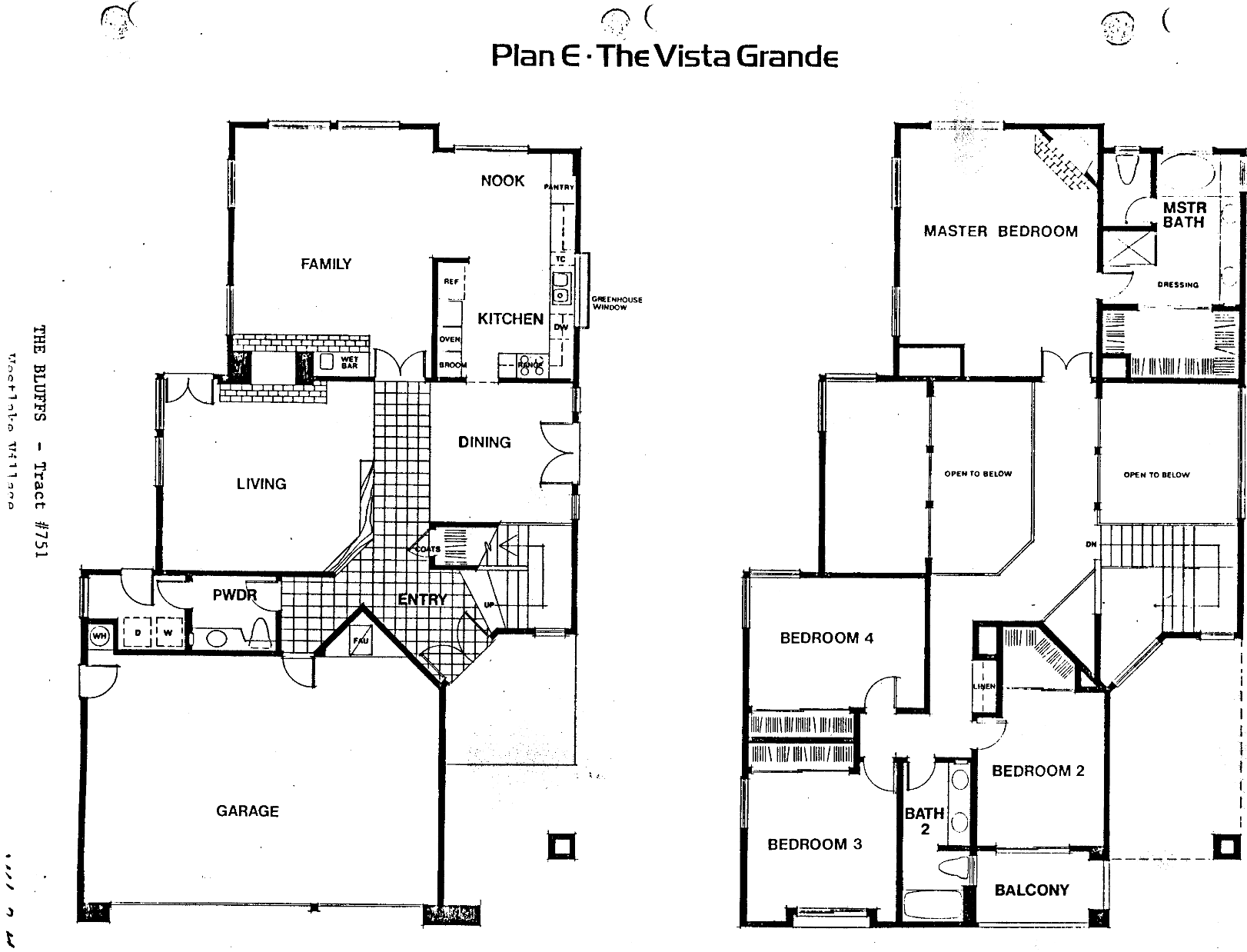
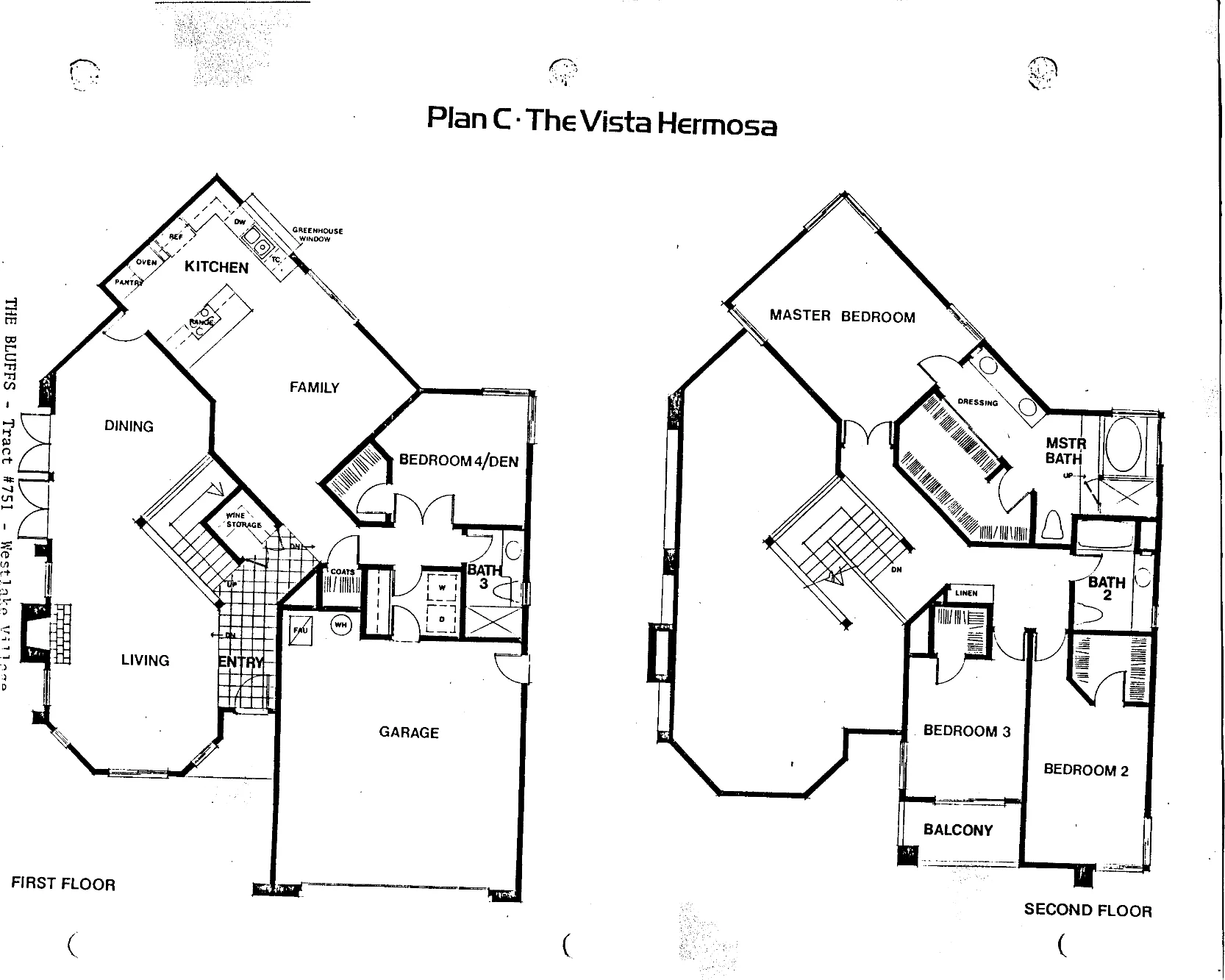
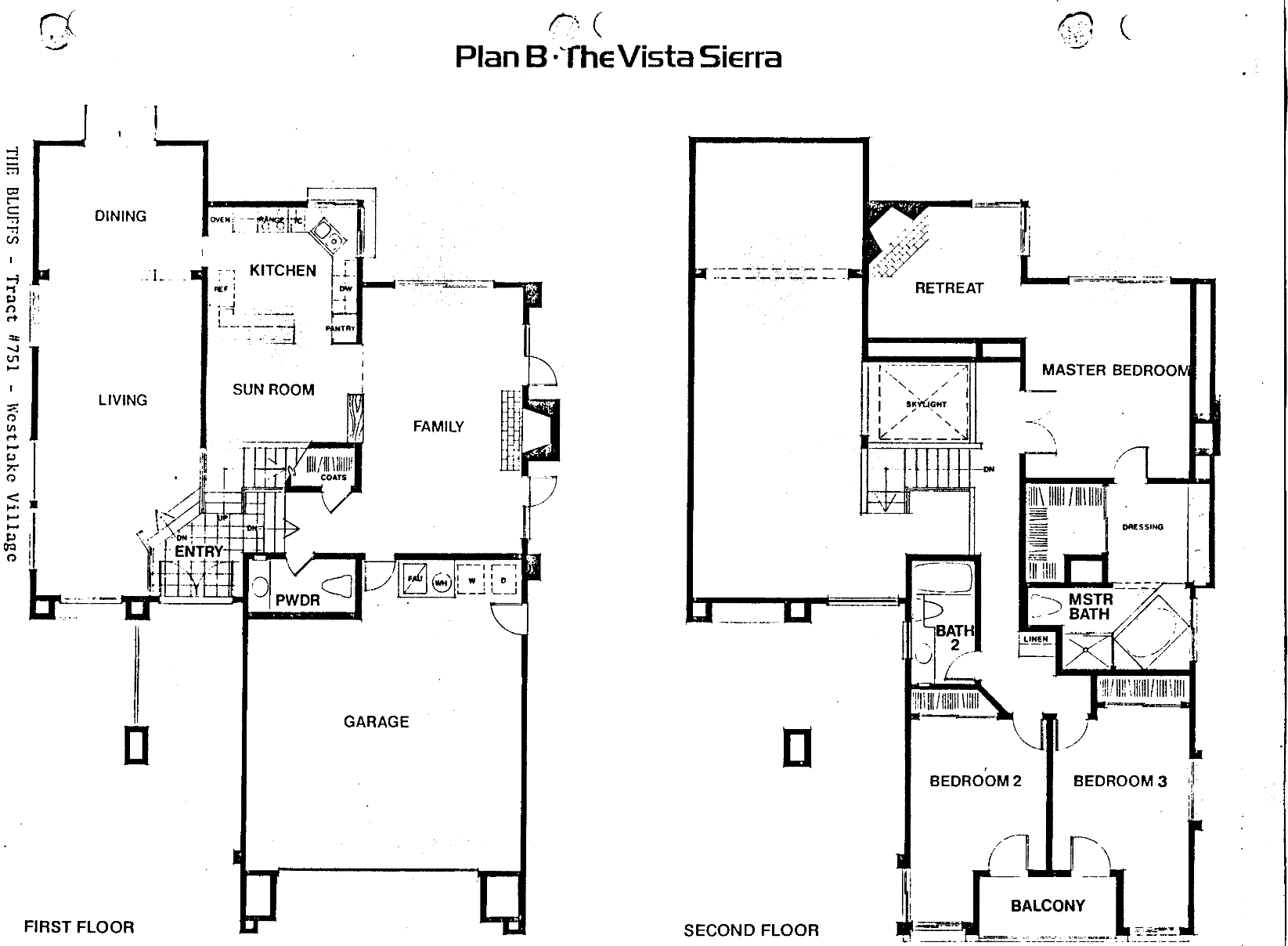
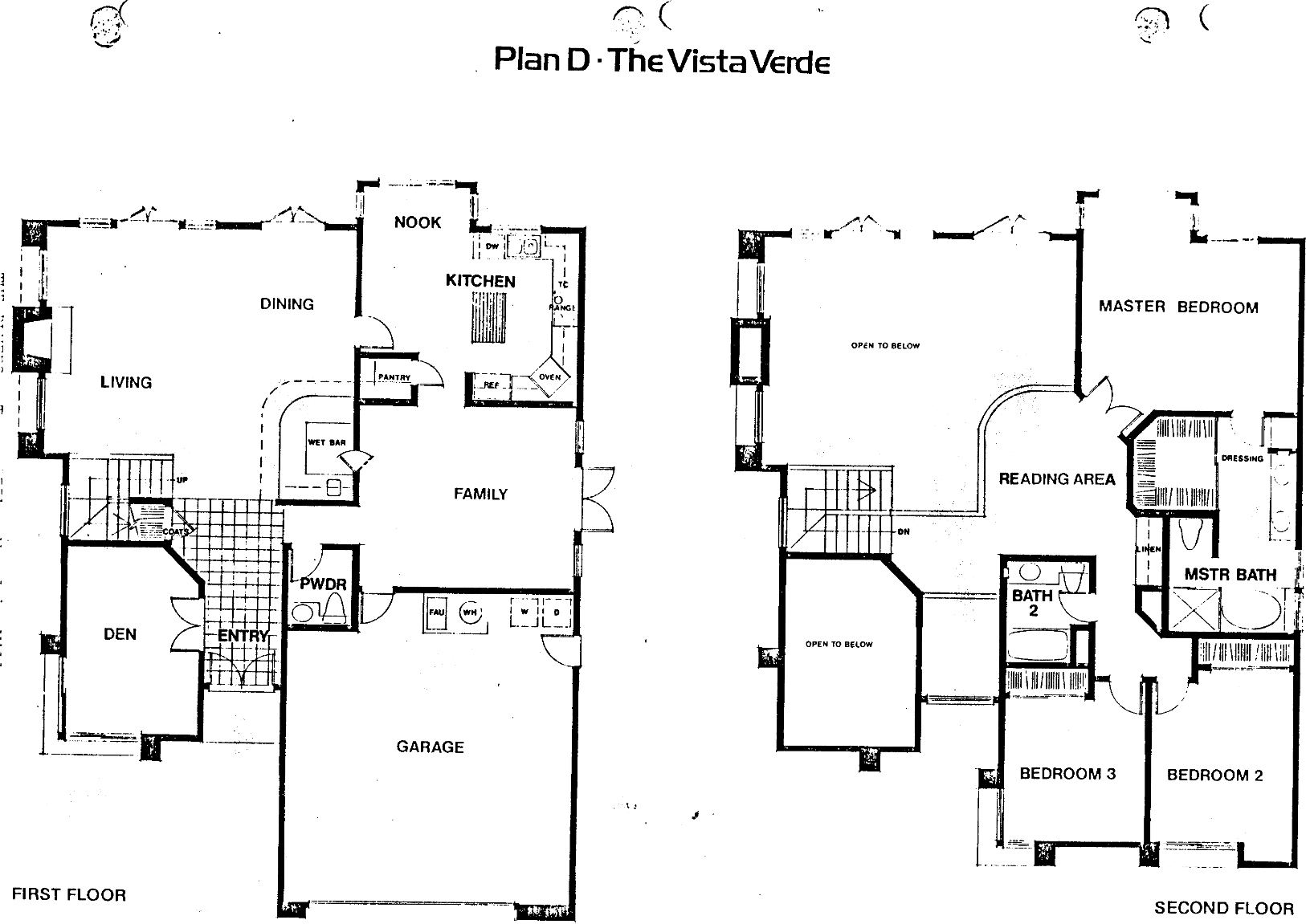
The Bluffs was marketed as tract 751, and the Conejo Simi Moorpark Association of Realtors plan archive holds six original drawings for it, all named with the same word: Plan 2, The Vista Del Sol; Plan E, The Vista Grande; Plan C, The Vista Hermosa; Plan 4, The Vista Mesa; Plan B, The Vista Sierra; and Plan D, The Vista Verde. The mixed numbering, two Arabic numerals and four letters, suggests the sheets came from more than one marketing phase, which fits the county dates of 1981 and 1984. What the plans have in common is the sloping, view-facing lot they were drawn for. Five of the six are two stories, with the formal rooms and the family room on the entry level and the bedrooms above so that the primary suite gets the balcony and the long view; all but one put a fourth bedroom or den and a full or three-quarter bath downstairs, the arrangement that today sells as a guest suite or a home office; and two of them, the Vista Sierra and the Vista Del Sol, include a sun room or “green room,” a glassed, south-facing room that was a fashion of the energy-conscious early 1980s. The drawings on file do not carry square footages, so the sizes below come from county records rather than from the sheets, and Gary Jacobs keeps the plan sheets on file to match a given home to its original plan.
Drawings on file for the tract. Other plans, elevations and options may have been offered.
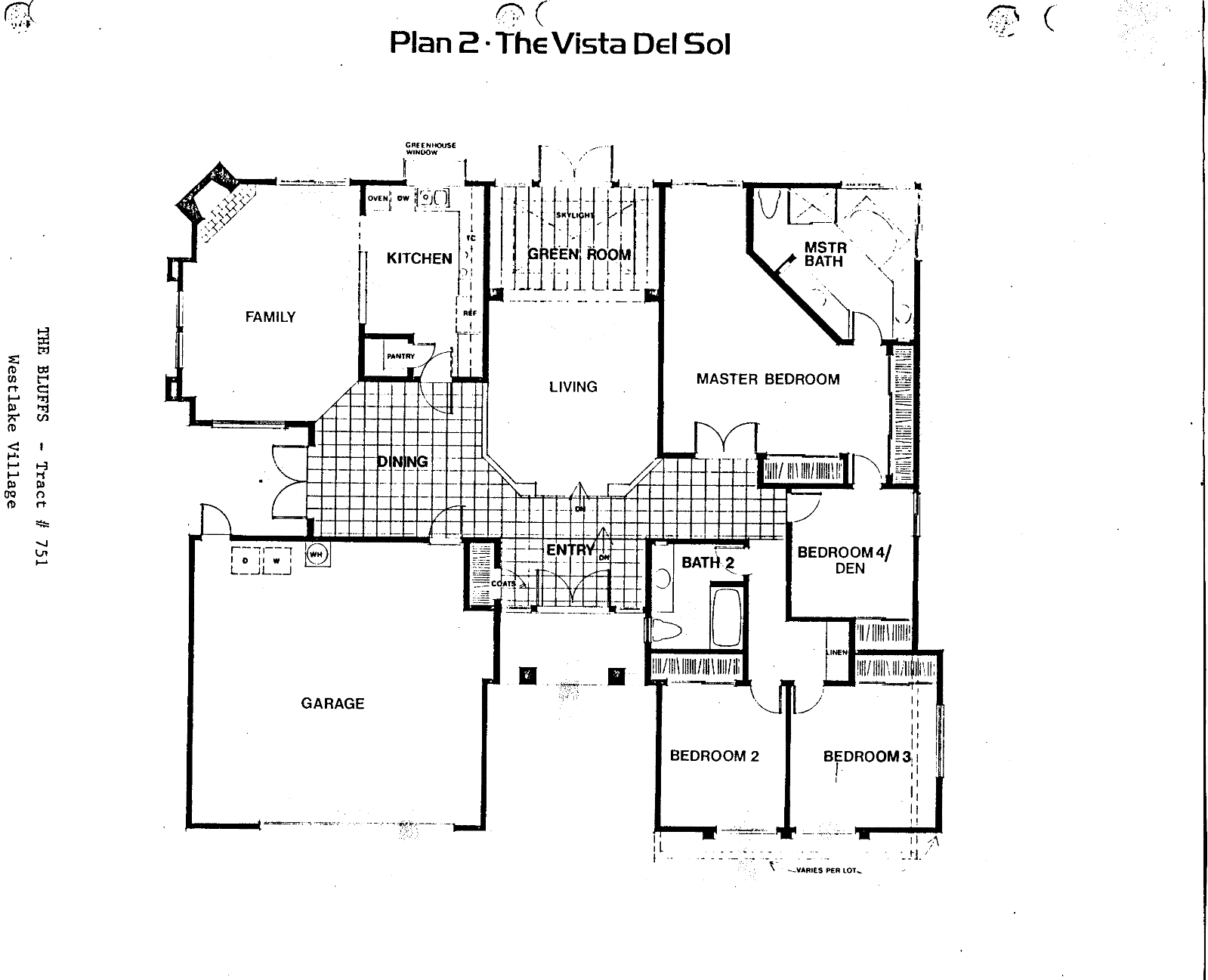


| Plan | Stories | Bedrooms as drawn | What sets it apart |
|---|---|---|---|
| Plan 2 · The Vista Del Sol | One | Primary, bedrooms 2 and 3, bedroom 4/den | The single-story plan among those on file; living, dining, family room and kitchen, a “green room” sunroom and a three-car garage |
| Plan E · The Vista Grande | Two | Primary plus bedrooms 2, 3 and 4 upstairs | All four bedrooms up; living, family, nook, dining and powder room down; balcony |
| Plan C · The Vista Hermosa | Two | Primary plus bedrooms 2 and 3 up; bedroom 4/den down | Downstairs bedroom with bath 3; living, dining, family room and kitchen; balcony |
| Plan 4 · The Vista Mesa | Two | Primary plus bedrooms 2 and 3 up; bedroom 4/den down | Skylit dining room, nook and family room; downstairs bedroom with bath 3 |
| Plan B · The Vista Sierra | Two | Primary with retreat plus bedrooms 2 and 3 up | Sun room off the kitchen, family room, powder room down; primary retreat and balcony |
| Plan D · The Vista Verde | Two | Primary plus bedrooms 2 and 3 and a reading area up | Den, wet bar and powder room down; two-story volume over the living room |
What the plans mean on the ground today: county records for The Bluffs cluster around five sizes, 2,630, 2,648 and 2,680 square feet for the four-bedroom homes, 2,855 square feet for a larger four-bedroom, and 3,106 square feet for the five-bedroom, four-bath homes of the 1984 phase on lower Glastonbury Road. The median is about 2,630 and the largest homes run to roughly 3,100 to 3,200 square feet. That range sits just above the original plan sizes, which tells a buyer two things. First, the tract has not been rebuilt: a 2,648 square foot home sold in 2025 is the plan it started as, and so is a 3,106 square foot home sold in 2024. Second, the additions that have happened are modest, a converted sun room, an enclosed patio, a bonus room over the garage, rather than second-story pop-tops, because the plans already had the second story. Recorded listings describe the same features again and again: “soaring” or “cathedral” ceilings in the living room, a two-story formal dining room, three fireplaces in some plans (living room, family room and primary bedroom), a downstairs bedroom and bath, and a primary suite with walk-in closet and balcony. What buyers should check is whether a sun room or green room has been enclosed and finished without a permit, whether the square footage a listing claims includes that space, and, on the 1981 homes, whether the original windows, roof and mechanical systems have been replaced; the sections on inspections and remodels below go into detail.
The Bluffs streets and how the tract is laid out
The Bluffs has two streets. Glastonbury Road is the spine, climbing from the Triunfo Canyon Road side of the hill near Westlake Boulevard up onto the ridge, with house numbers in the 2000s and 2100s carrying the 1981 and 1984 dates that define the tract, and Goldenrod Court is a cul-de-sac off it with numbers around 1999 to 2023, all dated 1981. County records tie the two together under assessor parcel numbers in the 697-0-16 and 697-0-17 series, and the MLS files the homes as “Bluffs, The–751.” Recent Redfin listing pages for 2023 Goldenrod Court, 2146 Glastonbury Road and 2081 Glastonbury Road all carry the tract 751 subdivision code, which is the cleanest evidence of where the tract begins and ends.
Where it ends matters, because the same hill holds two tracts that agents and even some listing services blur together. The upper, eastern end of Glastonbury Road, around the 2200 block, and all of Channelford Road are single-story homes of about 2,040 to 2,140 square feet built in 1974 to 1976, and the MLS files them as Southshore Hills, tract 720, with dues to the Southshore Hills Property Owners Association. A 1976 single-story at 2257 Glastonbury Road, for example, was listed in 2025 and 2026 as “Southshore Hills (720)” with a $50 monthly association fee, and 2039 Channelford Road, a 1975 single-story on nearly half an acre that sold in April 2026, was filed the same way. So Channelford Road is not part of The Bluffs, even though the two streets meet at Southshore Hills Park and share the view. Going the other way, several agents have filed genuine Bluffs homes, 1981 and 1984 two-stories on Glastonbury Road and Goldenrod Court, under “Southshore Hills–720” because that is the tract name people know; those listings still report no association dues. A buyer searching the MLS by tract name will miss homes either way, which is one reason Gary Jacobs tracks this hill by address rather than by subdivision code.
The layout is what a hillside tract of its era looks like: a single road with homes on both sides, garages facing the street, the downhill side of the lot dropping away behind the house. On the lake side of the ridge that means a rear yard with a pool terrace and a slope below it, and a view out over the Southshore Hills rooftops to the lake and the Conejo Valley beyond; on the other side it means a yard that backs toward the reservoir hills and open land. Lots range from about 8,300 square feet on the tightest Glastonbury Road parcels to about 20,000 square feet on Goldenrod Court and up to roughly two-thirds of an acre at the largest, with a median of about 11,760 square feet. Parking is a two-car or three-car attached garage plus a driveway; the 1981 homes with the 2,680 square foot plan tend to have the three-car garage, and at least one Goldenrod Court home advertises room for an RV beside the drive. The road is public and maintained by the City of Thousand Oaks, not by an association, and there is no gate.
The views: the lake on one side, the reservoir on the other
The Bluffs is named for the landform it occupies, and the landform is the reason to buy here. The ridge south of Westlake Lake is the last high ground before the hills that separate the Conejo Valley from the Santa Monica Mountains. From the top of Glastonbury Road the view to the north takes in the rooftops of Southshore Hills, the southwest arm of the lake, Westlake Island and the lake tracts on the far shore, and behind them the hills that close the Conejo Valley to the north. To the south and west the ridge drops toward the Las Virgenes Reservoir, the drinking-water lake that the Las Virgenes Municipal Water District keeps in the hills behind Westlake Village, and the 360 acres of protective open land the district owns around it. Both views are why every original plan here was named “The Vista.”

Not every lot gets both views, or either, and the sales record shows how much that matters. The 1981 homes along the crest of Glastonbury Road and the Goldenrod Court homes on the outside of the cul-de-sac are the ones listings describe with words like “serene views” and “overlooking the pool and hills”; a 2,648 square foot Goldenrod Court home on a little over a quarter acre sold in September 2025 on the strength of its view and pool, while a home of the same plan on a flatter interior lot trades on its yard instead. The lower 1984 homes on Glastonbury Road, the 3,106 square foot five-bedrooms, sit at the base of the ridge nearer Triunfo Canyon Road and Westlake Elementary, and their views are of the hillside and the treetops rather than the lake. A buyer weighing two Bluffs homes at the same price should walk the rear yard of each at the same time of day, because the difference between a lake view and a hillside view here is not visible from the street.
The reservoir side deserves its own note. The Las Virgenes Reservoir holds roughly 9,500 to 10,000 acre-feet of treated drinking water, about a three-month supply for the district, imported from the Metropolitan Water District of Southern California and stored as what the district calls an “insurance policy” against shutdowns, drought and earthquakes. After the 1994 Northridge earthquake, when imported water was cut off, the district reports that reservoir water was flowing to its customers within hours while nearby communities waited up to a week. The water is drawn through a concrete intake tower with valves at five depths and treated again at the Westlake Filtration Plant, which can produce about 15 million gallons a day. The reservoir is not a recreation lake, the district’s land around it is fenced water-supply property rather than a park, and buyers who imagine a lakeside trail behind their house should confirm what access, if any, the district permits before they count on it. What the reservoir does give The Bluffs is a permanent backdrop of open hills that will not be built on, and the quiet that comes with it.
Why people move to The Bluffs
The first reason is the house. Nothing else on the south side of Westlake Lake offers a 1980s two-story of 2,630 to 3,100 square feet with two-story ceilings, a downstairs bedroom and bath and an upstairs primary suite with a balcony; the tracts below are 1970 ranch houses, the tracts across Westlake Boulevard are 1960s, and the newer homes of comparable size in Westlake Village are either far larger and more expensive, in North Ranch or Three Springs, or attached. A family that wants five bedrooms and four baths in a single-family home under $2 million in a Westlake Village ZIP code has very few choices, and the 1984 five-bedrooms on Glastonbury Road are among them.
The second is the lot and the view. A quarter to half an acre, a pool, and a rear yard that looks over the lake basin or into permanent open hills, on a public road with no gate and no through traffic, is a combination that the flat lake tracts cannot offer at any price and the hillside tracts across the valley offer only with a homeowners association attached. The third is the absence of that association: no monthly dues, no architectural committee, no rental restrictions, no special assessments, and no shared insurance to argue over, in a tract small enough that the neighbors know each other anyway. The fourth is the park: Southshore Hills Park at the corner, rebuilt in 2021, a lighted court and a playground and a lawn that the tract treats as its own front yard. The fifth is the schools, Westlake Elementary at the bottom of the hill and Westlake High across the lake, both consistently among the highest-rated in the Conejo Valley Unified district. The sixth is scarcity itself. Two sales a year in a tract of 57 homes means that a Bluffs home holds its value in a soft market because there is never a competing listing on the street, and it means that the person who buys one is, on the evidence, likely to keep it for a decade or more.
Living in The Bluffs
The The Bluffs HOA: dues, rules and monthly costs
The Bluffs has no homeowners association. Every recent listing for a tract-751 home reports “No HOA” or leaves the dues field empty: 2023 Goldenrod Court, sold in October 2024, was marketed with “NO HOA” in the description; 2116 Glastonbury Road, sold in December 2025, and 2044 Glastonbury Road, sold in October 2021, both show an association of “None” on their listing pages; and 2146 and 2081 Glastonbury Road, both sold in May 2023, carry no dues. There is no gate, no common pool, no clubhouse and no assessment for landscaping, and the street is a public road maintained by the City of Thousand Oaks. For a buyer comparing The Bluffs with the rest of the hill, that is a real and recurring difference: the Southshore Hills Property Owners Association next door bills its members roughly $50 to $60 a month, about $600 to $725 a year, for greenbelt and park-edge upkeep, and the lake tracts below carry Westlake Lake Management Association obligations on top of their own dues.
No association does not mean no rules. The tract is zoned RPD 1.8 by the City of Thousand Oaks, a residential planned development designation that fixes the density at roughly 1.8 homes per acre and puts exterior changes, additions and accessory dwelling units under the city’s planning and building review rather than an architectural committee. The original tract may have recorded conditions, covenants and restrictions when it was mapped in 1981, and a few older CC&Rs in this part of Thousand Oaks survive without an active association to enforce them; the preliminary title report will show whether any exist on a given lot, and buyers should read it rather than assume. Because there is no association there is also no earthquake, fire or roof insurance pooled across the tract, so each owner carries a full homeowner’s policy, and in a hillside neighborhood that borders open land the fire-insurance market is the cost item most likely to surprise a buyer from the flats. Property taxes follow the usual Ventura County pattern of roughly 1.1 percent of the purchase price plus local bonds; a Bluffs home that closed at about $1.8 million in 2025 shows a 2025 tax bill near $18,700 on its listing page, and a five-bedroom that closed at $1,675,000 in early 2024 shows about $19,600. There is no Mello-Roos district reported on any listing Gary Jacobs has reviewed for the tract, which is consistent with its 1981 date; buyers should confirm on the tax bill.
Schools serving The Bluffs: district, elementary, middle and high
The Bluffs is on the Ventura County side of Westlake Village, inside the City of Thousand Oaks, which puts it in the Conejo Valley Unified School District rather than Las Virgenes Unified. Every recent listing for the tract reports the same assignments: Westlake Elementary for kindergarten through fifth grade, Colina Middle School for sixth through eighth, and Westlake High School for ninth through twelfth. Westlake Elementary, at 1571 East Potrero Road, is the closest campus, about half a mile from Glastonbury Road according to the distances listing services calculate, close enough that many families walk or bike; it enrolls roughly 500 students. Westlake High, at 100 Lakeview Canyon Road on the north side of the lake, opened in 1978 with a first graduating class in 1980, enrolls about 2,000 students and is about two miles away; Colina Middle is the farthest of the three at roughly three miles, in Thousand Oaks.
The county line is close enough here that buyers sometimes assume the Las Virgenes schools, White Oak Elementary and Agoura High, apply; they do not, because the line runs through the lake and the whole southern hill is Thousand Oaks. Conejo Valley Unified also offers intradistrict transfers and specialty programs that can change where a student attends, and attendance boundaries are redrawn from time to time, so a family choosing The Bluffs for a specific campus should confirm the current assignment with the district office before removing contingencies. For families with younger children the practical point is that Westlake Elementary sits at the bottom of the same hill, and for older students the drive to Westlake High is around the west end of the lake on Westlake Boulevard and Lakeview Canyon Road.
Parks, trails and everyday life in The Bluffs
The Bluffs has a park in the middle of it. Southshore Hills Park, run by the Conejo Recreation and Park District, is a four-acre hillside park at the corner of Glastonbury Road and Channelford Road, established in 1983 as the tract was finishing. The district describes it as “hilly and passive,” and it is: lawns that follow the slope, mature trees, two picnic tables, two benches and a drinking fountain, a backstop, and a lighted outdoor basketball court that stays lit from sunset until 10 p.m. The play area was rebuilt in 2021 with a boat-themed playground and hill climbers, slides and shade canopies, a nod to the lake below. The park is open from 7 a.m. to 10 p.m. daily and the district can be reached at 805-495-6471. A Bluffs home on the park side of Glastonbury Road, as one 2025 sale advertised itself, looks across the street at open green rather than at another house, and for families that is the single most valued lot position in the tract. The district lists a Tanbark Court street address for the park on its website that appears to be a records error; the entrance is at the Glastonbury and Channelford corner.
The larger park for organized sports is Triunfo Community Park at 980 Aranmoor Avenue, a short drive east along Triunfo Canyon Road, with a baseball field, a softball field, two soccer fields, three lighted tennis courts, a lighted basketball court, a volleyball court, restrooms, ten picnic tables, a playground rebuilt in 2022 with natural-play structures and a monarch butterfly climber, and 92 parking spaces; the district converted its irrigation to reclaimed water in 2017. Westlake Lake itself is private and governed by the Westlake Lake Management Association, and The Bluffs is not a lake district, so a Bluffs owner does not get a dock, a fishing badge or a community slip; what the tract gets is the view of the water and a short walk or drive down to The Landing on the east shore for restaurants and the boardwalk. Hiking is a matter of a few minutes’ drive rather than a trailhead at the end of the street: the Conejo Open Space Conservation Agency trails to the west and south of Westlake Boulevard, and the Santa Monica Mountains trailheads along Potrero Road and Westlake Boulevard toward Hidden Valley, are the usual choices, and one 2024 listing on Glastonbury Road advertised “hiking access” nearby without naming the trail; buyers should confirm which trails are open and where they start.
Daily life is quiet and car-based. The homes are up a hill with a single road in and out, there is no through traffic because Glastonbury Road serves only the tract and the park, and the nearest shopping is at the bottom of the hill on Westlake Boulevard and Triunfo Canyon Road, with the larger centers at Westlake Boulevard and Thousand Oaks Boulevard a few minutes north. The noise a buyer notices on a visit is the park on a weekend afternoon and, on the lower lots, Triunfo Canyon Road; the crest lots hear very little.
Commuting from The Bluffs: freeway access and the daily drive
The Bluffs is reached from Triunfo Canyon Road near its west end at Westlake Boulevard, and Westlake Boulevard is the way to everything. North on Westlake Boulevard the U.S. 101 interchange is roughly two to three miles from the bottom of Glastonbury Road, six to ten minutes off-peak and noticeably longer at the morning and evening peaks, when Westlake Boulevard backs up between Thousand Oaks Boulevard and the freeway. The Lindero Canyon Road interchange to the east, reached along Triunfo Canyon Road and Lakeview Canyon Road, is the alternate for a commute toward Agoura Hills and the San Fernando Valley, and residents learn which of the two to use by time of day. A Ventura-bound commute runs the 101 west through Thousand Oaks and Camarillo; a Los Angeles commute is the 101 east through Calabasas and the Valley, typically forty-five minutes to well over an hour to the Westside or downtown at peak, and the reason many Bluffs owners work locally or on a hybrid schedule. Metrolink’s Ventura County Line does not come to Westlake Village; the nearest stations are in Moorpark and Simi Valley to the north and Chatsworth to the east, and commuter express buses toward downtown Los Angeles board at park-and-ride lots along the 101 corridor; buyers should check current schedules, which change.
Errands are short. The nearest groceries, pharmacies and everyday shops are in the centers along Westlake Boulevard between Triunfo Canyon Road and Thousand Oaks Boulevard, including The Promenade at Westlake and the Westlake Plaza centers at the Thousand Oaks Boulevard intersection, a few minutes from the hill; The Landing on the lake’s east shore, off Triunfo Canyon Road, has restaurants on the water; and The Oaks mall in Thousand Oaks is about ten to fifteen minutes west on the 101. School runs are easy: Westlake Elementary is at the bottom of the hill on East Potrero Road, and Westlake High is around the west end of the lake and up Lakeview Canyon Road, a five- to ten-minute drive. The beach is the surprise for newcomers: Westlake Boulevard continues south past Potrero Road as State Route 23, Decker Canyon Road, a steep and winding two-lane road that reaches Pacific Coast Highway west of Malibu in about half an hour, and Kanan Road from Agoura Hills is the easier, wider route to Malibu proper in about the same time. Hidden Valley and Lake Sherwood are a few minutes west on Potrero Road, and the Santa Monica Mountains trailheads on that road and on Westlake Boulevard are closer to The Bluffs than to almost any other Westlake Village tract.
The Bluffs home prices and the market
The Bluffs home prices and the current market
The figures in this section were current when this guide was last reviewed. The sale record in the facts above and the listings below are drawn live from the MLS each time the page loads.
The Bluffs trades rarely, and when it trades it trades in a narrow band. In the two years through September 2026, four homes in the tract sold, at prices from $1,599,000 to $1,839,000 and a median of about $1.76 million; counting back to January 2024, six homes closed, every one between $1,585,000 and $1,839,000. In date order: 2116 Glastonbury Road, a 1981 four-bedroom of 2,680 square feet with a three-car garage and a pool on an 8,276 square foot lot, sold in January 2024 for $1,585,000; 2045 Glastonbury Road, a 1984 five-bedroom, four-bath home of 3,106 square feet with a pool on a 10,454 square foot lot, sold in February 2024 for $1,675,000, exactly its asking price, about $539 a square foot; 2023 Goldenrod Court, a 1981 four-bedroom of 2,648 square feet with three fireplaces and a heated pool and spa on about four-tenths of an acre, sold in October 2024 for $1,725,000 after listing at $1,775,000; 2008 Goldenrod Court, a 2,680 square foot four-bedroom on nearly half an acre with a three-car garage, RV parking and a remodeled kitchen, sold in June 2025 for its full $1,799,000 asking price; 1999 Goldenrod Court, a 2,648 square foot four-bedroom with a downstairs bedroom and bath, a heated pool and spa and a view, sold in September 2025 for $1,599,000 after listing at $1,649,000; and 2116 Glastonbury Road came back to market and sold again in December 2025 for $1,839,000, after a remodel of the kitchen, the primary bath, the flooring and the pool equipment, against an asking price of $1,849,000. The 2024 sale of that house at $1,585,000 and its 2025 resale at $1,839,000 bracket, in one address, what a remodel is worth on this street.
The years before tell the same story with a wider range. In 2023 three Bluffs homes closed: 2018 Glastonbury Road, a 1984 four-bedroom of 2,648 square feet on two-thirds of an acre with a pool, for $1,750,000 in February; 2146 Glastonbury Road, a 1981 four-bedroom of 2,855 square feet on a 17,000 square foot lot, freshly remodeled with bi-fold sliders and a quartz kitchen, for $2,000,000 in May against a $1,895,000 asking price, the tract’s recorded high; and 2081 Glastonbury Road, a 3,106 square foot five-bedroom with a gunite pool, for $1,800,000 in the same month after listing at $1,595,000 and closing about $200,000 over asking. In December 2023, 2015 Glastonbury Road, another 3,106 square foot five-bedroom, sold for $1,840,000 after starting at $2,175,000 in August. In October 2021, 2044 Glastonbury Road, a 2,630 square foot four-bedroom with a pool, sold in seven days for $1,615,000 against $1,549,000 asking. Taken together, the last five years put the tract at roughly $540 to $700 a square foot depending on condition and view, with remodeled homes on the larger lots at the top and original-condition homes and the five-bedrooms, which are the largest of the plans on file and so carry the lowest per-foot figures, at the bottom.
The turnover is the number to understand. Ten recorded sales across two streets in five years, in a tract of about 47 homes, is a pace of two a year, and several of those were the same house twice: 2146 Glastonbury Road sold for $1,050,000 in July 2022 and for $2,000,000 ten months later after its remodel, and 2116 Glastonbury Road sold in January 2024 and again in December 2025. Long holds are the norm: 2081 Glastonbury Road had not changed hands since 1998 when it sold in 2023, 1999 Goldenrod Court carried a 2025 tax bill of about $10,700, less than half its neighbors’, which is what a Proposition 13 basis from a long-ago purchase looks like, and 2045 Glastonbury Road had been held since 2008. The earlier prices on file give a sense of the tract’s arc: $410,000 for 2146 Glastonbury Road in 1993, $520,000 for 2081 in 1990, $869,000 for 2045 in 2003 and $1,025,000 for the same house in 2008, $882,500 for 2023 Goldenrod Court in 2012, $1,120,000 for 2015 Glastonbury Road in 2018. A buyer who wants a Bluffs home should expect to wait for one, and a seller who has one should expect the shortage to work in their favor. No Bluffs home was listed for sale on the major portals in early September 2026; the only active listing on Glastonbury Road at the time was the 1976 single-story at number 2257, which belongs to Southshore Hills.
Figures are drawn from public records and MLS closings and are rounded. They are a snapshot, not a valuation; contact Gary for a current read on any specific property.
Renting in The Bluffs: leases and rental prices
The Bluffs almost never leases. Gary Jacobs found no rental listing on Glastonbury Road or Goldenrod Court on the major rental portals in September 2026, and the MLS lease history for the tract is thin enough that no reliable rent by plan can be stated for it. That is what a 57-home tract of long-held, owner-occupied houses with no association and no investor-friendly small units looks like, and a tenant who wants to live here should expect to watch for a long time. Because there is no homeowners association, there are also no association rules on leasing, minimum terms or short-term rentals; what applies is the City of Thousand Oaks municipal code and state law, so an owner considering a furnished short-term arrangement should check the city’s current rules on short-term rentals before advertising.
The nearest evidence of what a Bluffs home would rent for comes from the hill below it and the tracts across the boulevard. In September 2026, Southshore Hills homes of about 2,820 square feet with four or five bedrooms were asking $6,800 a month on Highgate Road and on Folkestone Terrace, a 2,645 square foot four-bedroom on Valecroft Avenue was asking $6,200, and a 2,683 square foot five-bedroom in Foxmoor Hills on Stonesgate Street was asking $7,450. Gary Jacobs leased a renovated 2,465 square foot pool home at 1267 Willsbrook Court in Foxmoor Hills for $6,800 a month in June 2024 and again for $6,900 in August 2025. On that evidence a four-bedroom Bluffs home of about 2,650 square feet with a pool and a view would likely ask somewhere around $6,500 to $7,500 a month unfurnished in 2026, and a remodeled 3,106 square foot five-bedroom somewhat more, with furnished or short-term arrangements priced well above that; these are hedged estimates from neighboring tracts rather than Bluffs closings. A landlord here should plan on a tenant who wants the schools and the yard, a pool-service and gardener cost that is larger than in the flats, and a fire-insurance premium that a rental policy must reflect. A tenant should ask who maintains the pool and the slope, because on a hillside lot the slope is the expensive part.
What inspectors find in The Bluffs homes
A Bluffs home is forty to forty-five years old, and it was built in an era with its own habits. What follows is common in homes of this age in the Conejo Valley; each house varies, and a licensed inspector must confirm what applies to any specific property. The 1981 and 1984 dates put the tract past the Zinsco and Federal Pacific electrical panels and the aluminum branch wiring of the late-1960s and early-1970s tracts, so copper wiring and a conventional panel are the norm, but a 200-amp service was not standard and an inspector will note whether the panel has been upgraded to carry an electric range, an EV charger and a heat-pump system. Supply plumbing is copper of the period; drains may be ABS plastic or cast iron, and the sewer lateral to the street is worth a camera inspection on any hillside lot. Original windows were aluminum-framed and single-paned, and while many homes have been re-glazed, as listings for 2044 Glastonbury Road and 2008 Goldenrod Court advertised, a home with its original sliders and the original sun room glass will show it on the utility bill. Roofs on the tract are concrete or clay tile; a 1981 tile roof is often on its original tiles but past the life of the underlayment beneath them, and an inspector will look for slipped tiles, cracked ridge mortar and stains in the attic. One 2025 listing noted an eight-year-old roof and a heating and air system under two years old, which is the kind of disclosure a buyer should hope to see.
The hillside is the era-independent item. The Bluffs sits on graded fill and cut on a ridge, and the rear yards on the downhill lots step down to a slope. Inspectors look at the retaining walls, the drainage swales and area drains at the top of the slope, the condition of the slope planting, any cracking in pool decks and patios that suggests movement, and the age and condition of the pool itself, since nearly every home here has one and a 1980s gunite pool with its original plaster and plumbing is a significant line item. Foundations are slabs on the flat portion of the lot with stepped footings where the plan follows the grade, and hairline cracks in slab and stucco are ordinary; separation at the joints of a two-story volume, doors that bind on one side of the house, or a rear patio that has pulled away from the house are not, and call for a geotechnical or structural opinion. Because the tract has no association and the city is the only reviewer, the permit history of additions matters: enclosed sun rooms, converted garages, bonus rooms, second-story balcony enclosures and outdoor kitchens are all seen here, and the City of Thousand Oaks building division can produce the record. Finally, a home that borders the open land toward the reservoir is in a wildland-urban interface zone under state fire rules, and both the inspection and the insurance quote should address defensible space, vent screening and the roof and eave materials.
Remodels that add value in The Bluffs
The sales record in The Bluffs is unusually clear about what a remodel is worth, because two homes have sold twice within a few years on either side of one. At 2146 Glastonbury Road, a 2,855 square foot four-bedroom on a 17,000 square foot lot, the July 2022 purchase at $1,050,000 was followed by a full renovation, bi-folding sliders to the yard, a quartz kitchen, a marble-faced fireplace and new floors, and a May 2023 sale at $2,000,000, the tract’s recorded high, against an asking price of $1,895,000 and with no pool. At 2116 Glastonbury Road the January 2024 purchase at $1,585,000 was followed by a designer kitchen, a remodeled primary bath, new floors and new pool equipment and a December 2025 sale at $1,839,000. Nobody should read either as a formula, since the market moved in between and remodel costs on a hill are high, but the direction is unmistakable: a finished Bluffs home commands a premium of several hundred thousand dollars over an original one, and buyers who want the view and the lot without a project will pay for it.
The work that pays is the work that opens the plans up. The early-1980s layouts separate the kitchen, the breakfast nook and the family room from the formal living and dining rooms, and the most common remodel removes the wall between the kitchen and the family room and replaces the small rear sliders with wide bi-fold or multi-slide doors so that the family room, the patio and the view become one space, which is precisely what the 2146 Glastonbury Road remodel did. The second is the primary suite: the original baths were tub-and-shower rooms with a single vanity, and a suite with a walk-in shower, double vanity and a reworked closet is what every recent high sale advertised. The third is the sun room or green room on the Vista Sierra and Vista Del Sol plans, which owners have turned into an office, a gym or a permitted extension of the family room. Second-story additions are rare because the second story already exists; the additions the tract does see are bonus rooms over the garage on the three-car plans and rear extensions on the largest lots.
Accessory dwelling units are the newer question. California law allows an ADU and a junior ADU on a single-family lot regardless of local zoning, and with lots of a quarter to two-thirds of an acre several Bluffs parcels have room for a detached unit; the catch is the hillside, where the flat pad is mostly used by the house and the pool and a detached ADU may require grading and retaining walls that the City of Thousand Oaks will review. A garage conversion is the simpler path and the one most likely to be permitted quickly, at the cost of the covered parking that buyers here value. Because there is no association, the only architectural review is the city’s, and the city does not regulate paint colors, front-yard planting or the style of a remodel; it does regulate height, setbacks and grading, and its hillside rules add review for work on steeper slopes. Solar is common on the south-facing roofs and worth confirming as owned rather than leased. What does not pay is over-building the tract: a $4 million reconstruction on a $1.8 million lot has no comparable sale here to support it, and the buyer who wants that scale should look at the custom homes at the top of Highgate Road, where a 2025 build of about 8,000 square feet sold for $7.3 million in 2026 under its own small association.
Buying and selling in The Bluffs
What to weigh before buying in The Bluffs
The hill is the first thing to weigh. The Bluffs is a ridge-top tract with one road in, sloping lots, retaining walls and rear yards that drop away, and that geography costs money over time: slope maintenance, drainage, pool decks that move, and the fire-insurance market for a hillside home that borders open land toward the reservoir. The Woolsey Fire of November 2018 burned nearly 97,000 acres across the Santa Monica Mountains and forced evacuations in Thousand Oaks, Westlake Village and Oak Park; while there is no public record of Bluffs homes lost, the tract is inside the area where insurers now price wildfire exposure, and a buyer should obtain a binding insurance quote before the contingency period ends rather than after.
The age of the homes is the second. These are 1981 and 1984 houses, and an original-condition Bluffs home will need windows, a roof underlayment, a kitchen, baths, a pool re-plaster and often the heating and air system inside the first decade of ownership, which is why the remodeled homes command the premium they do and why a buyer paying $1.6 million for an original one should budget several hundred thousand dollars on top. The third is the lack of an association, which cuts both ways: no dues, but also no one to compel a neighbor to maintain a slope, keep an RV off the driveway or paint a house, and no reserve fund behind the street trees and the park edge. The fourth is the lake, which is a view rather than an amenity: The Bluffs is not a Westlake Lake Management Association district, so there is no dock, no slip and no fishing badge, and a buyer who wants the water itself should look at Westlake Island or Lakeshore. The fifth is the mixing of tracts on the hill: the 2200 block of Glastonbury Road and Channelford Road are 1970s single-story Southshore Hills homes with an association, and a buyer who wants a Bluffs two-story should confirm the year built, the tract number and the dues on any listing rather than the subdivision name an agent has typed in. The last is the commute. The 101 is close, but a daily drive to the Westside or downtown Los Angeles from the south side of Westlake Lake is long, and the quiet that makes the hill appealing on a Sunday is the distance that makes it tiring on a Tuesday.
Who buys in The Bluffs
The buyer who most often ends up in The Bluffs is a family with school-age children moving up from a smaller Conejo Valley home or arriving from Los Angeles, who wants four or five bedrooms, a pool and Westlake Elementary and Westlake High, and who has found that the 1960s and 1970s tracts around the lake do not have the room. The five-bedroom, four-bath homes on lower Glastonbury Road are almost purpose-built for a household with three or four children or a live-in grandparent, and the downstairs bedroom and bath in most of the two-story plans is what makes a multigenerational arrangement work without a remodel.
The second buyer is the view buyer, often a couple whose children are grown, who wants a hillside house with the lake below and the open hills behind and is willing to trade a dock or a golf course for the quiet and the absence of dues; a remodeled 2,650 to 2,850 square foot home on the crest of Glastonbury Road or the outside of Goldenrod Court is what they are waiting for, and the 2023 and 2025 high sales were to buyers of this kind. The third is the remodeler, who buys an original-condition home from a long-time owner, opens the kitchen to the family room, rebuilds the primary bath and the pool and either stays or sells, as the 2146 and 2116 Glastonbury Road histories show. The fourth, less common, is the single-story buyer looking for the one Vista Del Sol plan in the tract or a 1970s single-story on the Southshore Hills end of the street, who should be clear about which tract and which association they are buying into. Investors are rare here; the price-to-rent ratio does not favor them, and the tract has no history of leasing.
How The Bluffs compares with nearby neighborhoods
The nearest comparison is Southshore Hills, the tract that surrounds The Bluffs on the same hill. Southshore Hills is a decade older, 1970 for its main phase and 1974 to 1976 for the single-story homes on Hillsbury Road, Channelford Road and upper Glastonbury Road, and its homes are mostly single-story or split-level ranch plans of about 2,040 to 2,820 square feet with beamed ceilings, on lots that are often larger than The Bluffs’, up to about eight-tenths of an acre on the flag lots. It carries a property owners association of roughly $50 to $60 a month. Its 2024 to 2026 sales ran from about $1,430,000 for a 2,038 square foot single-story to $1,850,000 for a 2,808 square foot pool home, with the 2026 sale of 2039 Channelford Road at $1,695,000 as a direct neighbor to compare. On a per-foot basis the two tracts are close, with Southshore Hills slightly higher for its one-level plans and larger lots and The Bluffs higher for a finished two-story; the choice between them is really the choice between a 1970s single-story with an association and a 1980s two-story without one, on the same view.
Lakeshore and Westlake Island are the water comparisons. Lakeshore, on the east shore across the lake, is 1967 to 1969 attached townhomes and patio homes of about 1,300 to 2,250 square feet on lots of about 3,000 square feet, with dues of about $430 a month that pay for three pools, beaches and community docks, and prices from roughly $520,000 for an interior unit to about $2,455,000 for a lakefront unit with its own dock; a Bluffs buyer gets three times the lot and no dues, a Lakeshore buyer gets a boat. Westlake Island is the detached lakefront alternative, 1969 to 1970s homes on a guard-gated island with private docks, an association and lake dues, and prices that start well above The Bluffs and run past $4 million for rebuilt homes; the Island is what a Bluffs owner looks at across the water, and the price difference is the price of the dock. Three Springs, on the ridge to the south and east above Westlake Boulevard, is the closest thing to a newer version of The Bluffs: mid-1980s and later two-story homes, larger, on larger lots, with a homeowners association and prices that typically start where The Bluffs ends. A buyer who has outgrown The Bluffs in size but wants the same hill usually looks there. The full picture of the lake tracts, the hill and the county line is in the Westlake Village guide.
Gary’s track record in The Bluffs
Gary Jacobs has not represented a sale inside The Bluffs, and this guide does not pretend otherwise; with about two closings a year on two streets, most agents in the Conejo Valley have not. What Gary brings to the tract is the work around it. On Westlake Lake he sold 32108 Beachview Lane in Lakeshore, a 1968 three-bedroom of 1,753 square feet, in February 2018 for $690,000, and he leased 3808 Mainsail Circle on Westlake Island, a 1973 home of 1,568 square feet, in January 2010 at $2,725 a month, an early data point in a market that has since tripled. On the hillside tracts across Westlake Boulevard he leased 1267 Willsbrook Court in Foxmoor Hills, a renovated 2,465 square foot pool home built in 1969, in June 2024 for $6,800 a month and again in August 2025 for $6,900, which is the nearest verified lease comparison for a Bluffs home. In Village Homes, the 1970s tract of similar size to the north, he sold 2244 Silver Spring Drive, a 3,128 square foot pool home built in 1976, in January 2017 for $1,052,500 after leasing it four times between 2008 and 2013.
For The Bluffs specifically, Gary keeps the county record for every parcel on Glastonbury Road and Goldenrod Court, the six Vista plan sheets from the CSMAR archive, and the ten recorded sales since 2021 with their list-to-sale histories, and he can tell a buyer which addresses on the hill are tract 751 and which are the 1970s Southshore Hills homes that agents file under the same name. Anyone weighing a Bluffs home against a Southshore Hills single-story, a Lakeshore townhome or a Three Springs two-story can ask him for the comps side by side.
Buying or selling in The Bluffs: practical notes
Buyers: Expect to wait, and be ready when a home appears: the tract averages about two sales a year, and well-priced remodeled homes here have gone in a week and over asking, as 2044 Glastonbury Road did in 2021 and 2081 Glastonbury Road did in 2023. Confirm the tract before anything else, since the 2200 block of Glastonbury Road and Channelford Road are Southshore Hills, with an association and 1970s single-story plans; the year built, the assessor parcel number in the 697-0-16 or 697-0-17 series and the absence of dues identify a Bluffs home. Order the preliminary title report early and read it for any surviving CC&Rs. Get a binding fire-insurance quote inside the contingency period. Inspect the slope, the drainage and the pool as carefully as the house, and camera the sewer lateral. Pull the City of Thousand Oaks permit history for any enclosed sun room, bonus room or converted garage. Walk the rear yard at the time of day the view matters to you, because the difference between a lake view and a hillside view on this street is not visible from the curb. Verify the school assignments with Conejo Valley Unified rather than the listing.
Sellers: The record says that presentation is worth several hundred thousand dollars here, and that the buyers who pay the tract’s highs are paying for a finished kitchen open to the family room, a rebuilt primary bath, wide glass to the yard and a pool with new equipment; a seller with an original-condition home should price for the remodeler and expect a longer market time, as 2015 Glastonbury Road learned when it started at $2,175,000 in 2023 and closed at $1,840,000 four months later. Photograph the view at the right hour and from the upstairs balcony. Disclose the roof, the heating and air, the pool equipment and the window ages precisely, because the buyer’s inspector will find them anyway and a buyer who is told up front stays in escrow. Have the permit history for any addition ready. And lean on the two facts that no competing tract can claim: there is no association, and there is almost never another Bluffs home for sale at the same time.
Questions buyers ask about The Bluffs
How much does a house in The Bluffs in Westlake Village cost in 2026?
In the two years through September 2026, four Bluffs homes sold, at prices from $1,599,000 to $1,839,000 and a median of about $1.76 million; the six that closed from January 2024 through the end of 2025 were all four- or five-bedroom two-story homes of about 2,650 to 3,100 square feet with pools. The tract’s recorded high is $2,000,000, paid in May 2023 for a remodeled 2,855 square foot home on a 17,000 square foot lot, and the recent range works out to roughly $540 to $700 a square foot depending on condition and view. No Bluffs home was on the market in early September 2026, which is typical; the tract averages about two sales a year.
Does The Bluffs in Westlake Village have HOA dues?
No. The Bluffs, Ventura County tract 751 on Glastonbury Road and Goldenrod Court, has no homeowners association, and every recent listing for a tract-751 home reports no dues. The confusion comes from the surrounding Southshore Hills tract, whose 1970s homes on Hillsbury Road, Channelford Road and the upper 2200 block of Glastonbury Road pay a property owners association about $50 to $60 a month. Buyers should still read the preliminary title report for any recorded CC&Rs on a specific lot.
Which schools do homes on Glastonbury Road in Westlake Village go to?
The Bluffs is on the Ventura County side of Westlake Village, inside the City of Thousand Oaks, so it is in the Conejo Valley Unified School District, not Las Virgenes Unified. Recent listings all report Westlake Elementary at 1571 East Potrero Road, about half a mile away, Colina Middle School about three miles away, and Westlake High School at 100 Lakeview Canyon Road, about two miles away across the lake. Attendance boundaries can change, so families should confirm the current assignment with the district before relying on it.
When were the homes in The Bluffs built and what condition are they in?
Most of the tract is dated 1981, with a final phase of larger five-bedroom homes on lower Glastonbury Road dated 1984. They are two-story homes of about 2,630 to 3,106 square feet with two-story ceilings, a downstairs bedroom and bath in most plans and tile roofs. Condition varies widely: several homes have been fully remodeled since 2022 and sold at the top of the market, while long-held original-condition homes typically need windows, roof underlayment, kitchens, baths, pool re-plastering and heating and air systems. A licensed inspector should also review the slope, drainage, retaining walls and pool on any hillside lot here.
Is Channelford Road part of The Bluffs or Southshore Hills?
Channelford Road is Southshore Hills. Its homes, and the single-story homes in the 2200 block of Glastonbury Road, were built in 1974 to 1976 as the second phase of Southshore Hills, tract 720, and listings for them show Southshore Hills association dues; 2039 Channelford Road, a 1975 single-story of 2,140 square feet, sold in April 2026 for $1,695,000 filed that way. The Bluffs, tract 751, is the 1981 to 1984 two-story homes on the rest of Glastonbury Road and on Goldenrod Court, with no association. The two tracts meet at Southshore Hills Park on the corner of Glastonbury and Channelford Roads.
Do homes in The Bluffs have lake access or a dock on Westlake Lake?
No. The Bluffs sits on the ridge above the lake with views over it, but it is not a district of the Westlake Lake Management Association, so there is no private dock, community slip or fishing badge with a Bluffs home. Buyers who want a boat on the water should look at Westlake Island, Lakeshore or the other lakefront tracts. What The Bluffs does have is Southshore Hills Park at the corner of Glastonbury and Channelford Roads, a four-acre hillside park with a lighted basketball court and a boat-themed playground rebuilt in 2021.
How does The Bluffs compare to Southshore Hills in Westlake Village?
They share the same hill and the same views, and their prices are close, but the houses are different. Southshore Hills is a 1970 to 1976 tract of mostly single-story ranch homes of about 2,040 to 2,820 square feet with an association of roughly $50 to $60 a month, and its 2024 to 2026 sales ran from about $1,430,000 to $1,850,000. The Bluffs is a 1981 to 1984 tract of two-story homes of about 2,630 to 3,106 square feet with two-story ceilings, no association, and sales of $1,585,000 to $1,839,000 in 2024 and 2025. Buyers who need one level choose Southshore Hills; buyers who need five bedrooms or want no dues choose The Bluffs.
What does a house in The Bluffs rent for?
Almost none do; no Bluffs home was listed for lease on the major rental portals in September 2026 and the tract has very little lease history. The nearest evidence is Southshore Hills, where 2,820 square foot four- and five-bedroom homes were asking $6,800 a month in 2026, and Foxmoor Hills, where Gary Jacobs leased a renovated 2,465 square foot pool home for $6,900 a month in 2025. On that basis a four-bedroom Bluffs home with a pool would likely ask roughly $6,500 to $7,500 a month unfurnished, and a remodeled five-bedroom more; these are estimates from neighboring tracts, not Bluffs closings. There is no association, so no association rental rules apply, though owners should check the current City of Thousand Oaks rules before offering a short-term rental.
Nearby Westlake Village neighborhoods
Thinking about The Bluffs? Gary Jacobs has the original floor plans, the sales history for every street, and a current read on what is coming to market before it is public.
Talk with Gary Jacobs → | Back to the Westlake Village guide