Ridgeview Estates
Westlake Village Neighborhood Guide
Ridgeview Estates
1978 · two-story view homes on the hillside west of Westlake Boulevard · about 142 homes in the mapped area
Photo: Seanydelight, CC BY-SA 3.0, via Wikimedia Commons
Ridgeview Estates is a small hillside tract of two-story homes built in 1978 on the Ventura County side of Westlake Village, in the City of Thousand Oaks with Westlake Village 91361 addresses, on the slope west of Westlake Boulevard between Village Homes and Foxmoor. Its homes are among the larger late-1970s houses on this side of the master plan, most of them 2,300 to 3,500 square feet on quarter-acre and larger lots, and the upper side of the street looks out over the Conejo Valley to the Santa Monica Mountains. This guide covers how the tract came to be, the five original floor plans, which streets actually carry the Ridgeview Estates name and which belong to the neighboring Foxmoor Estates tract, the property owners association and its unusually low dues, schools, parks, and where prices and rents have landed.
Highlighted area is the approximate footprint of the Ridgeview Estates tract, drawn from the parcels in county records. Labels mark the other Westlake Village neighborhoods; click one to open its guide.
Not gatedRidgeview Estates is not a gated community.
Guard-gated communities in Westlake Village: Country Club EstatesSherwood Country ClubSycamore CanyonTrentwoodWestlake Island
Gated communities nearby: Hidden Valley EstatesBridgehavenMajestic OaksSherwood North ShoreMeadows at Sherwood
Homes for sale and recently sold in Ridgeview Estates
These lists are drawn to the outline of the Ridgeview Estates tract on the map above, so they hold Ridgeview Estates homes and nothing from the tracts next door. They come from the CSMAR multiple listing service and update as agents post them.
For sale in Ridgeview Estates right now
Active listings inside the tract.
Loading…
In escrow in Ridgeview Estates
Under contract but not yet closed — the closest read on what buyers are paying today.
Loading…
Sold in Ridgeview Estates in the last two years
Closed sales inside the tract, newest first.
Loading…
Where Ridgeview Estates is
How Ridgeview Estates came to be
Ridgeview Estates belongs to the second generation of Westlake Village. The land itself was part of the Albertson Ranch, some 12,000 acres straddling the Los Angeles–Ventura county line that the Russell brothers had first bought for cattle in 1881 and that Fred Albertson acquired in 1943. In 1963 the American-Hawaiian Steamship Company, controlled by shipping magnate Daniel K. Ludwig, bought the ranch for about $32 million and, with Prudential Insurance as its partner, hired A. C. Martin and Associates to master-plan a “city in the country.” The plan organized the ranch into residential neighborhoods separated by greenbelts, with a man-made lake on Triunfo Creek as the centerpiece, underground utilities, and the old oaks kept wherever the grading allowed. The first neighborhoods on both sides of the county line went up in the late 1960s while the lake was still filling, and the Ventura County portions of the plan, 8,544 acres in all, were annexed into the City of Thousand Oaks in 1968 and 1972.

The flat ground closest to the lake was built out first: Foxmoor in 1968 and 1969 on the creek bottom near Potrero Road, the first phase of Village Homes along Triunfo Canyon Road the same years. The hillside between those two neighborhoods, west of Westlake Boulevard, waited until the mid-1970s. County records date the single-story homes on Briarglen Avenue, Kerryglen Street, Thornhill Avenue and the lower part of Valecroft Avenue to 1975 through 1977, sold under the name Foxmoor Estates, and the larger two-story homes on the upper block of Valecroft Avenue and on Shadowglen Court to 1978, sold as Ridgeview Estates. Legal descriptions for parcels in both groups reference the same county tract map, which suggests the hillside was engineered as one subdivision and marketed in two phases with two product lines: a single-story line on the gentler lower ground and a two-story view line higher up the slope. The first Ridgeview Estates homes changed hands in mid-1978; one Valecroft Avenue house shows a first sale in June of that year at $147,000.
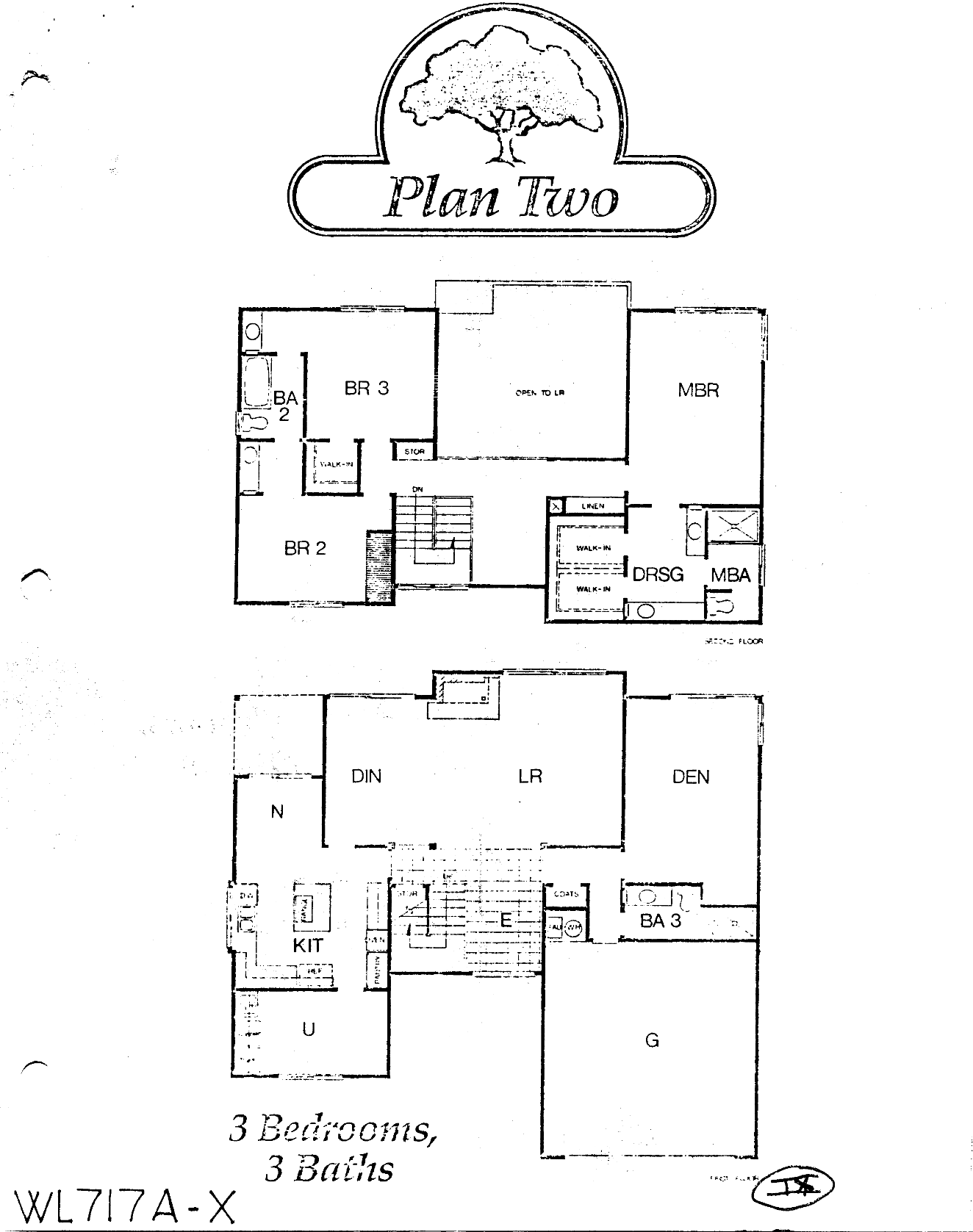
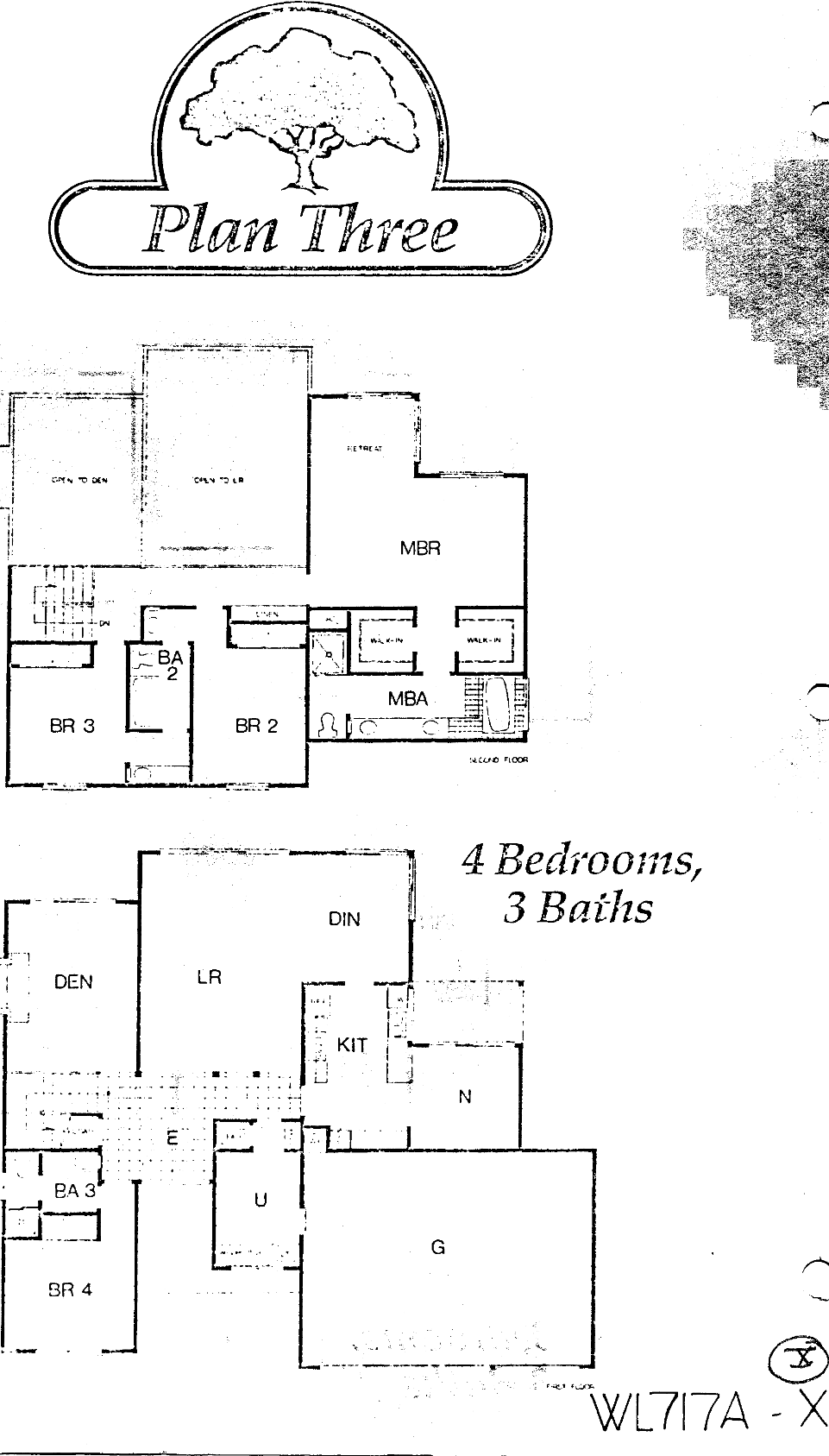
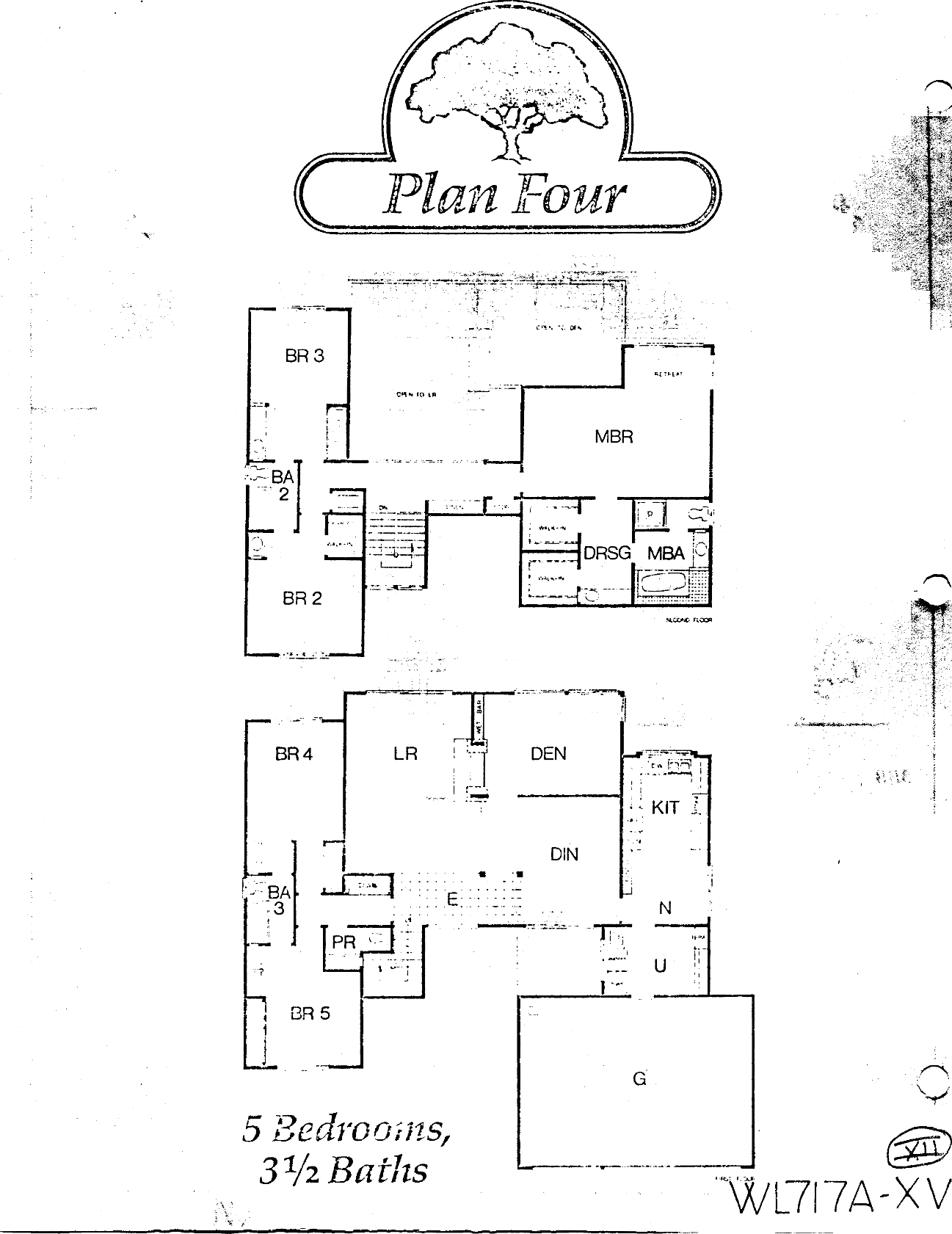
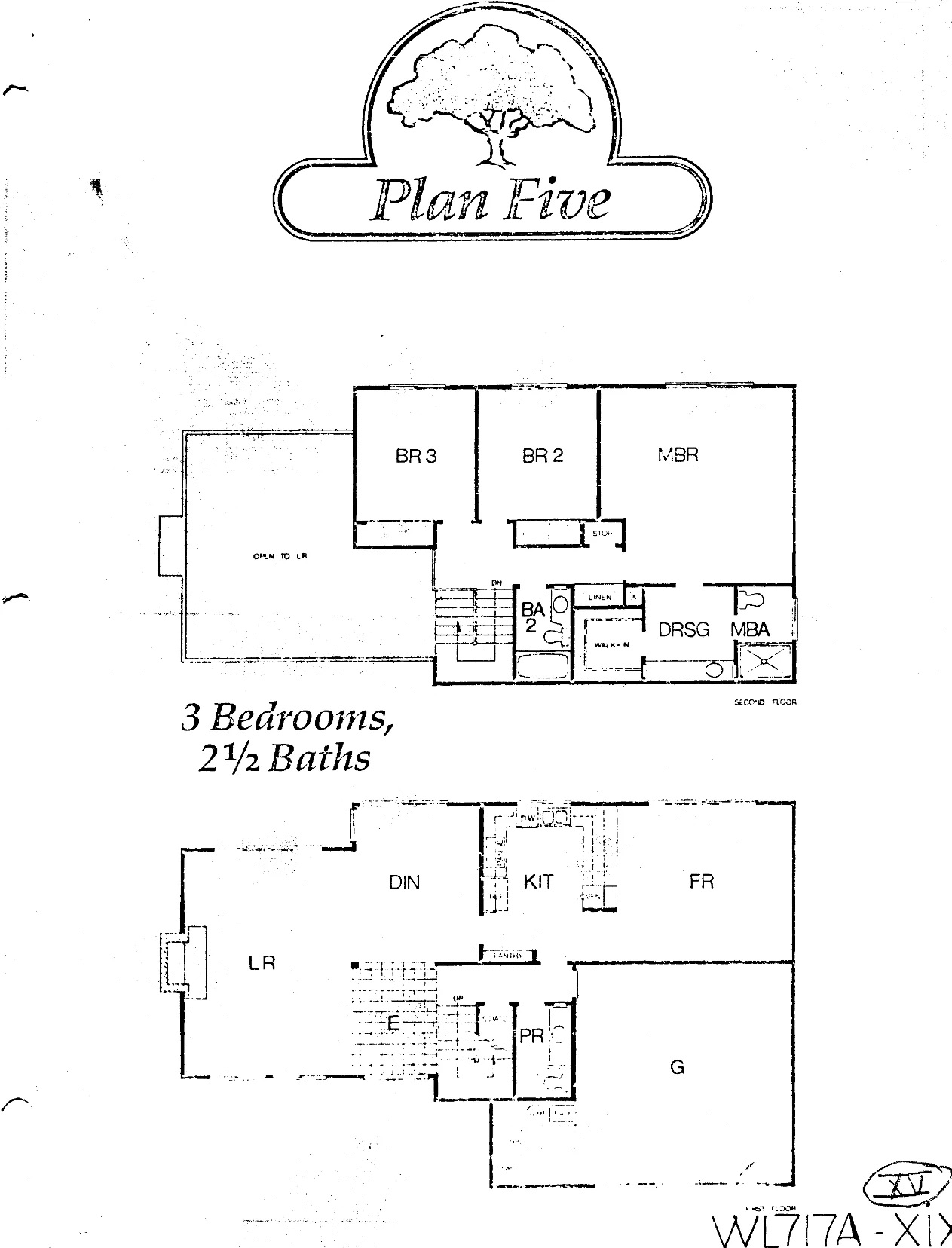
The name was honest advertising. The upper side of Valecroft Avenue sits on a ridge, and the plan sheets on file with the Conejo Simi Moorpark Association of Realtors, labeled for tract 717 and printed with an oak-tree logo, show five two-story plans clearly designed for lots that fall away from the street: living rooms and family rooms across the back, primary suites upstairs with retreats, and in the larger plans a downstairs bedroom or two for guests and older children. Buyers in 1978 were paying for the view and for square footage that the earlier Westlake tracts did not offer at that price, and that is still the neighborhood’s pitch nearly fifty years later.
The political geography has not changed since. The Los Angeles County third of the master plan incorporated as the City of Westlake Village in December 1981, and because California does not let a city sit in two counties, the Ventura County side stayed in Thousand Oaks while keeping its Westlake Village mailing addresses. A Ridgeview Estates owner therefore pays Ventura County property taxes, pulls permits from the City of Thousand Oaks, sends children to Conejo Valley Unified schools and uses a Westlake Village 91361 address, and a few parcels on the hill carry Thousand Oaks addresses in county and listing records instead. Gary Jacobs works both sides of the county line and keeps the tract 717 plan sheets on file.
The original floor plans, with the drawings
The Conejo Simi Moorpark Association of Realtors plan archive holds five plan sheets for Ridgeview Estates, filed as tract 717 and labeled Plan One through Plan Five. All five are two-story. All five put the living room, dining room and kitchen downstairs with the primary suite and at least two secondary bedrooms upstairs, and the three larger plans add a den and one or two downstairs bedrooms with a full bath, which is why a Ridgeview Estates listing so often mentions a “main-level bedroom” for guests or a parent. The drawings give bedroom and bath counts but not square footage, so the sizes below are Gary’s reading of county records rather than the builder’s numbers, and buyers should treat them as approximate. Plan Five is the smallest, a three-bedroom with two and a half baths; Plan One is a three-bedroom with two and a half baths and a retreat off the primary suite; Plan Two is a three-bedroom, three-bath with a downstairs den and full bath that converts easily to a fourth bedroom and a two-story living room; Plan Three is a four-bedroom, three-bath with bedroom four and bath three down; and Plan Four, the largest, is a five-bedroom with three and a half baths and two bedrooms downstairs.
Drawings on file for the tract. Other plans, elevations and options may have been offered.
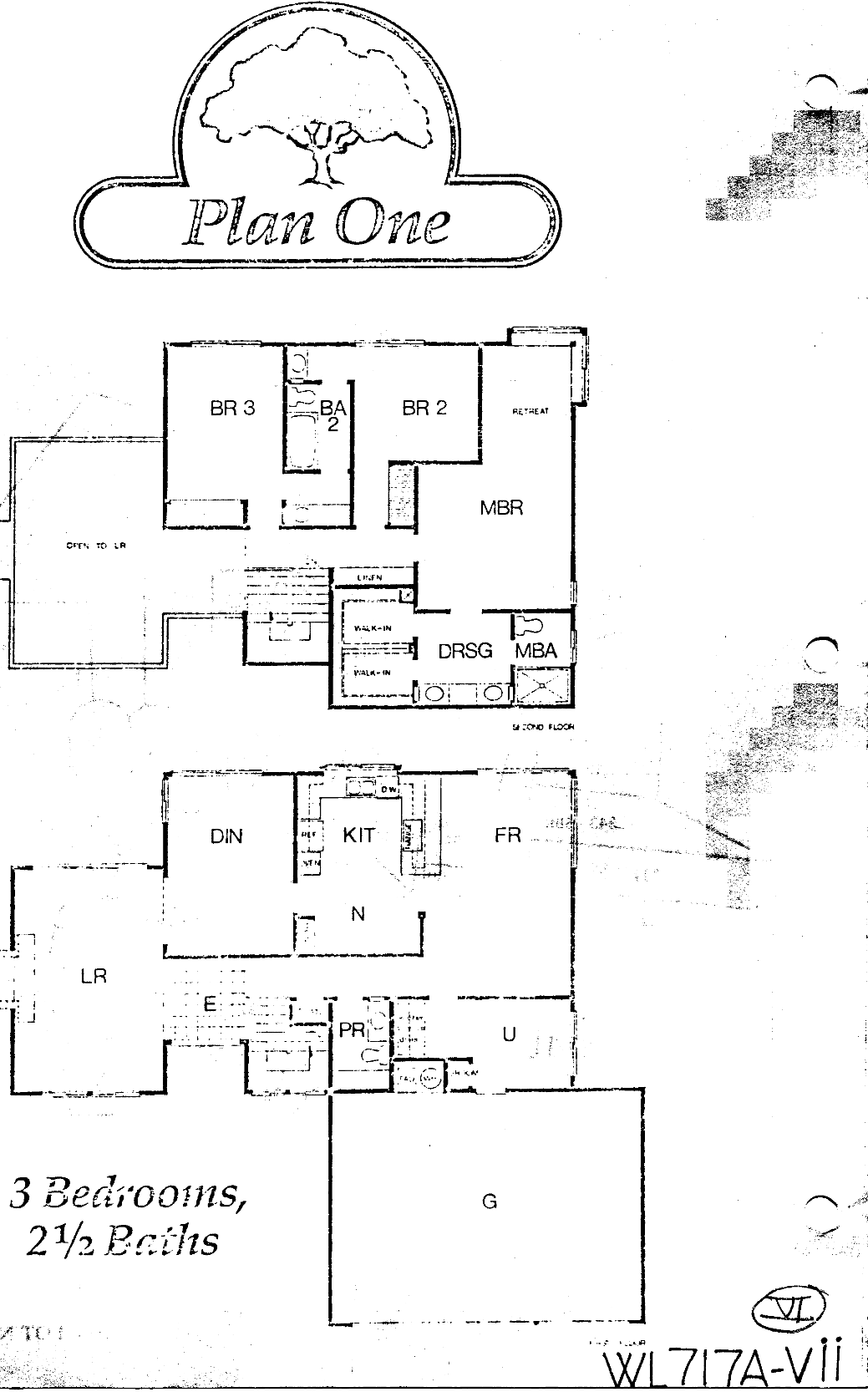


What the plans mean on the ground today: county records for the tract 717 homes cluster at 2,304 square feet for the three-bedroom plans, which turn up again and again on Valecroft Avenue with two and a half or three baths; around 2,600 to 2,760 square feet for the four-bedroom plans, listed as either three baths or two and a half; and 3,130 to 3,400 square feet for the five-bedroom plan on Shadowglen Court and the upper end of Valecroft. A number of homes measure well above those figures, for example a six-bedroom house at 1587 Valecroft Avenue recorded at 3,545 square feet and homes on the 1670 and 1680 blocks at 3,271 to 3,365 square feet, which points to additions over the years; one 2011 listing for a 2,762-square-foot house on the view side of Valecroft described it as “partially expanded” by about 299 square feet. Buyers should ask the City of Thousand Oaks for the permit history on any home that measures a few hundred feet over its plan, and should expect original-era systems in any house that has not been updated: 1978 homes in this area typically came with aluminum-frame single-pane windows, copper supply lines, tile or shake roofs, and 100- or 200-amp panels whose make a licensed inspector should check.
The streets, and how the tract is laid out
Ridgeview Estates is essentially one street and one court. Valecroft Avenue climbs the hillside west of Westlake Boulevard, and the homes that carry the “Ridgeview Estates-717” tag in listing and county records sit on its upper block, roughly the 1560s through the 1680s. Homes on the odd-numbered, upper side of the street back up to the ridge and take in the view; a 2011 listing put it plainly as the “VIEW side of street with views of mountains and hills, front and back.” Homes on the even-numbered side sit a little lower and tend to have the larger and flatter back yards, which is where several of the tract’s pools have gone in: 1588 Valecroft Avenue, for example, sits on about 17,000 square feet with a pool, and 1616 Valecroft Avenue on about 12,600 square feet with a pool, spa and gazebo. Shadowglen Court is a short cul-de-sac off the upper part of the street with the tract’s biggest plans and, at its head, two parcels that county records list at about an acre each.
The end of Valecroft Avenue is where the lots get unusual. Two homes in the 1670 and 1680 blocks sit on 0.32 and 0.57 acres, and a flag lot at the end of the cul-de-sac, reached behind its own electric gate, was marketed in 2015 for its “panoramic views.” Those oversized parcels are the closest thing Ridgeview Estates has to estate lots, and they are the ones to watch for buyers who want room for a detached studio or a second structure. Everywhere else the lots run about 8,300 to 13,000 square feet, which is roomier than Foxmoor or Village Homes below but with a slope built into most of them.
Because Valecroft Avenue serves only the homes along it and the small courts that hang off it, there is no through traffic to speak of. The trade-off is that every trip in or out uses the same climb from Westlake Boulevard, and the grade matters in a way it does not on the flat tracts: buyers should drive the street in the rain and after dark, and should look at how the driveway meets the street on any house they are serious about, since a steep or curved driveway is a daily fact of life here.
Ridgeview Estates and Foxmoor Estates: two tracts on one hillside
The most useful thing a buyer can know about this hillside is that its four residential streets belong to two different tracts with two different associations, and that listings and neighborhood maps blur the line. Redfin, Movoto and MLS records tag the two-story 1978 homes on upper Valecroft Avenue and Shadowglen Court as “Ridgeview Estates-717,” with the Ridgeview Estates Property Owners Association named on the listing. The same sources tag the homes on Briarglen Avenue, Kerryglen Street, Thornhill Avenue and the lower 1400 and 1500 blocks of Valecroft Avenue as “Foxmoor Estates-732,” with a separate Foxmoor Estates association. The Foxmoor Estates homes are a different product: single-story houses of about 1,366 to 2,250 square feet built in 1975 through 1977, three to five bedrooms, on lots that are often just as large as the Ridgeview lots or larger. A 1,552-square-foot house at 1528 Valecroft Avenue, for instance, sits on about 20,000 square feet, and 1508 Thornhill Avenue, a 2,252-square-foot single-story that sold in September 2024 for $1,799,000, sits on about a third of an acre with mountain views.
The distinction matters for three reasons. First, the two tracts sell at different prices and for different buyers: the single-story Foxmoor Estates homes draw one-level buyers and downsizers and have closed between roughly $1,220,000 and $1,800,000 since 2024, while the two-story Ridgeview Estates homes draw families wanting four or five bedrooms and have closed between roughly $1,335,000 and $2,200,000 since 2023. Second, the associations, dues and architectural rules are separate, even though both sets of dues are nominal. Third, an appraiser or a buyer pulling comparable sales by street will mix the two unless someone tells them not to; a 1,600-square-foot single-story on Briarglen is not a comp for a 2,700-square-foot two-story on upper Valecroft, and vice versa. Gary Jacobs keeps the sales history for both tracts and can tell a buyer at a glance which side of the line an address falls on. Listings for both groups appear under “Foxmoor Estates” in some agents’ descriptions, so the title report and the MLS tract field, not the marketing copy, are what to rely on.
The views, the slopes and the lots
The defining feature of Ridgeview Estates is elevation. The tract sits high enough above the valley floor that the upper side of Valecroft Avenue looks south and east across the Conejo Valley toward the Santa Monica Mountains, and listing after listing leads with that view: a 2024 sale at 1615 Valecroft Avenue advertised “unobstructed views of the Santa Monica mountains from every room,” a 2023 sale at 1587 Valecroft Avenue described “breathtaking views of the Santa Monica Mountains,” and a 2020 sale on the 1650 block promised “views upon views from inside and outside.” Not every house has the same exposure. Homes on the lower side of the street, on Shadowglen Court and toward the bottom of the block have “partial” or “hillside” views in listing language, which is the polite way of saying they look at the slope or at the roofs across the street. The difference shows up directly in price: the 2,304-square-foot three-bedroom at 1615 Valecroft, with its full view and a complete remodel, closed at $2,164,000 in June 2024, while the same plan at 1667 Valecroft closed at $1,335,000 in May 2023 and at 1623 Valecroft, with “partial views,” at $903,500 in December 2019.

Elevation comes with slopes, and the slopes come with responsibilities. Most Ridgeview Estates lots have a graded pad for the house and the yard with a cut or fill slope behind or below it, and the tract was built before the modern era of engineered retaining walls and drainage systems. Buyers should look carefully at how water leaves the lot, at the condition of any retaining walls and the slope planting, and at whether patios or decks have been extended onto fill. A 2026 listing on Briarglen Avenue, on the Foxmoor Estates side, mentioned newly added sprinklers “for the front, side yards and slope,” which is a small reminder that slope maintenance is part of ownership here. The reward is privacy and light: with the ground falling away behind the house, upper-side homes have no neighbor looking into the back yard, and the afternoon light is unobstructed.
The lots also explain why so many Ridgeview Estates homes have three-car garages and long driveways. The plans were laid out for wide, deep pads, and county records put the typical lot between about 8,300 and 13,000 square feet with several at 17,000 square feet and more. That is enough room for a pool on most of the flatter lots, and pools appear in a large share of listings, but a buyer considering adding one should have the pad’s bearing and the setback from the slope checked before assuming it will fit.
Living in Ridgeview Estates
The HOA, rules and monthly costs
Ridgeview Estates has a property owners association, but it is about as light as an association can be. MLS listings for tract 717 homes name it as the Ridgeview Estates Property Owners Association, sometimes shortened to Ridgeview Property Owners Association or Ridgeview Property Association, and put the dues at $105 per year on closings from 2023 through 2026, roughly nine dollars a month. Older listings show $65 per year in 2014 through 2017 and $90 per year on 2020 and 2021 closings, so the assessment has crept upward but remains nominal. An earlier draft of this research had recorded the figure as $105 per month; the listing pages Gary reviewed make clear it is $105 per year. Buyers who have been told a higher number should ask for the association’s current budget in the escrow disclosures.
Dues at that level buy governance rather than amenities. There is no pool, clubhouse, tennis court, gate or greenbelt owned by the association, and listings do not describe any common facilities; the money covers insurance, a bookkeeper or contract manager, and the cost of maintaining the covenants, conditions and restrictions that keep the tract looking like a tract. The practical effect for an owner is architectural review: exterior changes such as second-story additions, room additions visible from the street, fence and wall changes and significant repainting are the kinds of projects such associations typically review, and a buyer planning a remodel should request the CC&Rs and any architectural guidelines during the contingency period. A 2026 listing for 1616 Valecroft Avenue names Diamond Association Management as the association contact; Gary was not able to verify a website or phone number for that firm, so buyers should get the current management contact from the seller’s HOA disclosure package rather than from a listing.
The single-story Foxmoor Estates homes on Briarglen, Kerryglen, Thornhill and lower Valecroft have their own association, listed on recent closings at roughly $45 to $60 per year, also with no amenities. Neither tract is gated. Neither is known to carry Mello-Roos or other special assessments, which is consistent with a 1970s tract on the Thousand Oaks side, but the preliminary title report and the county tax bill are the documents that settle the question for any given parcel, and buyers should read both.
Schools
Ridgeview Estates is on the Ventura County side of Westlake Village, which puts it in the Conejo Valley Unified School District rather than Las Virgenes Unified, the district that serves the Los Angeles County side of the community. Listing pages for recent sales on Valecroft Avenue, Thornhill Avenue and Briarglen Avenue all show the same three assignments: Westlake Elementary at 1571 East Potrero Road in Westlake Village, a transitional-kindergarten-through-fifth-grade campus named a California Distinguished School in 2023, which sits inside the Foxmoor tract at the bottom of the hill; Colina Middle School at 1500 East Hillcrest Drive in Thousand Oaks; and Westlake High School at 100 North Lakeview Canyon Road. Westlake Elementary is close enough that families on the lower part of the hill can walk down to it, though the return trip is a climb.
The district maintains an assigned-school lookup map on its website, and because attendance boundaries can be redrawn and because a handful of parcels on the hill carry Thousand Oaks rather than Westlake Village addresses, buyers who are choosing a house for a specific school should confirm the assignment for the exact parcel with Conejo Valley Unified before removing contingencies. The district also offers school-choice and intra-district transfer applications for families who prefer a different campus, subject to space. Private and parochial options in the Conejo Valley and Agoura Hills are within a fifteen- to twenty-minute drive.
Parks, trails and everyday life
The neighborhood park for this hillside is Triunfo Community Park at 980 Aranmoor Avenue, on the Village Homes side of Triunfo Canyon Road, a Conejo Recreation and Park District facility open daily from 7 a.m. to 10 p.m. The district lists a playground rebuilt in 2022 around a natural-play theme with a monarch-butterfly climber, a baseball field, a softball field and two soccer fields available for reservation, three lighted tennis courts and a lighted basketball court that are first-come, a volleyball court, two restrooms, ten picnic tables and 92 parking stalls, and describes the setting as “rolling hillsides, oak trees, and direct trail access.” The park’s irrigation was converted to reclaimed water in 2017. For a Ridgeview Estates family it is the everyday destination for youth sports, tennis and the playground, a short drive or a longer walk around the hill.
The trail access is the other half of the story. The Conejo Open Space Conservation Agency maintains more than 150 miles of trails across roughly 12,400 acres of protected land in and around Thousand Oaks, and the trails that leave from Triunfo Community Park connect into the open space south and west of the neighborhood. The City of Thousand Oaks as a whole has set aside more than 15,000 acres as permanent open space and protects its oak trees by ordinance, which is why the hills behind Ridgeview Estates are still hills. Russell Park at 3199 North Medicine Bow Court, a seven-acre park developed in 1972 beside Westlake Hills Elementary, and the greenbelt that runs through Foxmoor along Potrero Valley Creek are the other close-in green spaces.
Westlake Lake is below the hill to the east. Ridgeview Estates is not a lakefront tract and carries no lake privileges, but the public paths and restaurants at the lake’s commercial edge, the Westlake Village Golf Course and the shops along Westlake Boulevard are all within a few minutes. Everyday errands are equally close: the shopping centers at the north end of Westlake Boulevard near the 101 hold the neighborhood’s supermarkets, pharmacies and banks, and The Promenade at Westlake, on the Los Angeles County side, and The Oaks in Thousand Oaks cover the rest.
Getting around: freeways, errands and the daily drive
Every trip from Ridgeview Estates begins with the descent down Valecroft Avenue to Westlake Boulevard, which is also State Route 23 through this part of the valley. North on Westlake Boulevard reaches the Ventura Freeway, U.S. 101, at the Westlake Boulevard interchange in roughly five to ten minutes off-peak, with the Lindero Canyon Road interchange on the Los Angeles County side a few minutes further east by way of Agoura Road or Thousand Oaks Boulevard. Westbound 101 toward Thousand Oaks, Camarillo and Ventura is generally the easier direction; eastbound toward Calabasas, the San Fernando Valley and downtown Los Angeles is the commute that shapes life here, and the stretch through Agoura Hills and Calabasas backs up predictably on weekday mornings. Residents should budget an hour or more to the Westside or downtown in the morning peak and considerably less on weekends. There is no rail service in Westlake Village; the nearest Metrolink stations are on the Ventura County Line in Moorpark and Simi Valley and on the Chatsworth side, and commuter express bus service to downtown Los Angeles has operated from park-and-ride lots along the 101 corridor, which prospective commuters should check for current routes and schedules.
South on Westlake Boulevard the road passes the Foxmoor tract and Westlake Elementary, meets Potrero Road, and continues as Route 23 into the Santa Monica Mountains as Decker Canyon Road, a winding two-lane route that reaches Pacific Coast Highway west of Malibu in about half an hour. Kanan Road from Agoura Hills is the wider and more popular route to the Malibu beaches and Point Dume, and Mulholland Highway connects the two. For a Ridgeview Estates family the beach is a realistic weekend habit rather than an expedition.
Errands are close. The commercial centers at the north end of Westlake Boulevard and along Agoura Road and Thousand Oaks Boulevard near the freeway hold the neighborhood’s supermarkets, drugstores, banks and most of its restaurants. The Promenade at Westlake, on the Los Angeles County side near Lindero Canyon Road, and The Oaks in Thousand Oaks, off Hillcrest Drive, are the two larger shopping destinations, each about ten to fifteen minutes away. School traffic is local: Westlake Elementary drop-off runs along Potrero Road at the bottom of the hill, Colina Middle is on Hillcrest Drive in Thousand Oaks, and Westlake High is off Lakeview Canyon Road on the north side of the freeway, all within a ten-to-fifteen-minute drive, with the freeway crossing at Westlake Boulevard being the choke point on school mornings.
Ridgeview Estates home prices and the market
Prices and the market
The figures in this section were current when this guide was last reviewed. The sale record in the facts above and the listings below are drawn live from the MLS each time the page loads.
Ridgeview Estates does not turn over often. With only several dozen homes in tract 717, a typical year brings one to three closings, and the verified record from 2023 through 2026 is short enough to list. In May 2023 a 2,304-square-foot three-bedroom at 1667 Valecroft Avenue closed at $1,335,000. In August 2023 a six-bedroom, 3,545-square-foot house with a pool and spa at 1587 Valecroft Avenue closed at $1,895,000. In September 2023 a four-bedroom on Shadowglen Court, recorded at 3,130 square feet by the county and marketed at about 3,500, closed at $2,200,000, the highest price in the tract’s recorded history. In October 2023 a 2,705-square-foot four-bedroom at 1611 Valecroft Avenue, marketed as a “blank canvas,” listed at $1,299,900 and closed at $1,465,000, well over its asking price. In June 2024 a fully remodeled 2,304-square-foot three-bedroom with a full mountain view and a new pool at 1615 Valecroft Avenue listed at $1,899,999 and closed at $2,164,000, about $939 per square foot. And in August 2025 a 2,645-square-foot four-bedroom with a pool at 1616 Valecroft Avenue closed at $1,910,000, having sold for $1,610,000 in July 2022 and $1,117,500 in October 2019.
Those numbers put the tract’s recent range at roughly $535 to $940 per square foot, with condition and view explaining most of the spread. Original-condition homes with partial views have traded in the $1.3 million to $1.5 million range; remodeled homes with pools and the full view have traded from about $1.9 million to $2.2 million. The same 1616 Valecroft Avenue house came back on the market in May 2026 at $1,799,000 and was reduced in steps to $1,599,000 by August before going under contract in early September, a sign that the 2025 price was a high-water mark and that buyers in 2026 have been more careful. On the Foxmoor Estates side of the hill the single-story homes tell a similar story: 1508 Thornhill Avenue, a remodeled 2,252-square-foot single-story on a third of an acre, closed at its $1,799,000 list price in September 2024, while 1443 Briarglen Avenue, a 1,605-square-foot single-story that came on in April 2026 at $1,600,000, took four price cuts and 90 days to close at $1,220,000 in June 2026.
In the last two years, three homes in the mapped hillside area, both tracts included, sold through the MLS, at prices from $1,310,000 to $1,775,000 and a median of $1,725,000; the Ridgeview Estates homes alone sit at the upper end of that range. Looking further back, the tract’s appreciation has been steady rather than spectacular: a 2,304-square-foot plan that sold for $370,000 in 1993 and $985,000 in 2016 closed at $2,164,000 in 2024 after a full remodel, and a 3,141-square-foot house that sold for $1,050,000 in 2015 would likely trade near double that today. Property taxes reset at sale; the 2025 tax bill on the 1615 Valecroft Avenue sale was about $24,900 on an assessed value of $2,207,280.
Figures are drawn from public records and MLS closings and are rounded. They are a snapshot, not a valuation; contact Gary for a current read on any specific property.
Leasing in Ridgeview Estates
Rentals are rare in Ridgeview Estates, as they are in most owner-occupied 1970s tracts on this side of Westlake Village, but the tract does have one current example that sets the market. A two-story, four-bedroom, three-bath home of 2,645 square feet at 1580 Valecroft Avenue, with a remodeled kitchen, a downstairs bedroom and bath, mountain views from the primary suite and a waterfall fountain in the yard, was listed for lease in May 2026 at $7,500 per month and had been reduced to $6,200 per month by September 2026. Redfin’s automated rental estimate for the remodeled three-bedroom at 1615 Valecroft Avenue was about $6,550 per month. Together those suggest that a clean, updated Ridgeview Estates home should lease somewhere in the low-to-mid $6,000s per month, with a premium for a pool and a full view and a discount for original kitchens and baths.
The neighboring tracts confirm the range. In September 2026 comparable houses were being offered in Foxmoor at $5,200 per month for a 2,336-square-foot four-bedroom and $6,500 to $7,000 per month for the 2,510-square-foot five-bedroom plan; in Foxmoor Hills at $6,800 to $7,450 per month for 2,680- to 2,820-square-foot homes; and in Village Homes at $5,795 to $6,500 per month for 2,000- to 2,500-square-foot homes. Ridgeview Estates homes are larger than most of those and have the view, so an owner leasing a well-kept house here should expect to land at the upper end of that band, roughly $6,000 to $7,500 per month, and to find tenants among relocating families who want Conejo Valley Unified schools for a year or two before they buy.
Gary has not verified any association restriction on leasing in Ridgeview Estates, and associations with nominal dues rarely impose minimum lease terms, but an owner should read the CC&Rs before advertising a house, and a tenant should ask for a copy of any rules that apply to parking, trash cans and exterior appearance. Landlords should also plan for the practical realities of a hillside house: slope irrigation, drainage and retaining walls need attention that a tenant will not give them, and a lease should say who is responsible for what. Gary Jacobs has leased homes in Foxmoor Hills and Village Homes on the same hill and can price a Ridgeview Estates rental against current comparables.
What inspectors find in Ridgeview Estates homes
Ridgeview Estates homes are 1978 construction, which puts them just past the era of the worst wiring and panel problems and squarely in the era of original systems that are now approaching fifty years old. Common findings in homes of this age, each of which varies from house to house and must be confirmed by a licensed inspector, start with the roof: the tract was built with concrete or clay tile on many homes and wood shake on others, and while tile lasts, the underlayment beneath it does not, so an inspector will look for slipped tiles, failed flashing at the chimney and valleys, and evidence of past leaks in the attic. Homes that still have their original shake roofs, or a composition roof laid over old shake, are due for replacement, and a listing that advertises a “recently tuned” tile roof is describing exactly this maintenance.
Inside the walls, 1978 homes in Ventura County generally have copper supply lines rather than galvanized steel, but the copper is original and pinhole leaks and worn valves are common; the 2024 sale at 1615 Valecroft Avenue advertised “new PEX hot/cold plumbing throughout,” which tells a buyer what the alternative looks like. Drain lines are usually ABS plastic by this date, but cast iron does appear, and a sewer-line camera inspection is worth its cost on any hillside lot where the lateral runs downhill to the street. Electrical panels should be identified by brand; the Zinsco and Federal Pacific panels associated with earlier tracts are less common in 1978 construction but have been found in homes of this vintage, and any panel that has not been replaced deserves a close look. Aluminum branch wiring, an issue in some late-1960s and early-1970s homes, is not expected here but should be ruled out rather than assumed away.
The other recurring items are windows, HVAC and the lot. Original aluminum-frame single-pane sliders are still in place in some homes and are the first thing most buyers replace; dual-pane replacements appear in nearly every recent listing. Furnaces and air-conditioning condensers are typically on their second or third replacement, and a buyer should ask for the age and service record of each. Outside, the inspector’s attention should go to drainage across the pad and down the slope, to any retaining wall or planter wall showing lean or cracking, to decks and patios extended over fill, and to pool equipment age on homes with pools. Additions and expansions, which county records suggest exist in a number of Ridgeview Estates homes, should be matched against City of Thousand Oaks permit records. None of this is unusual for a 1978 hillside tract; it is simply the checklist for one.
Remodels that pay here
The sales record in Ridgeview Estates is unusually clear about what remodeling is worth. The two highest prices in the tract’s history, $2,200,000 on Shadowglen Court in September 2023 and $2,164,000 at 1615 Valecroft Avenue in June 2024, both went to homes that had been thoroughly updated, and the 1615 Valecroft sale is the textbook case: a 2,304-square-foot three-bedroom, the smallest plan on file for the tract, sold for $985,000 in 2016 and $1,365,000 in 2018 and then, after a remodel that included an opened floor plan with folding glass doors to the yard, a new island kitchen, wide-plank floors, PEX repiping, a new pool and spa and drought-tolerant landscaping, sold for $2,164,000 in 2024, $264,000 over its asking price. By contrast the 2,705-square-foot four-bedroom at 1611 Valecroft, marketed the previous autumn as a “blank canvas,” brought $1,465,000, which means the market was paying roughly $700,000 more for the smaller, finished house than for the larger, unfinished one.
The projects that show up in the winning listings are consistent. Opening the kitchen to the family room and the family room to the yard, which the original plans separate with walls and a standard slider, is the single most common change and the one buyers respond to first. Replacing windows and sliders with dual-pane units, converting the downstairs den or bonus room into a proper bedroom with a full bath for guests or parents, which Plans Two, Three and Four practically invite, and finishing the primary suite with dual walk-in closets, a separate soaking tub and a walk-in shower are next. On the view side of the street, anything that brings the view into the main rooms, from a bigger opening at the back of the living room to a deck off the primary suite, carries weight that it would not on a flat lot. Pools pay here in a way they do not in every neighborhood, because the lots are large enough and the climate suits them, but only where the pad has room without disturbing the slope.
Additions are a larger question. County records show a number of Ridgeview Estates homes expanded beyond their plans, and the large lots at the end of Valecroft Avenue and on Shadowglen Court have room for more. California law now requires cities to permit an accessory dwelling unit of at least 800 square feet on nearly any single-family lot, and allows a junior accessory dwelling unit of up to 500 square feet inside the existing house, with limits on what a homeowners association may prohibit; the City of Thousand Oaks administers those rules through its planning division, and any hillside lot will bring grading and drainage review into the conversation. An ADU on one of the tract’s quarter-acre-plus lots is realistic; on the steeper lots it may not be. Owners should get a preliminary read from the city and the association’s architectural committee before spending on drawings. Gary Jacobs can show which homes in the tract have been expanded and what they sold for.
Buying and selling in Ridgeview Estates
The case for Ridgeview Estates
The first reason people choose Ridgeview Estates is the view, and it is not a marketing view but a real one: the upper side of Valecroft Avenue looks across the Conejo Valley to the Santa Monica Mountains from the main rooms, the primary suite and the yard, and there are only a few neighborhoods on the Ventura County side of Westlake Village where a house built for families rather than for estates can say that. The second is size. At 2,300 to 3,400 square feet as built, with three-car garages and a downstairs bedroom in most plans, the homes are larger than the 1960s tracts below them and were designed for the way families live now, with a family room off the kitchen and room for a guest or a parent on the main level.
The third is the carrying cost. Dues of $105 per year, no Mello-Roos and Ventura County property taxes make Ridgeview Estates one of the least expensive Westlake Village addresses to hold once the purchase is done, and the absence of a pool and clubhouse is, for many buyers, a feature: nothing to fund, nothing to argue about at the annual meeting. The fourth is the lot. Quarter-acre and larger parcels, some at half an acre or more, give room for a pool, a garden and in some cases a second structure, and the slope gives privacy that a flat lot of the same size cannot. The fifth is the schools, with Westlake Elementary at the bottom of the hill and the Colina and Westlake High feeder pattern that has anchored family demand on this side of the community for decades. And the sixth is quiet. One street and one court, no through traffic, open space behind and the whole of Westlake Village a few minutes below.
What to weigh before you buy
The slope is the first thing to weigh. Every Ridgeview Estates lot has one, and a buyer takes on the drainage, the retaining walls, the slope planting and irrigation and, on some lots, a steep driveway. The homes were built before current hillside engineering standards, and a soils or geotechnical opinion is a reasonable expense on any lot where the yard has been extended, a pool sits close to the edge of the pad, or a wall is showing its age. The view is the second: not every house has it, the difference between a full view and a partial one is several hundred thousand dollars in the sales record, and a buyer should stand in the back yard and in the primary bedroom before deciding what a specific house is worth.
Age is the third. These are 1978 homes, and an unrenovated one will need windows, a kitchen, baths, possibly a roof and possibly a repipe, which in this market runs well into six figures before the cosmetic work starts; the sales record rewards finished houses and discounts unfinished ones by more than the cost of the work, which is a caution for buyers planning to do it themselves and an opportunity for buyers willing to. The fourth is the tract boundary. Ridgeview Estates and Foxmoor Estates share a hillside and a reputation, but they are different products at different prices with different associations, and a comparable sales analysis that mixes them will mislead in either direction. The fifth is scarcity: with only several dozen homes and one to three sales a year, a buyer who wants a specific plan on the view side of the street may wait a long time for it, and a seller who prices to the last sale rather than to the buyer pool may sit, as the 2026 relisting of 1616 Valecroft Avenue showed.
Finally, the county line. Ridgeview Estates has a Westlake Village address but is in the City of Thousand Oaks and Ventura County, which is an advantage for taxes and schools and a source of confusion for permits, police and utility accounts. Buyers moving from the Los Angeles County side should expect a different city hall, a different school district and a different sheriff’s station, and should not assume that a Westlake Village address means Westlake Village city services.
Who ends up buying here
The typical Ridgeview Estates buyer is a family with school-age children moving up from a smaller house in the Conejo Valley or relocating from the San Fernando Valley or the Westside for the schools, the space and the quiet, and who wants four or five bedrooms, a three-car garage and a yard without paying lakefront or gated-community prices. The downstairs bedroom in the larger plans draws multigenerational households, and several recent listings have described that room as suited to “guests or multi-generational living.” A second group is the view buyer: often a couple whose children are grown, who could afford more house but wants the mountains from the kitchen and is willing to trade a single-level plan for them. The single-story Foxmoor Estates homes on the streets below absorb most of the one-level demand on this hill, which leaves Ridgeview Estates to buyers who are comfortable with stairs.
A third group is the remodeler, whether a buyer intending to live in the house or a small investor, drawn by the gap in the sales record between finished and unfinished homes; the 2023 “blank canvas” sale on Valecroft Avenue was the kind of purchase that attracts them. And a fourth is the long-term owner, who is the reason the tract turns over so slowly: a number of Ridgeview Estates homes have been held for twenty, thirty and in a few cases nearly fifty years, and when they come to market they are often original inside and priced accordingly. Tenants, when a house does lease, are usually relocating families using a year in the tract to learn the Conejo Valley before buying.
How Ridgeview Estates compares with its neighbors
The nearest comparison is the one already made: the single-story Foxmoor Estates homes on Briarglen, Kerryglen, Thornhill and lower Valecroft, built 1975 to 1977, are smaller at about 1,366 to 2,250 square feet on lots as large or larger, with dues of $45 to $60 per year, and they have closed between roughly $1,220,000 and $1,800,000 since 2024. Ridgeview Estates homes are two-story, 2,300 to 3,500 square feet, and have closed between roughly $1,335,000 and $2,200,000 since 2023, so a buyer is paying for square footage and the view rather than for a different location, and a buyer who wants one level should look at the lower streets first.
Foxmoor, the 1968 and 1969 tract at the bottom of the hill between Westlake Boulevard and the lake, is the flat-land alternative: about 270 homes of roughly 1,880 to 2,570 square feet on 6,100- to 9,150-square-foot lots, with a creekside greenbelt, a clubhouse and pool, Westlake Elementary in the middle of the tract and quarterly dues of about $230 to $240. Its 35 sales since January 2024 ran from about $1,140,000 to $2,700,000 with a median near $1,550,000. Foxmoor offers the school within walking distance and a real association with amenities; Ridgeview Estates offers larger homes, larger lots, the view and a tenth of the dues. On a per-square-foot basis the two tracts trade in a similar band, with Ridgeview’s view homes at the top of it.
Foxmoor Hills, the 1969 to 1971 tract on the plateau above Foxmoor off Bridgegate Street, is the closest match in spirit: about 309 homes of roughly 2,260 to 3,090 square feet on 8,300- to 28,000-square-foot lots, with vaulted beamed ceilings, a greenbelt and dues of about $135 per year, and a median sale near $1,725,000 since January 2024 in a typical range of $1.3 million to $2.6 million. Foxmoor Hills is larger and offers more variety, including single-story plans and rebuilt estates; Ridgeview Estates is smaller, newer by a decade, and more uniform. Village Homes, the 622-home planned development along Triunfo Canyon Road north of the hill, built in phases from 1969 to 1978 with a clubhouse, pool, spa and tennis courts and dues of about $270 per quarter, offers a fuller amenity package on smaller lots, about 7,400 square feet at the median, with a median sale near $1,460,000; its 1976 to 1978 phase on Rim Crest, Silver Spring and the surrounding streets is the closest in age to Ridgeview Estates.
Further afield, Three Springs in the hills south of the lake and Southshore Hills above the lake’s south shore are the other Ventura County hillside neighborhoods with view lots, and Gary’s guides to each cover their plans, associations and sales. For the community as a whole, including the Los Angeles County side and the lakefront tracts, the Westlake Village guide is the place to start.
Gary’s track record in Ridgeview Estates
Gary Jacobs has not represented a sale inside Ridgeview Estates itself, which with only several dozen homes and a handful of sales a year is true of nearly every agent in the Conejo Valley. What he brings to the tract is the work on the hill around it and the records that go with it. In Foxmoor Hills he leased 1267 Willsbrook Court, a renovated 2,465-square-foot home with a pool, in June 2024 at $6,800 per month and again in August 2025 at $6,900 per month. In Village Homes he sold 2244 Silver Spring Drive, a 3,128-square-foot 1976 home with a pool and spa from the phase built in the same years as Ridgeview Estates, in January 2017 for $1,052,500, having leased it four times between 2008 and 2013, and he leased a 4,600-square-foot custom home at 1869 Tamarack Street in October 2022 at $9,000 per month. In Foxmoor he sold 1490 Cheswick Place, a 2,494-square-foot two-story with a pool, in January 2018 for $970,000.
For Ridgeview Estates specifically, Gary keeps the five tract 717 plan sheets, the county building and lot data for every parcel on Valecroft Avenue and Shadowglen Court, and the sales history for both Ridgeview Estates and the Foxmoor Estates streets below it, sorted so that a comparable sales analysis stays on the right side of the tract line. Buyers can ask him for the comps on any specific house, and sellers can ask for a plan-by-plan read on what remodeled and original homes have brought.
Buying or selling here: practical notes
Buyers: Confirm the tract first. Ask which association the house belongs to, Ridgeview Estates or Foxmoor Estates, and pull the MLS tract field and the title report rather than relying on the listing description, because the two tracts are priced and built differently. Stand in the back yard and the primary bedroom to judge the view for yourself; the sales record shows the difference between a full view and a partial one is worth several hundred thousand dollars. Budget for a sewer camera, a roof inspection and, on any lot with an extended yard or a pool near the slope, a geotechnical opinion. Ask the City of Thousand Oaks for the permit history if the square footage runs more than a few hundred feet over the plan. Read the CC&Rs for the architectural rules before assuming an addition or an ADU will be simple. And be patient: with one to three sales a year, the right house on the right side of the street may take a season or two to appear, and Gary can put a buyer in front of owners who are thinking about selling before a listing goes public.
Sellers: Price to the buyer pool, not to the last sale. The tract’s highs in 2023 and 2024 went to fully remodeled homes with full views, and the 2026 relisting of a pool home that had sold at $1,910,000 the year before, reduced from $1,799,000 to $1,599,000 before going under contract, is the lesson in what happens when a 2025 price meets a 2026 buyer. Present the view: open the window coverings, clear the back yard sightline and photograph at the right hour. Have the roof, the plumbing and the electrical panel documented before listing, because these are the questions every buyer’s inspector will ask, and a seller who has answers keeps the price. Gather the association documents, the permit history and the plan sheet for the house, all of which Gary can help assemble, and expect a buyer who is comparing the house against Foxmoor Hills and Village Homes as much as against the last Ridgeview Estates sale.
Questions buyers ask about Ridgeview Estates
How much does a house in Ridgeview Estates, Westlake Village cost in 2026?
In the last two years, three homes in the mapped hillside area sold through the MLS, at prices from $1,310,000 to $1,775,000 and a median of $1,725,000. Verified sales in the Ridgeview Estates tract from 2023 through 2025 ranged from $1,335,000 for an original-condition 2,304-square-foot three-bedroom to $2,200,000 for a remodeled four-bedroom on Shadowglen Court, with a fully renovated three-bedroom view home closing at $2,164,000 in June 2024 and a 2,645-square-foot pool home at $1,910,000 in August 2025. The same pool home was relisted in 2026 and reduced to $1,599,000 before going under contract, so 2026 pricing for a good four-bedroom sits around $1.6 million to $1.9 million, with fully remodeled view homes above $2 million. Original-condition homes with partial views trade in the $1.3 million to $1.5 million range.
What are the HOA dues in Ridgeview Estates and what do they cover?
The Ridgeview Estates Property Owners Association charges $105 per year on 2023 through 2026 listings, roughly nine dollars a month, up from $65 to $90 per year on older closings. The dues cover insurance, administration and enforcement of the CC&Rs; there is no pool, clubhouse, gate or greenbelt. A 2026 listing names Diamond Association Management as the contact, which buyers should confirm from the escrow disclosures. The single-story Foxmoor Estates homes on the streets below have a separate association at about $45 to $60 per year.
Which streets are in Ridgeview Estates and which are Foxmoor Estates?
MLS and county records tag the two-story 1978 homes on the upper block of Valecroft Avenue, roughly the 1560s through the 1680s, and on Shadowglen Court as “Ridgeview Estates-717.” The single-story 1975 to 1977 homes on Briarglen Avenue, Kerryglen Street, Thornhill Avenue and the lower 1400 and 1500 blocks of Valecroft Avenue are tagged “Foxmoor Estates-732” and belong to a separate association. Listing descriptions sometimes use the two names loosely, so the MLS tract field and the title report are the documents to rely on for any specific address.
Which schools do Ridgeview Estates homes go to?
Ridgeview Estates is on the Ventura County side of Westlake Village, in the Conejo Valley Unified School District. Listing assignments for recent sales on Valecroft Avenue show Westlake Elementary at 1571 East Potrero Road, a 2023 California Distinguished School at the bottom of the hill, Colina Middle School at 1500 East Hillcrest Drive in Thousand Oaks, and Westlake High School at 100 North Lakeview Canyon Road. Boundaries can change and a few parcels carry Thousand Oaks addresses, so families should confirm the assignment for a specific parcel with the district’s assigned-school lookup map before buying.
How big are the homes in Ridgeview Estates and what floor plans were built?
The tract was built in 1978 with five two-story plans, numbered One through Five, ranging from a three-bedroom with two and a half baths to a five-bedroom with three and a half baths and two bedrooms downstairs. County records put the three-bedroom plans at about 2,304 square feet, the four-bedroom plans at about 2,600 to 2,760 square feet and the five-bedroom plan at about 3,130 to 3,400 square feet, with expanded homes recorded up to about 3,545 square feet. Most homes have three-car garages, and the larger plans include a downstairs bedroom and full bath.
What should a buyer check in a 1978 Ridgeview Estates home?
Homes of this age and setting commonly show original tile or shake roofs with worn underlayment, original copper plumbing with pinhole leaks, aging electrical panels, single-pane aluminum windows where they have not been replaced, and furnaces and air conditioners on their second or third cycle. Because every lot is on a slope, drainage, retaining walls, slope irrigation and any patio or pool built near the edge of the pad deserve particular attention, and additions should be checked against City of Thousand Oaks permit records. Each house varies and a licensed inspector must confirm the condition of any specific property.
Can you rent a house in Ridgeview Estates, and what does it cost?
Rentals are uncommon but do appear. In 2026 a four-bedroom, 2,645-square-foot two-story at 1580 Valecroft Avenue was offered for lease at $7,500 per month in May and reduced to $6,200 per month by September, and automated rental estimates for remodeled homes in the tract run around $6,500 per month. Comparable houses in Foxmoor, Foxmoor Hills and Village Homes were leasing for about $5,200 to $7,450 per month at the same time, so a well-kept Ridgeview Estates home should lease in the $6,000 to $7,500 range depending on condition, view and pool.
How does Ridgeview Estates compare with Foxmoor Hills?
Both are hillside tracts on the Ventura County side of Westlake Village with low-dues associations and view lots. Foxmoor Hills is older, built 1969 to 1971, larger at about 309 homes, and more varied, with single-story and two-story plans of about 2,260 to 3,090 square feet, a greenbelt, dues near $135 per year and a median sale around $1,725,000 since January 2024. Ridgeview Estates is a 1978 tract of several dozen two-story homes of 2,300 to 3,500 square feet with dues of $105 per year, no amenities and recent sales from $1,335,000 to $2,200,000. Buyers wanting a single-level plan or a bigger choice of homes tend toward Foxmoor Hills; buyers wanting a newer, larger two-story with a valley view tend toward Ridgeview Estates.
Nearby Westlake Village neighborhoods
Thinking about Ridgeview Estates? Gary Jacobs has the original floor plans, the sales history for every street, and a current read on what is coming to market before it is public.
Talk with Gary Jacobs → | Back to the Westlake Village guide