Westlake Canyon Oaks
Westlake Village Neighborhood Guide
Westlake Canyon Oaks
1978–1981 · about 230 homes on the canyon slope north of the 101
5840 Cardoza Drive, sold by Gary Jacobs
Westlake Canyon Oaks is the hillside tract of about 230 single-family homes on the east side of Lindero Canyon Road in the City of Westlake Village, on the Los Angeles County side of the county line, built in three county-approved phases between 1978 and 1981. Buyers come for a combination that is hard to find elsewhere in Westlake Village: a Las Virgenes Unified address, single-story and two-story homes of 1,300 to 2,300 square feet on lots that average about an eighth to a quarter of an acre, an association that costs $40 a month, and prices that in 2026 have run from about $1.0 million to $1.35 million. This guide covers how Canyon Oaks came to be, the four original mission-named floor plans, the eleven streets and the three tract maps behind them, the hillside and the views, the Westlake Canyon Oaks Association, the schools, the parks, prices and rents, what inspectors find in homes of this age, the remodels that have paid, and how the neighborhood compares with Westlake Hills, Village Homes and the other tracts around it.
Highlighted area is the approximate footprint of the Westlake Canyon Oaks tract, drawn from the parcels in county records. Labels mark the other Westlake Village neighborhoods; click one to open its guide.
Not gatedWestlake Canyon Oaks is not a gated community.
Guard-gated communities in Westlake Village: Country Club EstatesSherwood Country ClubSycamore CanyonTrentwoodWestlake Island
Gated communities nearby: RenaissanceThe ColonyBraemar TownhomesKensington ParkMeadow Oaks
Homes for sale and recently sold in Westlake Canyon Oaks
These lists are drawn to the outline of the Westlake Canyon Oaks tract on the map above, so they hold Westlake Canyon Oaks homes and nothing from the tracts next door. They come from the CSMAR multiple listing service and update as agents post them.
For sale in Westlake Canyon Oaks right now
Active listings inside the tract.
Loading…
In escrow in Westlake Canyon Oaks
Under contract but not yet closed — the closest read on what buyers are paying today.
Loading…
Sold in Westlake Canyon Oaks in the last two years
Closed sales inside the tract, newest first.
Loading…
Where Westlake Canyon Oaks is
How Westlake Canyon Oaks came to be
Westlake Canyon Oaks sits on ground that was still cattle range when Daniel K. Ludwig’s American-Hawaiian Steamship Company bought the 12,000-acre Albertson Ranch in 1963 for $32 million. Ludwig brought in the Prudential Insurance Company as a partner and hired the Los Angeles architecture and planning firm A.C. Martin and Associates to draw a master plan for a “city in the country,” with a man-made lake at the center, commercial districts, interconnected greenbelts and residential neighborhoods each organized around open space and, where possible, a school. The ranch straddled the Los Angeles–Ventura county line, and the two halves went different ways: the 8,544 acres in Ventura County were annexed into the City of Thousand Oaks between 1968 and 1972, while the 3,456 acres in Los Angeles County stayed unincorporated until residents voted to form the City of Westlake Village in 1981. Canyon Oaks belongs to the Los Angeles County half, which is why it is legally in Westlake Village, is served by the City of Westlake Village and Los Angeles County agencies, and sends its children to Las Virgenes Unified rather than Conejo Valley Unified.
The tract was one of the last neighborhoods approved under Los Angeles County rather than by the new city. The county recorded three tract maps for it, each as a planned unit development: tract 33522 in 1978, with 76 lots on Logwood Road, Janlor Drive, Oakrim Drive and Whim Court; tract 33523 in 1979, with 79 lots on Overfall Drive, Catarina Court and Cardoza Drive; and tract 32994 in 1980 and 1981, with 75 lots on Hedgewall Drive, Landino Drive, Kerrmoor Court and Mingus Court. The planned-unit-development designation matters because it is what allowed the builder to cluster the houses on the buildable benches of the hillside and hold the steeper ground and the drainage courses as common open space, with a homeowners association to own and maintain it. That is the origin of the Westlake Canyon Oaks Association and the greenbelt and playground that the dues have paid for ever since.
The Conejo Simi Moorpark Association of Realtors plan archive files the tract as number 744 with four plans named for California missions: San Miguel, San Jose, San Fernando and San Francisco. The archive does not record the merchant builder, and Gary does not guess at one. What the plans do reveal is the buyer the builder had in mind at the end of the 1970s: a family that wanted a house in the Westlake Village master plan and the Las Virgenes schools, but at a price well under the lakefront tracts and the larger homes then going up in North Ranch. The answer was a compact, efficient set of three- and four-bedroom plans between roughly 1,300 and 1,900 square feet, two of them single-story, on hillside lots large enough for a pool, with mountain views thrown in by the topography rather than by design.
Prices have followed the arc of the whole Conejo Valley. A two-story home on Hedgewall Drive that sold for $623,500 in July 2011 sold again in June 2026 for $1,230,000. Gary sold a 1,305-square-foot single story on Oakrim Drive for $633,500 in March 2016; an identical-sized single story on Catarina sold in June 2026 for $1,210,000. The houses have not changed size. What changed is that a Las Virgenes Unified single story on a quarter-acre hillside lot within five minutes of the 101 became one of the scarcest things in the market.
The original floor plans, with the drawings
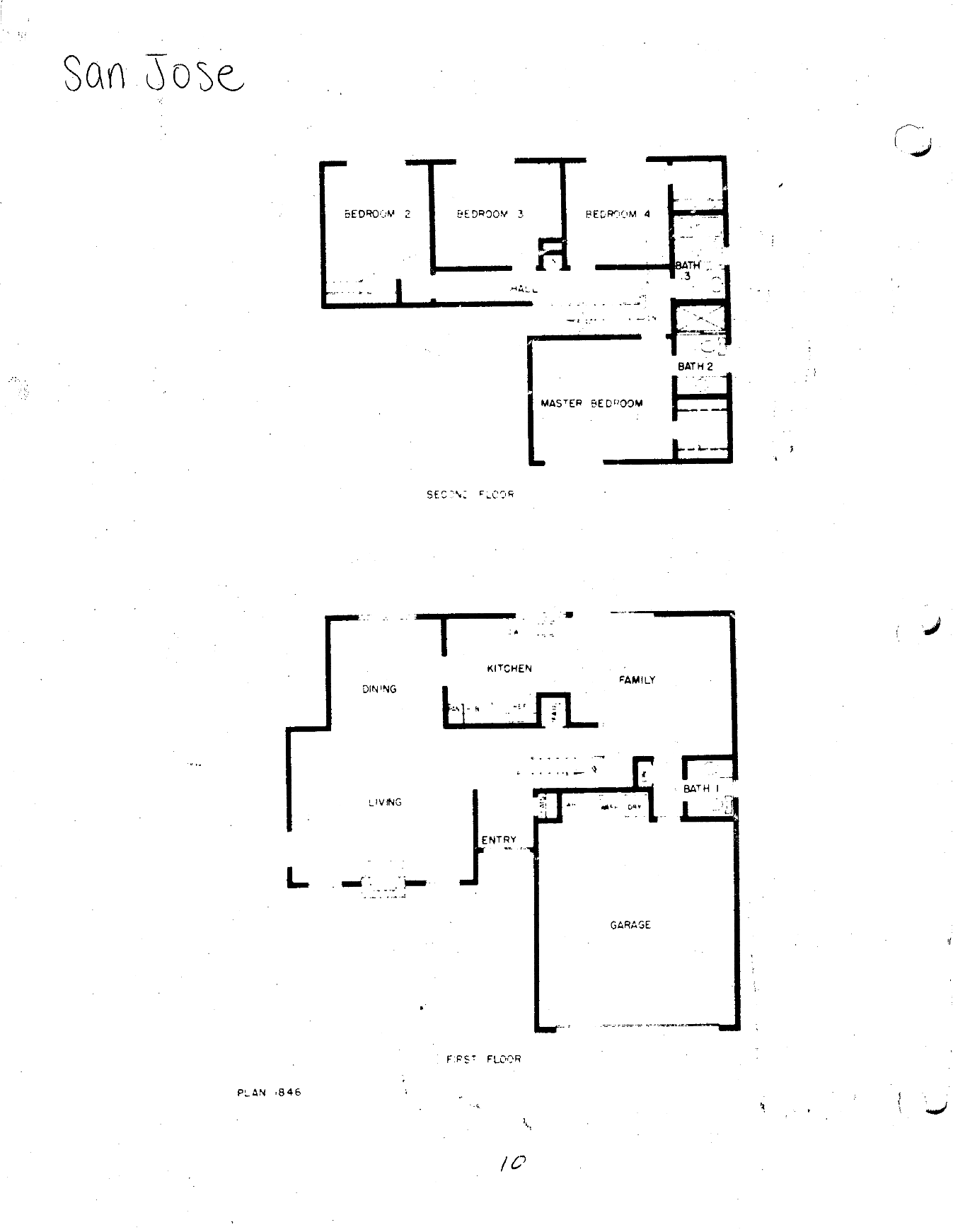
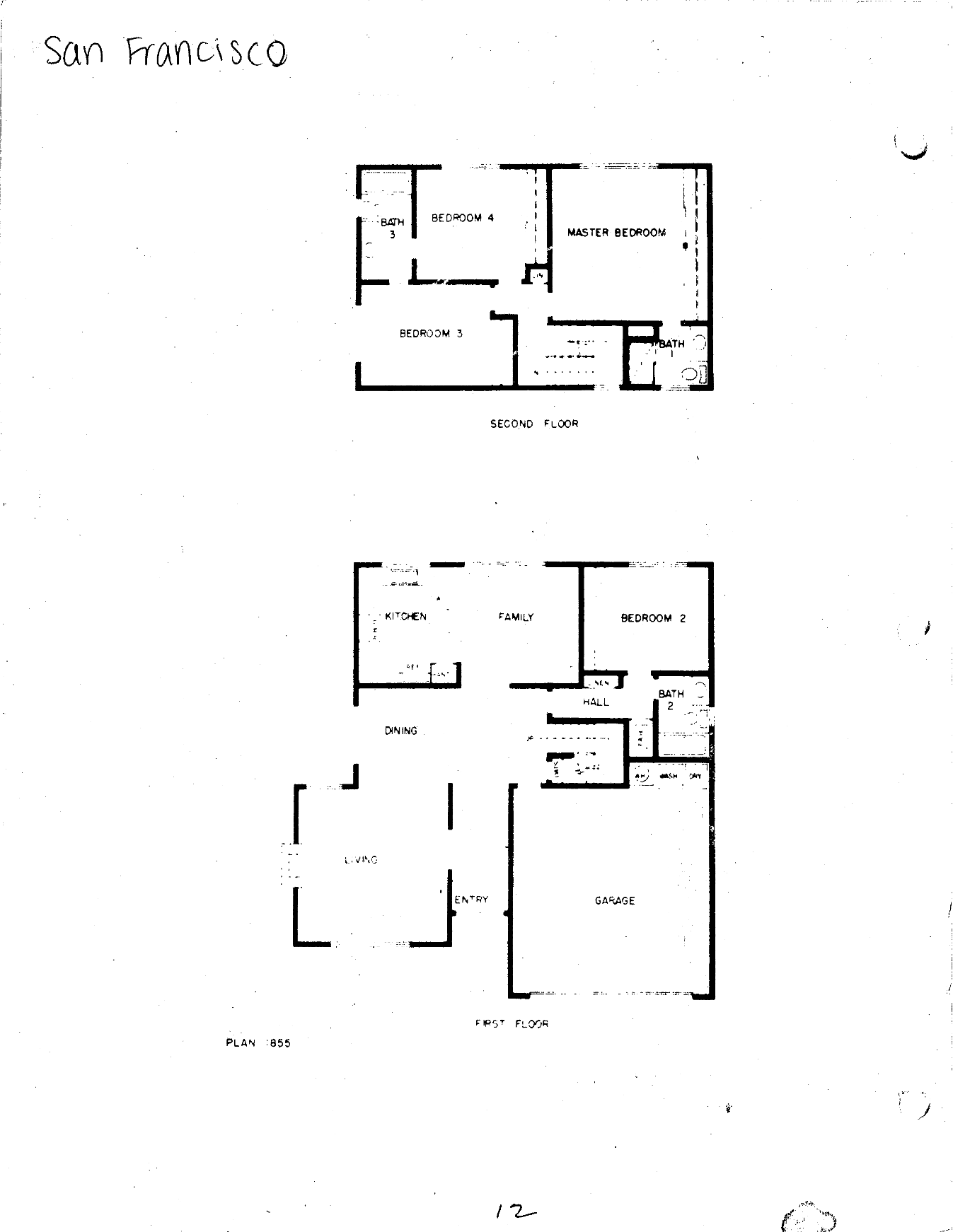
The plan archive for tract 744 holds four drawings, each carrying a plan number that appears to be the original square footage: the San Miguel, Plan 1342; the San Jose, Plan 1646; the San Fernando, Plan 1708; and the San Francisco, Plan 1855. Two are single-story and two are two-story, and all four share the late-1970s formula of a formal living room and dining room near the entry, a kitchen open to a family room across the back, a master bedroom with a dressing area, and a two-car garage on the street. The numbers do not match county records exactly, which is normal for tracts of this age: the county carries the smallest homes at 1,305 square feet and the common two-story at 1,837, so a buyer should treat the plan number as the builder’s marketing figure and the county figure as the one that appraisers will use.
Drawings on file for the tract. Other plans, elevations and options may have been offered.
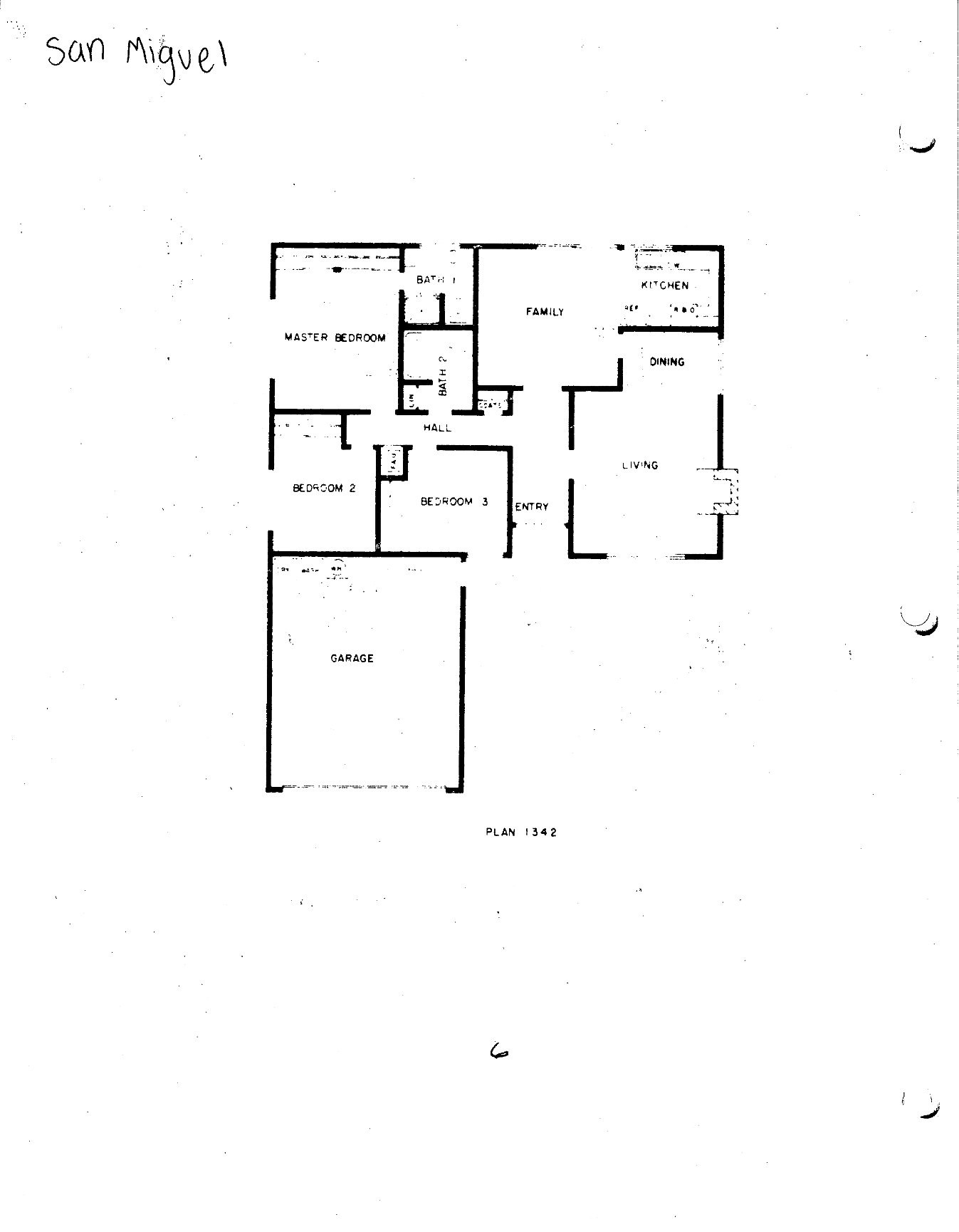


The San Miguel is the single-story three-bedroom, two-bath plan, with a living room, dining room, family room, kitchen and a two-car garage; county records show it at about 1,305 square feet, and it is the plan Gary sold twice, at 30820 Oakrim Drive in March 2016 and 5840 Cardoza Drive in October 2016. The San Jose is the smaller two-story, with the living room, dining room, kitchen, family room and a bath downstairs and the master and bedrooms two, three and four upstairs. The San Fernando is the larger single story, four bedrooms and two baths, with what the brochure calls a “ranch kitchen,” a dining room, a living room and a master with a dressing area; county records put it at about 1,673 square feet, which matches the house Gary leased at 30815 Oakrim Drive in 2014 and the July 2026 sale at 5835 Cardoza Drive. The San Francisco is the larger two-story: living, dining, kitchen, family room, bedroom two and bath two downstairs, and the master, bedrooms three and four and bath three upstairs. County records show the common two-story at about 1,837 square feet, the size of 5884 Logwood Road, which Gary sold in August 2022, and of the June 2026 sale at 30830 Overfall Drive, with a larger variant of about 1,925 square feet on the 1980–81 streets.

On the ground, the plans have held their shape better than in many 1970s tracts, because the hillside lots leave less room to sprawl and the association reviews exterior changes. County records show a median of about 1,840 square feet and a top end near 3,430, and everything above about 2,300 square feet is an addition: a family-room push-out into the rear yard, a bedroom over the garage on the two-story plans, or a full second story on a San Miguel or San Fernando. The more common changes are interior. The 2026 sale on Catarina advertised “widened openings to kitchen and living room” on a San Miguel, which is the single most common remodel in the tract, and the Hedgewall and Kerrmoor listings of 2026 both advertised fully remodeled kitchens and new heating and air. A buyer should compare the seller’s stated square footage against the county figure, pull the City of Westlake Village permit history for any addition, and ask the association whether its architectural committee approved the exterior work. Gary keeps the four drawings on file and can usually tell a buyer which plan a house started as before the tour.
The streets, and how the tract is laid out
Canyon Oaks is entered from Lindero Canyon Road, and once inside it there is no through traffic; every street either loops back or ends in a court. The layout follows the three tract maps, which were built in order up the hill. The first phase, tract 33522 of 1978, is the lowest and closest to Lindero Canyon: Logwood Road, Janlor Drive, Oakrim Drive and Whim Court, 76 lots in all. Three of Gary’s four transactions in the neighborhood are on these streets, at 5884 Logwood Road, 30820 Oakrim Drive and 30815 Oakrim Drive, and they show the range of the first phase, from a 1,305-square-foot single story to an 1,839-square-foot two-story on lots of roughly 7,000 to 9,000 square feet.

The second phase, tract 33523 of 1979, added 79 lots on Overfall Drive, Catarina Court and Cardoza Drive. Cardoza carries the largest lots in the tract; the July 2026 sale at 5835 Cardoza Drive sits on 12,821 square feet, and Gary’s 2016 sale at 5840 Cardoza had a backyard deep enough for a pergola, a spa and an open view to the mountains. Overfall Drive has the two-story homes with the best of the eastern views, and the June 2026 sale at 30830 Overfall advertised a pool, a spa and a view of Ladyface Mountain across the Agoura Hills. Catarina is the short court between them, and listings sometimes print it as Catarina Drive rather than Catarina Court; the county tract map uses Court.
The third phase, tract 32994 of 1980 and 1981, is the highest ground: Hedgewall Drive, Landino Drive, Kerrmoor Court and Mingus Court, 75 lots. These are the last homes built and the ones most likely to carry the larger 1,925-square-foot two-story variant, as the June 2026 sale at 6058 Hedgewall Drive did. Listings for Kerrmoor print it as both Kerrmoor Court and Kerrmoor Drive, and the active 2026 listing at 6046 Kerrmoor uses Drive. House numbers run in the 5800s and 6000s on Logwood, Cardoza, Hedgewall and Kerrmoor and in the 30800s on Oakrim, Overfall and Catarina, which reflects the county grid rather than anything about the streets themselves.
Two quirks of the address deserve a note. First, ZIP code 91362 is shared between the City of Westlake Village and the Thousand Oaks side of the line, so listing portals and even some county records print Canyon Oaks addresses as “Thousand Oaks, CA 91362.” Every home in the tract is inside the City of Westlake Village. Second, the tract is a planned unit development, so the association owns common lots between and behind the houses; a buyer should read the recorded tract map to see exactly where a lot ends and the greenbelt begins, because a fence line and a lot line are not always the same thing on a hillside.
The hillside, the greenbelt and the views
The defining physical fact of Westlake Canyon Oaks is that it climbs. The tract occupies the west-facing slope east of Lindero Canyon Road, and the three phases were built one above the other, so that the 1978 streets sit near the road and the 1980–81 streets sit near the top. The builder benched the hillside into pads, which is why the lots are irregular in shape and why the county records show them ranging from about 6,600 to more than 12,000 square feet with a median near 8,200: a pad on the inside of a curve is smaller and flatter, and a pad on the outside of a curve or at the end of a court picks up a wedge of slope that is counted in the lot but not always usable.

The payoff for the slope is the view. Homes on the upper streets and on the outer edges of the loops look east and north across the Lindero Canyon corridor toward Ladyface Mountain and the ridges above Agoura Hills, and two-story homes get the view from the upstairs bedrooms even where the yard does not. The 2026 sales bear this out: the Overfall Drive two-story with a pool and a “mountain view of Ladyface” closed at $1,325,000, the highest price of the year, while the Cardoza single story on the largest lot but with a hillside view closed at $1,005,000. Gary’s 2016 listing at 5840 Cardoza was photographed from the backyard precisely because the pergola and spa sat under an open sky with the mountains beyond.
The greenbelt is the other half of the planned-unit-development bargain. The association’s common lots run between and behind the streets and include a small park and playground for the tract; earlier research described the dues as covering that greenbelt, park and playground, and buyers should ask the association for its map of common areas. On a hillside, common open space also does a practical job: it is where the drainage courses and the steeper slopes were left ungraded, so the association rather than the individual owner is responsible for maintaining them. That is a benefit when it works and a shared expense when it does not, which is why a buyer should read the association’s reserve study and its recent minutes for any discussion of slope repair, drainage or retaining walls before removing contingencies.
Living in Westlake Canyon Oaks
The HOA, rules and monthly costs
The association is the Westlake Canyon Oaks Association, and every 2026 listing in the tract names it. The dues printed on the four homes that closed in June and July 2026, on Hedgewall, Catarina, Overfall and Cardoza, were $120 per quarter, which the listings also express as $40 a month; the active listing on Kerrmoor Drive prints $45 a month, which may reflect a recent increase or a rounding on the agent’s part. Earlier research had put the dues at about $84 per quarter, which appears to be an older figure. Either way, the association is one of the least expensive in Westlake Village, in the same low tier as the Westlake Hills Property Owners Association across Lindero Canyon and far below the several hundred dollars a month charged by the lake and gated associations.
What the dues buy is the common area of the planned unit development: the greenbelt lots, a small park and playground, and the association’s slope and drainage responsibilities, together with the usual insurance, reserves and administration. There is no pool, clubhouse, tennis court or gate, and the streets are public and maintained by the City of Westlake Village. One June 2026 listing named GM Management as the association’s manager; Gary could not verify a management-company phone number for this guide, and a buyer or seller should request the current management contact through escrow or from the seller’s disclosure package.
Like most Westlake Village associations, Westlake Canyon Oaks has recorded covenants, conditions and restrictions and an architectural review process for exterior changes, which in a hillside tract typically covers paint colors, roof materials, fences, room additions and anything that changes drainage. The tract predates the Mello-Roos era, and Gary is not aware of any Mello-Roos or special assessment district on the property tax bills, but a buyer should confirm on the preliminary title report and the county tax bill. Rental rules, if any, should be checked directly in the current CC&Rs; nothing in the 2026 listings suggested a rental cap.
Schools
Because Canyon Oaks is on the Los Angeles County side of Westlake Village, it is in the Las Virgenes Unified School District, and every 2026 listing in the tract printed the same three assignments: White Oak Elementary in Westlake Village, Lindero Canyon Middle School in Agoura Hills and Agoura High School. The district’s own account, and the Wikipedia entry for the city, describe the same feeder pattern for the incorporated city. Las Virgenes Unified maintains an online school locator at images.lvusd.org, and a buyer should run the specific address through it and confirm with the district office in Calabasas before relying on any assignment, because boundaries can change and open-enrollment rules vary from year to year.
The school question is the single biggest reason a buyer chooses Canyon Oaks over the tracts on the other side of Lindero Canyon Road. Westlake Hills, Village Homes and Foxmoor Hills are in the City of Thousand Oaks and in the Conejo Valley Unified district, with Westlake Hills or Westlake Elementary, Colina Middle and Westlake High. The two districts are both well regarded, and families move in both directions across the line, but a family that specifically wants Las Virgenes Unified at a price under the lake and North Ranch neighborhoods will find that Canyon Oaks, First Neighborhood and the Three Springs area are the places to look. Private and parochial options in the Conejo Valley and Agoura Hills are within a short drive.
Parks, trails and everyday life
The neighborhood has its own small park and playground on association land, which is what the dues chiefly pay for, and a City of Westlake Village park generally known as Canyon Oaks Park lies at the edge of the tract near Hedgewall Drive and Lindero Canyon Road; the city’s parks page was not available for this guide, and buyers should confirm the park’s name and amenities on the city’s site or by walking it. The larger everyday park is Russell Park, directly across Lindero Canyon Road in Westlake Hills at 3199 N. Medicine Bow Court: seven acres run by the Conejo Recreation and Park District, open daily from 7 a.m. to 10 p.m., with a fully accessible playground, a half-mile walking path around the lawn, a volleyball court, a baseball backstop, five picnic tables and a shade structure. It is close enough that Canyon Oaks families use it as their own.
The hillside setting also puts the Santa Monica Mountains and the Simi Hills within a few minutes’ drive. The trailheads off Kanan Road and Westlake Boulevard, the open space above North Ranch and the Lake Lindero area of Agoura Hills to the east are all short trips, and Lindero Canyon Road itself has a wide shoulder that cyclists use to climb toward the Agoura Hills ridge. Within the tract, the loops and courts are quiet enough for evening walks and children on bicycles, and the absence of through traffic is one of the things residents mention most.
For errands, Canyon Oaks sits between two commercial districts. Thousand Oaks Boulevard and Lindero Canyon Road at the bottom of the hill carry neighborhood shopping, restaurants, the medical and professional offices of the Westlake Village business district and the Westlake Village Civic Center, and Kanan Road in Agoura Hills to the east carries another set of grocery and everyday stores. The Promenade at Westlake and The Landing on the Ventura County side are a few minutes down the 101 to the west, and The Oaks mall in Thousand Oaks is ten to fifteen minutes off-peak. Malibu’s beaches are reached by Kanan Dume Road or Westlake Boulevard to Decker Canyon in roughly thirty to forty minutes, depending on the day.
Getting around: freeways, errands and the daily drive
Canyon Oaks is one of the best-placed neighborhoods in Westlake Village for the freeway. Lindero Canyon Road runs down the hill from the tract entrance to the U.S. 101 interchange in roughly two to four minutes, and the interchange has full on- and off-ramps in both directions. Eastbound toward Calabasas and the San Fernando Valley, the commute from the on-ramp to the 405 runs about 30 minutes off-peak and considerably longer in the morning rush; westbound toward Thousand Oaks, Camarillo and Ventura, the 101 is generally lighter. Lindero Canyon itself is a four-lane arterial with a wide bike shoulder, and it carries school traffic in the morning, since it serves Westlake Hills Elementary, Lindero Canyon Middle School in Agoura Hills and the schools south of the freeway, so residents who leave between about 7:30 and 8:15 a.m. plan for it.
The alternatives to the freeway are the surface roads the master plan laid out. Thousand Oaks Boulevard runs west along the north side of the 101 through the Westlake Village business district to Westlake Boulevard and on into Thousand Oaks, and east into Agoura Hills where it becomes Agoura Road, so a resident can reach The Promenade at Westlake, the Civic Center, the medical offices along Lindero Canyon and Townsgate Road and the shopping on Kanan Road in Agoura Hills without touching the freeway. Kanan Road also leads south over the mountains to Malibu, about 12 miles from the 101 to Pacific Coast Highway, and Westlake Boulevard to Decker Canyon is the western route to the same coast; either is a thirty-to-forty-minute drive in ordinary conditions.
Groceries and everyday errands are at the bottom of the hill and along Kanan Road, with the larger centers a few minutes farther: The Promenade at Westlake and The Landing on the Ventura County side to the west, and The Oaks mall in Thousand Oaks off the 101 at Hillcrest Drive, about ten to fifteen minutes off-peak. There is no rail service in Westlake Village; the nearest Metrolink stations on the Ventura County Line are Moorpark to the northwest and Chatsworth to the east, both a drive of twenty to thirty minutes, and Los Angeles County and Ventura County transit run limited bus service along the 101 corridor. Most Canyon Oaks households, like most in the Conejo Valley, drive.
Westlake Canyon Oaks home prices and the market
Leasing in Westlake Canyon Oaks
Canyon Oaks is overwhelmingly owner-occupied, and lease listings inside the tract are rare. As of early September 2026 there was no home for rent on any of the eleven streets on the major rental portals, and that is typical: in most years only a handful of homes lease, usually when an owner relocates for a few years rather than sells. Gary has handled two of those. In June 2014 he leased 30815 Oakrim Drive, a four-bedroom San Fernando plan of 1,673 square feet built in 1978, at $2,800 a month, and in May 2015 he leased 30820 Oakrim Drive, a three-bedroom single story of 1,305 square feet, at $2,850 a month before selling the same house the following March.
Those 2014 and 2015 figures are far below today’s market. Single-family houses of comparable size on the Westlake Village rental portals in September 2026 were asking roughly $4,900 for a four-bedroom two-story of 2,251 square feet in Westlake Hills across Lindero Canyon and $6,450 to $7,200 for four-bedroom homes of 1,737 to 1,895 square feet in the Foxmoor area on the Ventura County side. Adjusting for the Las Virgenes Unified address, the hillside setting and the size of the Canyon Oaks plans, Gary’s working estimate is that a well-kept single story here would lease in the range of about $4,500 to $5,500 a month and a two-story in the range of about $5,000 to $6,500, with a pool and a view at the top of that range; an owner should treat those as ranges to be tested against the market on the day, not as promises.
Two practical points for landlords and tenants. First, the association’s CC&Rs should be read for any rental restrictions before a lease is signed, and the tenant should receive the rules and architectural guidelines, because the association will hold the owner responsible for a tenant’s trash cans, vehicles and yard. Second, the homes are 45 years old, and a landlord who has not updated the heating and air, the water heater and the supply plumbing should expect the first year of a lease to surface them; the tenant, in turn, should ask when those systems were last replaced. The tract’s strengths as a rental, the schools, the quiet, the yard and the freeway access, are the same as its strengths as a purchase, which is why tenants here tend to stay and, in more than one case Gary has seen, to buy in the neighborhood later.
What inspectors find in Westlake Canyon Oaks homes
Every home in Canyon Oaks was built between 1978 and 1981, which puts it at the end of one era of tract construction and the beginning of another, and inspection reports in the tract tend to read alike. The following are common in homes of this era; each house varies, and a licensed inspector must confirm the condition of any specific property.
Roofs and exteriors. Many homes in the tract carry concrete tile roofs, as the July 2026 Cardoza listing advertised, and a good number are original. Tile itself lasts, but the underlayment beneath it has a life of roughly 30 to 40 years, and an inspector who finds cracked or slipped tiles and stained sheathing in the attic is usually describing underlayment that is due; a full relay on a house this size is a significant expense and a common negotiation item. The stucco and wood trim of the era are generally sound, but the fascia, eaves and window trim on the sun-facing west elevations often show dry rot. Original windows were single-pane aluminum sliders; many have been replaced with dual-pane vinyl, and a house that still has the originals will show it in the utility bills and the summer heat upstairs.
Plumbing and electrical. Homes of 1978 to 1981 in this area were generally plumbed with copper supply lines and ABS or cast-iron drains, and the inspector’s interest is in the water heater’s age and strapping, the condition of the angle stops and supply lines under sinks, the main shutoff and the pressure regulator, and, on a hillside, whether the sewer lateral has settled or been invaded by roots; a sewer camera inspection is worth its cost here. Electrical panels of this era can include Zinsco and Federal Pacific brands, both of which many inspectors and insurers flag for replacement, so a buyer should ask the make of the panel early. Aluminum branch wiring is less common in homes built after the mid-1970s but is worth ruling out. Original heating and air systems are past their life, and the 2026 listings on Hedgewall and Kerrmoor both advertised new systems for exactly that reason.
Slabs, slopes and drainage. The houses sit on slab foundations on benched hillside pads, and the inspector will look for the usual cosmetic cracking in slabs and stucco, for doors and windows out of square that can indicate differential movement, and above all for drainage: how the roof water and the rear-yard water get off the pad, whether area drains are clear, whether the slope behind the house is held by a retaining wall and whether that wall belongs to the owner or the association. A geotechnical review is not routine on a resale but is reasonable where an inspector notes movement or where a buyer intends to add a pool or a second story. Pools and spas in the tract are mostly 1980s and 1990s vintage; the equipment, plaster and coping are the things to have separately inspected.
Additions and permits. The county records show the tract’s largest homes at about 3,430 square feet, well above any original plan, and additions of the 1980s and 1990s were not always permitted. A buyer should compare the seller’s square footage against the county’s, request the City of Westlake Village permit history, and confirm with the association that its architectural committee approved any exterior change. Termite and wood-destroying-organism reports are standard in this market and usually find something in a 45-year-old house; the question is only whether it is a section one item the seller will clear.
Prices and the market
The figures in this section were current when this guide was last reviewed. The sale record in the facts above and the listings below are drawn live from the MLS each time the page loads.
In the two years through June 2026, 8 homes in Westlake Canyon Oaks sold through the MLS, at prices from $1,150,000 to $1,340,000 and a median of $1,244,908. The four closings of June and July 2026 mark the range clearly. At the top, 30830 Overfall Drive, a 1979 two-story of 1,837 square feet with a pool, a spa and a Ladyface Mountain view, sold on June 12, 2026 for $1,325,000, about $721 a square foot, after 57 days on the market at an asking price of $1,375,000. On June 30, 6058 Hedgewall Drive, a 1980 two-story of 1,925 square feet on a 9,235-square-foot corner lot with a remodeled kitchen and new heating and air, sold for $1,230,000, about $639 a square foot; it had come to market in February at $1,349,000 and had sold in July 2011 for $623,500.
The single stories tell the other half of the story. On June 26, 30806 Catarina, a 1980 San Miguel plan of 1,305 square feet with widened openings, hardwood floors, two remodeled baths and a three-car garage, sold for $1,210,000, about $927 a square foot, after only 23 days at an asking price of $1,199,000; the same house had sold in November 2023 for $1,005,000. And on July 31, 5835 Cardoza Drive, a 1979 San Fernando plan of 1,673 square feet on the tract’s largest lot of 12,821 square feet, with new vinyl-plank floors and paint but an older kitchen, a decomposed-granite yard and a tile roof, sold for $1,005,000, about $601 a square foot, after 38 days. The spread between $601 and $927 a square foot on two single stories that closed five weeks apart is the clearest lesson in the tract: buyers are paying for the finished condition of the house, and a small, fully updated home can out-earn a larger original one.
The active listing as of early September 2026 is 6046 Kerrmoor Drive, a 1980 two-story of 1,837 square feet on a 9,709-square-foot lot, advertised as a complete renovation with a new kitchen and new heating and air, listed July 30 at $1,244,999 and under contract by mid-August. That number, against the $1,325,000 Overfall sale of the same plan with a pool and the $1,200,000 Gary obtained for the same plan at 5884 Logwood Road in August 2022, suggests that the common two-story in good condition has settled in a band of roughly $1.2 million to $1.33 million, with the pool and the view accounting for the difference.
The longer arc is the reason existing owners are reluctant sellers. Gary’s March 2016 sale of the 1,305-square-foot single story at 30820 Oakrim Drive for $633,500 and his October 2016 sale of the same plan at 5840 Cardoza Drive for $668,500 set the price of a Canyon Oaks single story a decade ago; the June 2026 Catarina sale of the same plan at $1,210,000 shows that price nearly doubling in ten years. The two-story went from $623,500 on Hedgewall in 2011 to $1,200,000 on Logwood in Gary’s 2022 sale to $1,230,000 and $1,325,000 in 2026. Turnover is low: 8 MLS sales in two years out of about 230 homes is under 2 percent of the tract per year, and the homes that do come up are often original owners or long-term owners selling for the first time since the 1980s or 1990s.
Figures are drawn from public records and MLS closings and are rounded. They are a snapshot, not a valuation; contact Gary for a current read on any specific property.
Remodels that pay here
The Canyon Oaks sales record is unusually clear about what a remodel is worth, because the 2026 closings included the same plans in different conditions. The San Miguel single story at 30806 Catarina, fully updated with widened openings between the kitchen and living room, hardwood floors, granite counters and two remodeled marble-tile baths, sold in June 2026 for $1,210,000, or about $927 a square foot, in 23 days. The larger San Fernando single story at 5835 Cardoza Drive, with new vinyl-plank flooring and paint but an older kitchen and a decomposed-granite yard, sold five weeks later for $1,005,000, or about $601 a square foot, in 38 days. The Catarina house is 368 square feet smaller and sits on a lot less than two-thirds the size, and it sold for $205,000 more. The lesson is that in this tract a finished kitchen, opened walls and updated baths are worth more than square footage or lot size.
The remodels that pay, in order of return, are these. Opening the wall or the pass-through between the kitchen and the living or family room on the single-story plans, which every recent top-of-market sale in the tract has done, and which is a modest structural job on a slab-on-grade house. A kitchen remodel with new cabinetry, stone counters and stainless appliances, which the Hedgewall, Catarina and Kerrmoor listings of 2026 all advertised. Updated baths, particularly the master, with the dressing area of the original plans folded into a larger bathroom or walk-in closet. Wood or engineered-wood floors throughout, which buyers in this market now expect. And, because these are 1978–81 houses, the systems: a new heating and air system, dual-pane windows and a re-laid tile roof are the items a buyer will otherwise deduct for, so a seller who has done them recovers the cost and shortens the sale.
Additions are a more careful calculation. The tract has homes up to about 3,430 square feet in county records, so second-story additions on the single-story plans and rear extensions on the two-story plans have been done and approved. On a hillside pad, though, the cost of an addition rises with the slope, the association’s architectural committee will weigh the effect on neighbors’ views, and the price ceiling of the tract, around $1.35 million in 2026, limits how much of a large addition a seller can recover. A buyer who wants 2,800 square feet will usually do better to buy a larger home in Westlake Hills or Three Springs than to build it in Canyon Oaks. The exception is a second story that captures the mountain view; the 2026 premium for the Overfall Drive view suggests that is one addition the market rewards.
Accessory dwelling units are the newest question. California law now requires local agencies and, within limits, homeowners associations to allow accessory dwelling units and junior accessory dwelling units on single-family lots, and the Canyon Oaks lots of 8,000 to 12,000 square feet are large enough for a detached unit on many pads. Slope, setbacks, access and the association’s remaining design authority all matter, and a buyer who intends to build one should consult the City of Westlake Village planning department and the association before closing. Gary is not aware of a completed detached unit sale in the tract to date, so any value premium is unproven here; the Cardoza lots, with the most flat ground, are the likeliest candidates.
Buying and selling in Westlake Canyon Oaks
The case for Westlake Canyon Oaks
The schools, at the price. Canyon Oaks is one of a small number of Westlake Village tracts in Las Virgenes Unified where a family can still buy a detached single-family home for close to $1 million. White Oak Elementary, Lindero Canyon Middle and Agoura High are the assignments printed on every listing, and the tracts around the lake and in North Ranch that share those schools start several hundred thousand dollars higher.
The single stories. Two of the four original plans are one level, at about 1,305 and 1,673 square feet in county records, and they are among the most sought-after homes in this part of Westlake Village because so few tracts of the late 1970s built single-story plans at all. Gary has sold two of them and leased a third; they draw downsizers, first-time buyers and families in roughly equal numbers, and they sell fast when they are updated, as the 23-day Catarina sale of June 2026 showed.
The association that costs $40 a month. For $120 a quarter, an owner gets a greenbelt, a small park and playground and the shared responsibility for the tract’s slopes and drainage, with no pool or clubhouse to fund. It is the kind of association that most buyers barely notice on the monthly budget, which is the point.
The hillside and the views. The lots are irregular and the yards climb, but the trade is a west-facing hillside with mountain views to the east and north from the upper streets and the two-story plans, the kind of view that on the Ventura County side of the line or around the lake commands a premium the Canyon Oaks buyer does not pay.
The freeway two minutes away without hearing it. The tract sits far enough up Lindero Canyon that the 101 is neither audible nor visible from most of it, and close enough that the on-ramp is a few minutes down the hill. The absence of through traffic inside the tract, because every street loops or ends in a court, is the other half of that equation.
How Westlake Canyon Oaks compares with its neighbors
The closest comparison is Westlake Hills, directly across Lindero Canyon Road. Westlake Hills is larger, about 658 homes built in two phases in 1970–73 and 1977–78 around its own elementary school and Russell Park, and its homes are bigger, with a median of about 2,090 square feet and a second phase of 2,400 to 2,600 square feet; its 2024–26 sales ran from about $1.05 million to $1.7 million with a median near $1.425 million, against Canyon Oaks’s two-year range of $1.15 million to $1.34 million and median of about $1.24 million. On a per-square-foot basis the two are close, and the choice between them usually comes down to the district, Conejo Valley Unified with Westlake Hills Elementary inside the loop versus Las Virgenes Unified in Canyon Oaks, and to size versus hillside views. Both associations are inexpensive, Westlake Hills at about $43 a year and Canyon Oaks at $120 a quarter, and neither has a gate or a pool.
Village Homes and Foxmoor Hills are the other 1970s family tracts on the Ventura County side, south and west of Canyon Oaks around Triunfo Community Park and Westlake Elementary. They share Westlake Hills’s Conejo Valley Unified assignments (Westlake Elementary, Colina Middle, Westlake High), offer flatter lots and greenbelt walking paths, and sell in a range that overlaps Canyon Oaks’s; a buyer comparing them is usually weighing the two districts and the difference between a greenbelt tract on the valley floor and a hillside tract with views.
The nearest Las Virgenes Unified alternative is Renaissance, the gated tract of about 177 detached homes built in 1997 and 1998 immediately south of Canyon Oaks on the same side of Lindero Canyon Road. Renaissance is the opposite trade: newer and gated, with a community pool, spa and playground behind the gate and an association fee of roughly $113 a month in earlier research, but on smaller homes of about 1,400 to 1,730 square feet on small lots with the land held in common, so a buyer gets a 1990s house and amenities in exchange for the yard and the lot that Canyon Oaks offers for $40 a month. Hidden Canyon, farther along the same corridor, is covered in its own guide. A buyer who wants the same schools in a newer house with a gate and a pool looks at Renaissance; a buyer who wants the same schools with a real yard, a hillside view and the lowest dues comes to Canyon Oaks. The broader picture, including the lake tracts and North Ranch, is in the Westlake Village guide.
Gary’s track record in Westlake Canyon Oaks
Gary Jacobs has represented four transactions in Westlake Canyon Oaks, on three of the tract’s streets, and they span both the sale and the lease side of the neighborhood over eight years. The most recent is 5884 Logwood Road, a four-bedroom, three-bath two-story of 1,839 square feet built in 1978 in the tract’s first phase, which Gary sold in August 2022 for $1,200,000, a price that the June 2026 sale of the same plan on Overfall Drive at $1,325,000 and the 2026 Kerrmoor listing at $1,244,999 have since confirmed as the floor for the common two-story in good condition.

In 2016 Gary sold two of the tract’s San Miguel single stories within seven months. 30820 Oakrim Drive, a three-bedroom, two-bath home of 1,305 square feet built in 1978, sold in March 2016 for $633,500; Gary had leased the same house in May 2015 at $2,850 a month, so he had already marketed it once and knew both the tenant market and the buyer market for the plan. 5840 Cardoza Drive, the same plan built in 1979 on one of the deeper Cardoza lots, with a pergola, a spa and a mountain view from the yard, sold in October 2016 for $668,500. Those two sales set the price of a Canyon Oaks single story a decade ago; the same plan sold for $1,210,000 on Catarina in June 2026.
The fourth transaction is a lease: in June 2014 Gary leased 30815 Oakrim Drive, a four-bedroom San Fernando single story of 1,673 square feet built in 1978, at $2,800 a month. Between them, the four transactions cover three of the four original plans, both phases of the 1978–79 streets, and the full arc of the tract’s prices from the mid-$600,000s to $1.2 million. For a buyer or seller, the practical value is that Gary has walked these houses, has the drawings, and can price a Canyon Oaks home against the plan and the street rather than against a ZIP-code average that mixes in Thousand Oaks and the lake.
What to weigh before you buy
The houses are 45 years old and mostly compact. The largest original plan is about 1,925 square feet, and a family that needs four bedrooms plus an office, or a home of 2,500 square feet or more, will either be buying an addition or looking elsewhere. The two-story plans put three or four bedrooms upstairs, and a buyer who wants a bedroom on the main floor should target the San Francisco plan, which has one, or the single stories.
The hillside lots are not flat. County records count the whole lot, but a pad on the outside of a curve may include a slope that cannot hold a pool or a lawn, and a buyer who wants a large flat yard should walk the lot with a tape and the tract map rather than rely on the square footage. Drainage, retaining walls and the boundary between an owner’s slope and the association’s greenbelt are the questions to ask, and the association’s reserve study is the document to read.
The systems are due. The tile roofs are often on their original underlayment, the heating and air systems in many homes are on their second or third cycle, and Zinsco and Federal Pacific panels turn up in inspections of this era. A buyer of an original-condition home should budget for these; a buyer of a remodeled home should confirm that the remodel included them and not only the finishes.
The prices reflect condition more than size. The 2026 sales ranged from $601 to $927 a square foot on the same street pattern in the same summer, and a buyer who sees a $1.0 million listing and a $1.2 million listing on the same plan is usually looking at the cost of the kitchen and baths between them, not at a bargain.
The address confuses portals. Listing sites and some public records print Canyon Oaks addresses as Thousand Oaks 91362, and a buyer who searches only “Westlake Village” may miss a listing, while a buyer who assumes a Thousand Oaks address means Conejo Valley Unified will be wrong about the schools. Gary searches the tract by its MLS name, Westlake Canyon Oaks-744, rather than by city.
Who ends up buying here
Families targeting Las Virgenes Unified at the lowest possible entry price are the largest group. Canyon Oaks, with First Neighborhood and parts of Three Springs, is where a family can get White Oak, Lindero Canyon and Agoura High in a detached house with a yard for around $1 million to $1.3 million, and the four-bedroom two-story plans on Overfall, Hedgewall, Logwood and Kerrmoor are what they buy.
One-level buyers are the second group, and they are the most persistent. Downsizers from the larger two-story tracts of Westlake Village and Agoura Hills, and buyers who simply want a home without stairs, watch the San Miguel and San Fernando plans closely because so few single-story homes of this size exist in the area, and they will pay the tract’s highest price per square foot for one in finished condition. Gary’s buyers at 30820 Oakrim Drive and 5840 Cardoza Drive in 2016 were both in this group.
First-time and move-up buyers from the condominium market are the third. A buyer leaving a two-bedroom condominium along Via Colinas or Lindero Canyon, or a townhouse in Agoura Hills, finds in Canyon Oaks the first detached house with a yard that the budget allows in the Westlake Village master plan, and often stays for twenty years.
Commuters who want the 101 close and quiet make up the balance: professionals working in Calabasas, Woodland Hills or Thousand Oaks who want the two-minute on-ramp and the absence of freeway noise, and a growing number of hybrid workers who chose the view lots on the upper streets for the home office window.
Buying or selling here: practical notes
Buyers: Search the tract by its MLS name, Westlake Canyon Oaks-744, and by ZIP code 91362 rather than by city, because portals print many of these addresses as Thousand Oaks. Decide early between the single-story and two-story plans, because the single stories draw a separate and more urgent pool of buyers and often sell in under a month; the June 2026 Catarina sale went in 23 days. Walk the lot with the tract map, ask which slopes belong to the association, and read the association’s reserve study and recent minutes for slope and drainage discussion. Ask the age of the roof underlayment, the heating and air system, the water heater and the make of the electrical panel, and budget for what has not been done. Run the address through the Las Virgenes Unified locator and confirm with the district. And expect to compete: only 8 MLS sales in two years means that a well-priced, updated home will draw multiple offers, and the ones that sit are the ones priced for a remodel that has not happened.
Sellers: The 2026 record is unambiguous that condition sets the price in Canyon Oaks. A single story with an opened kitchen, updated baths and wood floors sold for $927 a square foot; a larger single story with new floors and paint but an older kitchen sold for $601. If a full kitchen remodel is not practical before listing, the highest-return items are new flooring, paint, the opening between the kitchen and living room on the single-story plans, and documentation of the roof, heating and air, windows and panel. Gather the association’s current dues, CC&Rs, architectural approvals for any exterior changes, and the city permit history for any addition, because buyers’ agents in this tract will ask for all of it. Price against the plan and the street, not the ZIP code; Gary has the sales history for every street and the four original drawings, and he has sold and leased the plans on Oakrim, Cardoza and Logwood himself.
Questions buyers ask about Westlake Canyon Oaks
How much does a house in Westlake Canyon Oaks cost in 2026?
In the two years through June 2026, 8 homes in Westlake Canyon Oaks sold through the MLS, at prices from $1,150,000 to $1,340,000 and a median of $1,244,908. The four closings of June and July 2026 ran from $1,005,000 for a 1,673-square-foot single story in original condition to $1,325,000 for an 1,837-square-foot two-story with a pool and a mountain view, and a fully renovated two-story was under contract in August 2026 at an asking price of $1,244,999. Updated homes have sold for $700 to $930 a square foot and original-condition homes for about $600.
How big are the homes in Canyon Oaks, Westlake Village?
The tract was built from four original plans named for California missions: the San Miguel single story of about 1,305 square feet with three bedrooms, the San Fernando single story of about 1,673 square feet with four bedrooms, and the San Jose and San Francisco two-story plans of roughly 1,650 to 1,925 square feet with four bedrooms. County records put the median home at about 1,840 square feet, and the largest homes in the tract, up to about 3,430 square feet, are additions. Lots run from about 6,600 to 12,800 square feet, with a median near 8,200.
What are the HOA dues in Westlake Canyon Oaks and what do they cover?
The Westlake Canyon Oaks Association charged $120 per quarter, or $40 a month, on the four homes that closed in June and July 2026, and one active 2026 listing printed $45 a month. The dues maintain the planned unit development’s common areas, described in earlier research as a greenbelt with a small park and playground, along with the association’s slope and drainage responsibilities and its reserves. There is no pool, clubhouse, tennis court or gate, and the streets are public. Buyers should confirm the current dues and the management company’s contact through the seller’s disclosure package.
Which school district is Westlake Canyon Oaks in?
Westlake Canyon Oaks is in the City of Westlake Village on the Los Angeles County side of the county line, which places it in the Las Virgenes Unified School District. Every 2026 listing in the tract printed White Oak Elementary, Lindero Canyon Middle School and Agoura High School as the assigned schools. The Westlake Hills, Village Homes and Foxmoor Hills tracts across Lindero Canyon Road are in Thousand Oaks and in Conejo Valley Unified instead. Families should run the specific address through the Las Virgenes Unified school locator and confirm with the district before buying.
When were the homes in Canyon Oaks built and what condition issues should buyers expect?
The tract was built in three phases from 1978 to 1981 under three Los Angeles County tract maps, on slab foundations on benched hillside pads, mostly with concrete tile roofs. Inspectors in the tract commonly note original roof underlayment, aging heating and air systems, single-pane aluminum windows where they have not been replaced, Zinsco or Federal Pacific electrical panels in some homes, and hillside drainage and retaining-wall questions. Each house varies, and a licensed inspector, a sewer camera inspection and a review of the association’s reserve study are the standard due diligence here.
Is Westlake Canyon Oaks gated, and does it have a park?
Canyon Oaks is not gated; its streets are public City of Westlake Village streets, though none of them carries through traffic because each loops back or ends in a court. The association owns greenbelt lots with a small park and playground for the tract, a City of Westlake Village park generally known as Canyon Oaks Park lies at the tract’s edge near Hedgewall Drive and Lindero Canyon Road, and Russell Park, a seven-acre Conejo Recreation and Park District park with an accessible playground and a half-mile walking path, is directly across Lindero Canyon Road in Westlake Hills.
How does Westlake Canyon Oaks compare with Westlake Hills?
The two tracts face each other across Lindero Canyon Road but sit in different counties, cities and school districts. Westlake Hills, in Thousand Oaks and Conejo Valley Unified, has about 658 homes built in 1970–78 with a median of about 2,090 square feet and 2024–26 sales from roughly $1.05 million to $1.7 million. Canyon Oaks, in the City of Westlake Village and Las Virgenes Unified, has about 230 homes built in 1978–81 with a median of about 1,840 square feet, hillside lots with mountain views, and sales over the last two years from about $1.15 million to $1.34 million. Both associations are inexpensive, and neither has a gate or pool.
What do homes in Westlake Canyon Oaks rent for?
Lease listings inside Canyon Oaks are rare, and there were none active in September 2026. Gary Jacobs leased a 1,673-square-foot four-bedroom single story on Oakrim Drive at $2,800 a month in 2014 and a 1,305-square-foot three-bedroom on Oakrim Drive at $2,850 in 2015; rents have risen substantially since, and comparable four-bedroom houses elsewhere in Westlake Village were asking about $4,900 to $7,200 a month in September 2026. A well-kept Canyon Oaks single story would likely lease in the range of about $4,500 to $5,500 and a two-story in the range of about $5,000 to $6,500, subject to the market on the day.
Nearby Westlake Village neighborhoods
Thinking about Westlake Canyon Oaks? Gary Jacobs has the original floor plans, the sales history for every street, and a current read on what is coming to market before it is public.
Talk with Gary Jacobs → | Back to the Westlake Village guide