Westlake Hills, Westlake Village CA: Homes, HOA & Schools
Westlake Village Neighborhood Guide
Westlake Hills
1970–1978 · about 658 homes around Russell Park and Westlake Hills Elementary, north of the 101
3251 W Sierra Drive, sold by Gary Jacobs
Westlake Hills is the 1970s neighborhood on the north side of the 101 in Westlake Village that was built around its own elementary school and its own seven-acre park, and that is still the way most people describe it: about 658 single-family homes on a ring of mountain-named streets in the City of Thousand Oaks, Ventura County, with Westlake Village 91362 addresses. Families buy here for Westlake Hills Elementary and Russell Park at the center of the loop, for two-story homes of 2,000 to 2,700 square feet at a price that undercuts the tracts around the lake, and for a property owners association that costs less per year than most associations charge per month. This guide covers how the tract came to be, the six original floor plans, the streets and the two building phases, what the association actually does, the schools, the park, current prices and rents, what inspectors find in homes of this age, and how Westlake Hills compares with its neighbors.
Highlighted area is the approximate footprint of the Westlake Hills tract, drawn from the parcels in county records. Labels mark the other Westlake Village neighborhoods; click one to open its guide.
Not gatedWestlake Hills is not a gated community.
Guard-gated communities in Westlake Village: Country Club EstatesLake SherwoodSherwood Country ClubSycamore CanyonThistleberryTrentwoodWestlake Island
Gated communities nearby: NorthgateMajestic OaksHidden Valley EstatesOak PlaceFairway Estates
Homes for sale and recently sold in Westlake Hills
These listings are drawn to the outline of the Westlake Hills tract shown on the map above, so they cover Westlake Hills and nothing from the tracts next door. They come from the CSMAR multiple listing service and update as agents post them. A section can legitimately come back empty: in a tract this size, weeks can pass with nothing for sale.
For sale in Westlake Hills now
Every active listing inside the tract.
Loading…
In escrow in Westlake Hills
Under contract but not yet closed, which is the earliest read on where prices are heading.
Loading…
Sold in Westlake Hills, last two years
Closed sales with price, size and year built.
Loading…
Where Westlake Hills is
The history of Westlake Hills: how the tract was built
The ground under Westlake Hills has a longer history than most Conejo Valley subdivisions. The property owners association’s own account notes that the Chumash village of Hipuk stood in this part of the valley, that the land passed into Rancho El Conejo and then, in 1881, into the Russell Ranch, and that it later served as a working cattle and movie ranch where episodes of Gunsmoke and Bonanza were filmed. Wikipedia’s account adds the chain of title: the Russell brothers bought at $2.50 an acre in 1881, William Randolph Hearst took the ranch in 1925, and Fred Albertson bought it in 1943 and ran it as a movie ranch. In 1963 Daniel K. Ludwig’s American-Hawaiian Steamship Company paid $32 million for the 12,000-acre Albertson Ranch, brought in the Prudential Insurance Company as a partner, and commissioned A.C. Martin and Associates to draw a master plan for a “city in the country” of 70,000 people, with a man-made lake at the center, interconnected greenbelts, underground utilities and neighborhoods each built around a school and a park.
Westlake Hills is one of the earliest expressions of that plan on the Ventura County side of the county line. The ranch straddled the Los Angeles–Ventura line, and the Ventura County portions were annexed into the City of Thousand Oaks in 1968 and 1972, which is why every home in Westlake Hills is legally in Thousand Oaks and served by Thousand Oaks police, planning and parks while carrying a Westlake Village mailing address. The Westlake Hills Property Owners Association dates its own founding to 1968, before the first houses were finished, and describes the neighborhood as having been “laid out as a series of concentric circles with its own park and elementary school at the center.” That is exactly what the plat shows: Sierra Drive loops around the middle of the tract, the courts hang off it on both sides with east and west prefixes, and the school and Russell Park sit in the middle on Medicine Bow Court, whose two halves are addressed north and south of the center.
County records date the first homes to 1970 on Appalachian Way, Great Smokey Court, Panamint Court and Wasatch Court, followed in 1971 by Salmon River Circle, Bear River Court and Fall River Circle, and in 1972 and 1973 by Adirondack Court, Black Hills Court and Cumberland Road, with Sierra Drive filling in through the whole decade. The Conejo Recreation and Park District acquired the land for Russell Park in 1971 and had it developed as a park by 1972, so the center of the neighborhood was in place while the outer streets were still dirt. The second phase came in 1977 and 1978 on Allegheny Court, Blue Ridge Court, Sawtooth Court and Medicine Bow Court, and those later homes are noticeably larger: county records put the 1970–73 streets at a median of roughly 1,840 square feet and the 1977–78 streets at roughly 2,430 to 2,600. A buyer who cares about size should learn which phase a street belongs to before touring.
The builder was designing for the family buyer of the early 1970s who wanted more than the 1,700-square-foot ranch houses of the 1960s tracts but could not stretch to the lakefront. The result was a mostly two-story neighborhood of three- and four-bedroom homes with vaulted living rooms, a family room off the kitchen and a two-car garage, on flat lots of about a sixth of an acre, five minutes from the 101 and a short walk to the school. That formula has held: fifty years on, the school is still the reason many buyers start looking here.
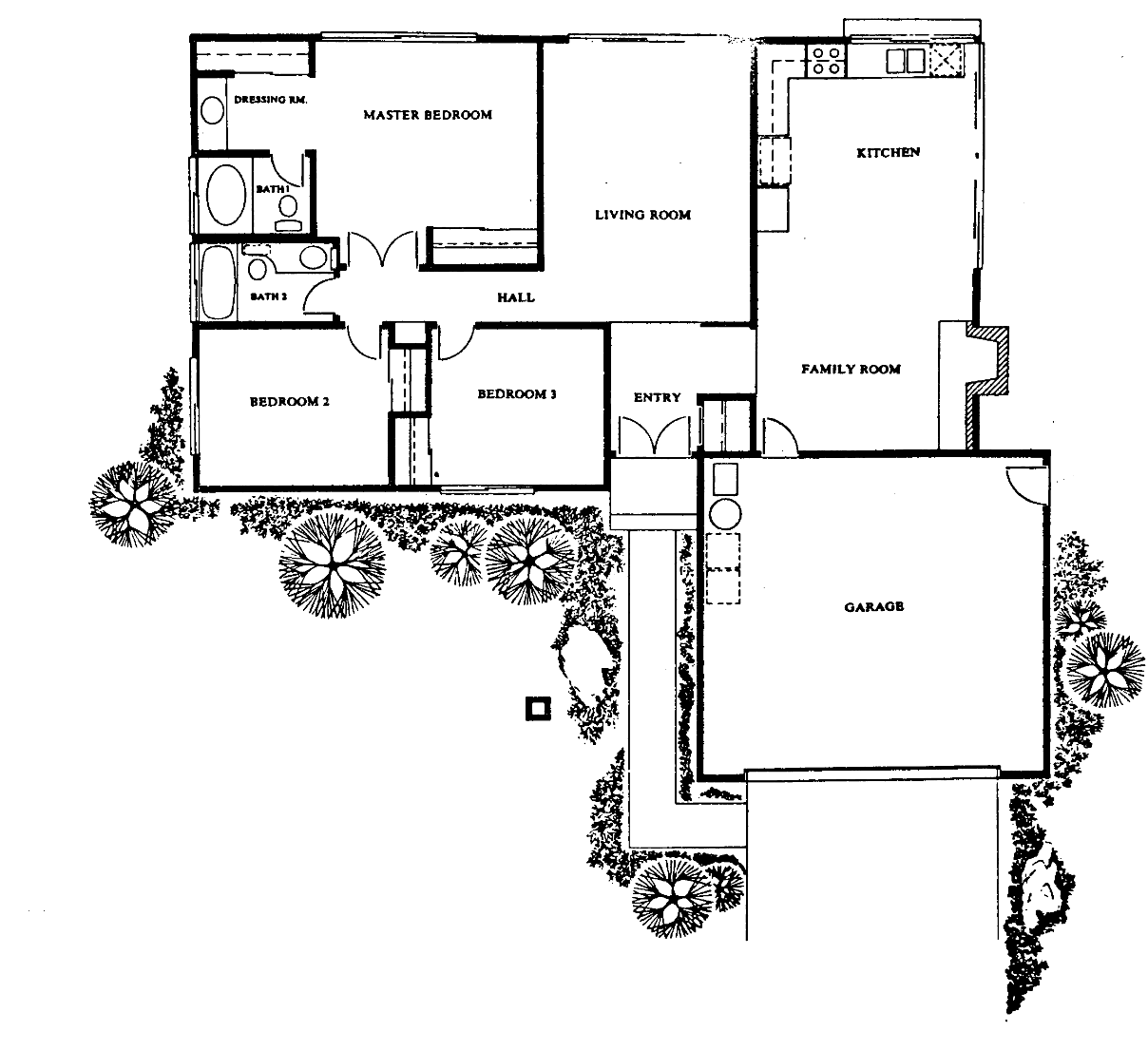
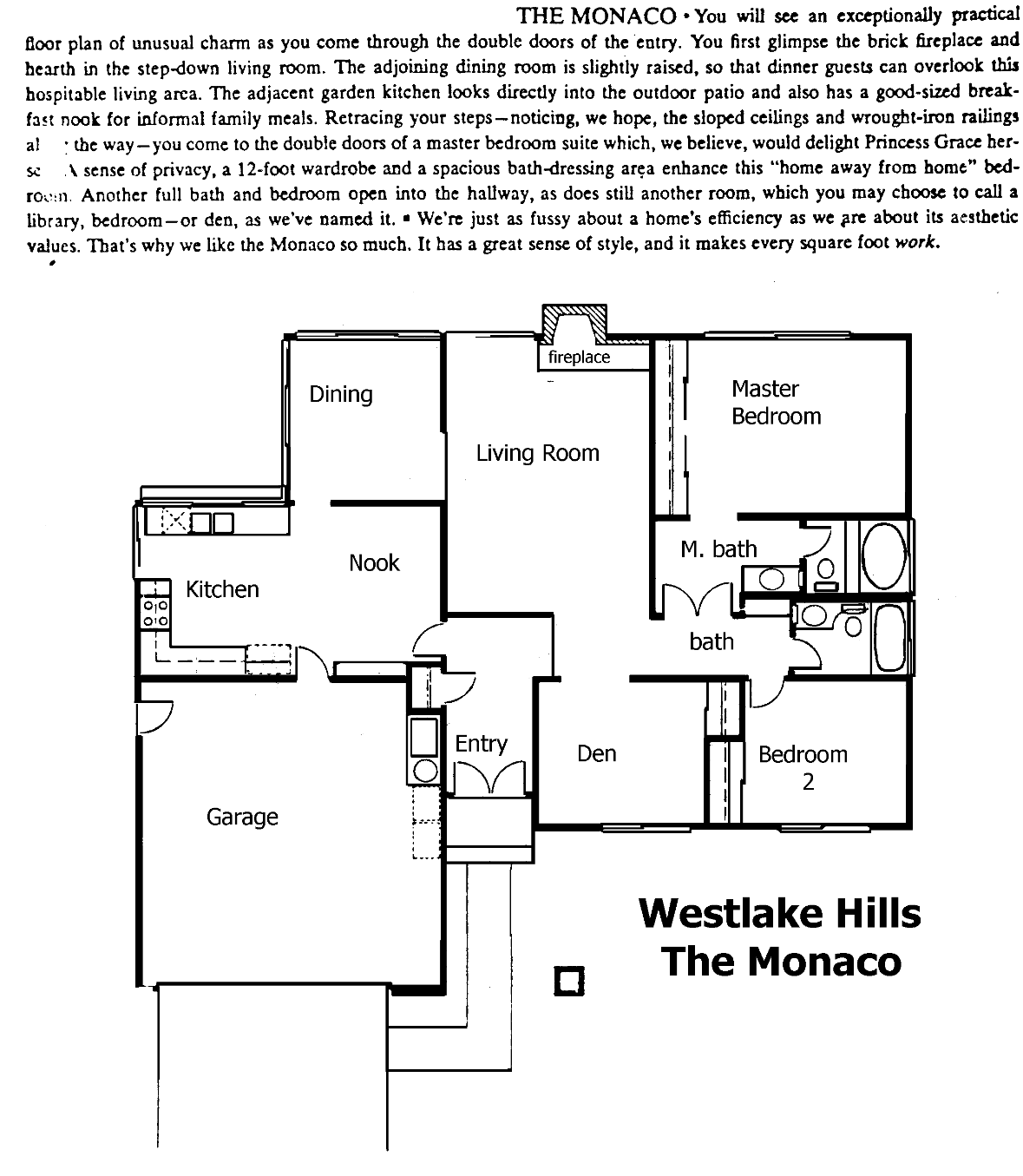
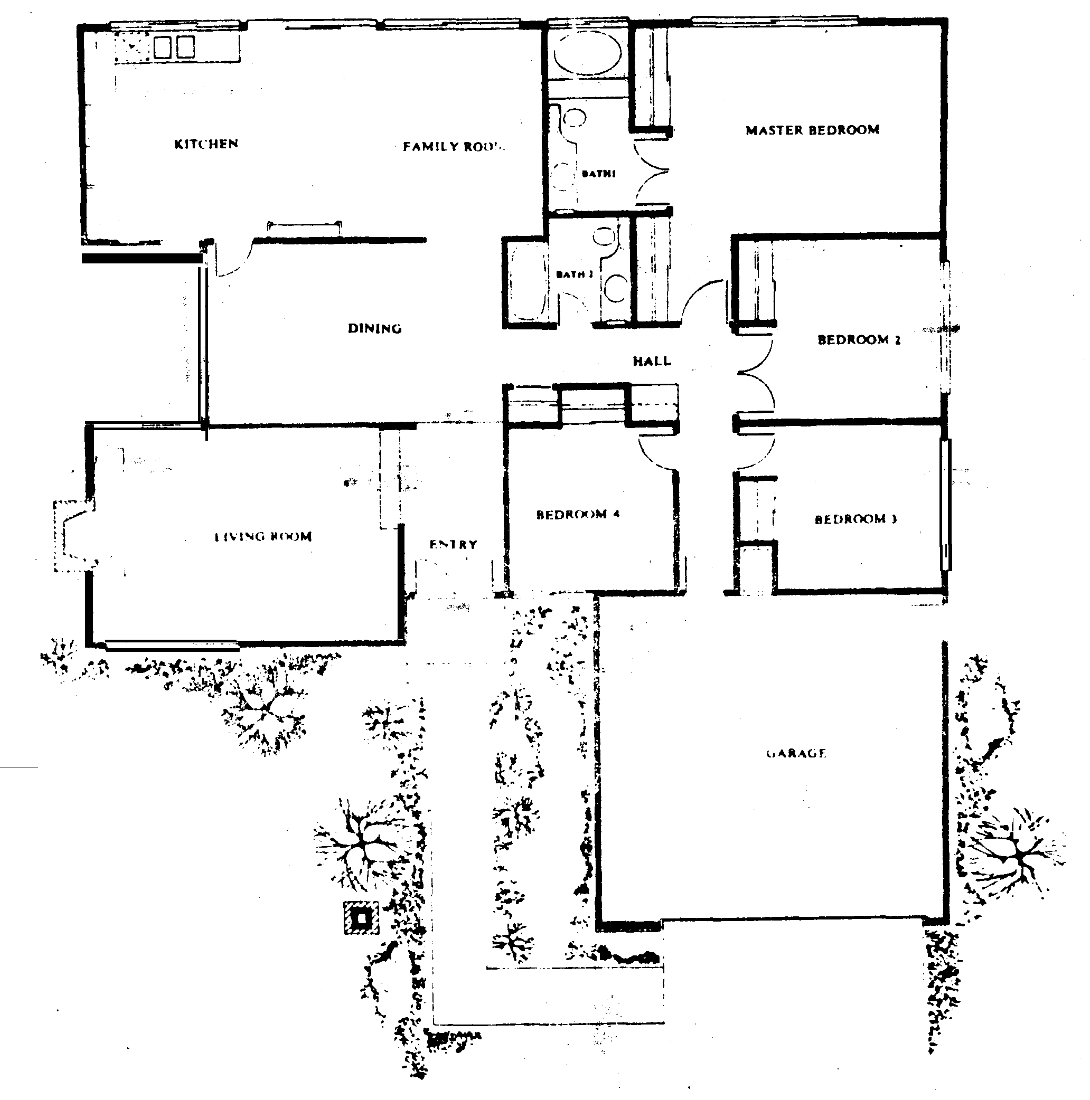
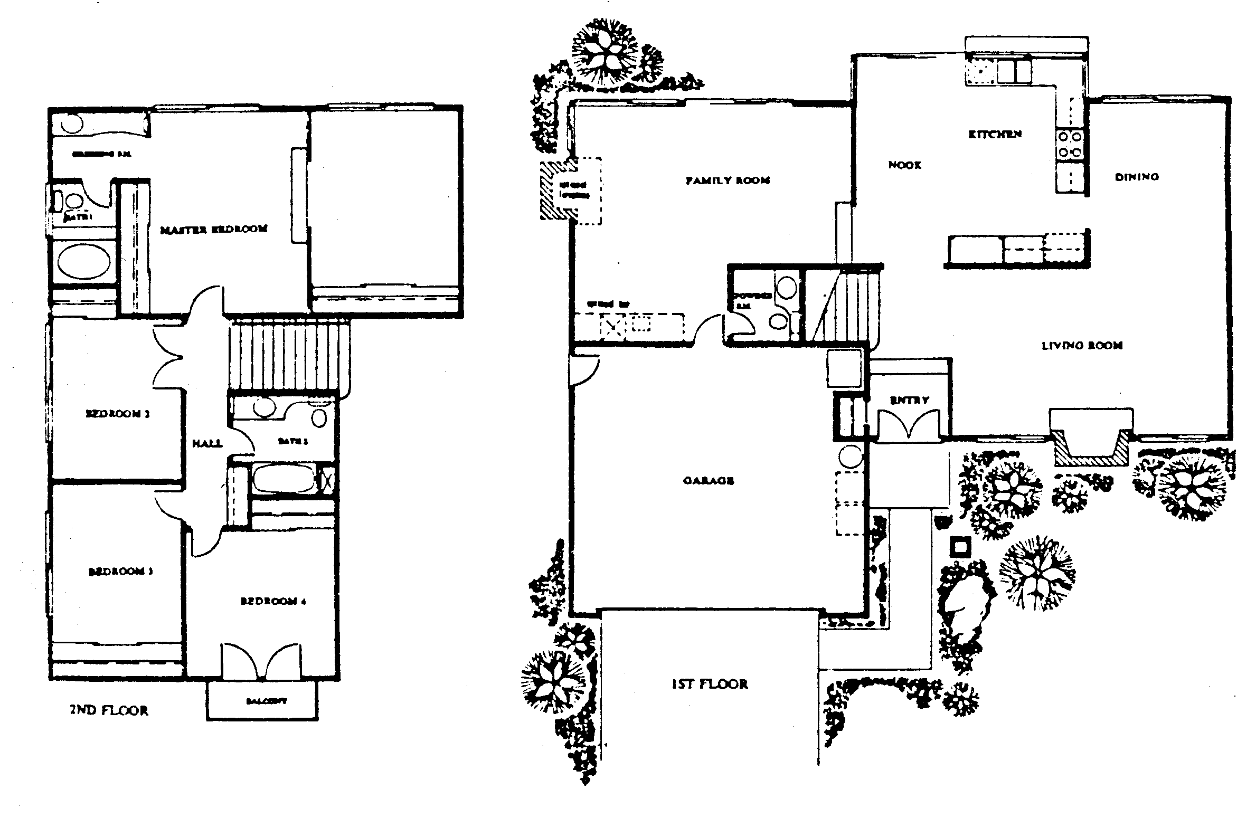
Westlake Hills original floor plans, with the builder drawings
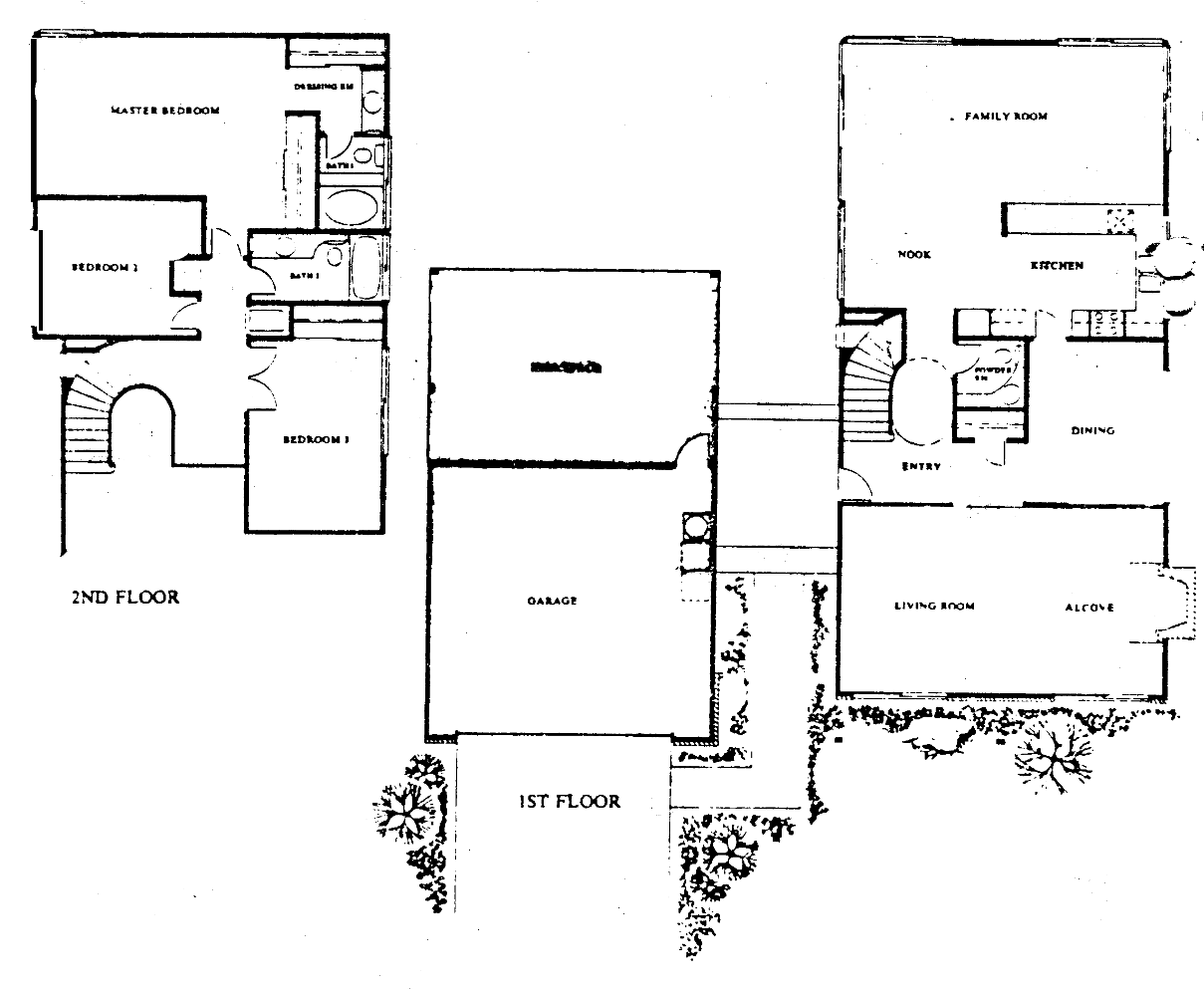
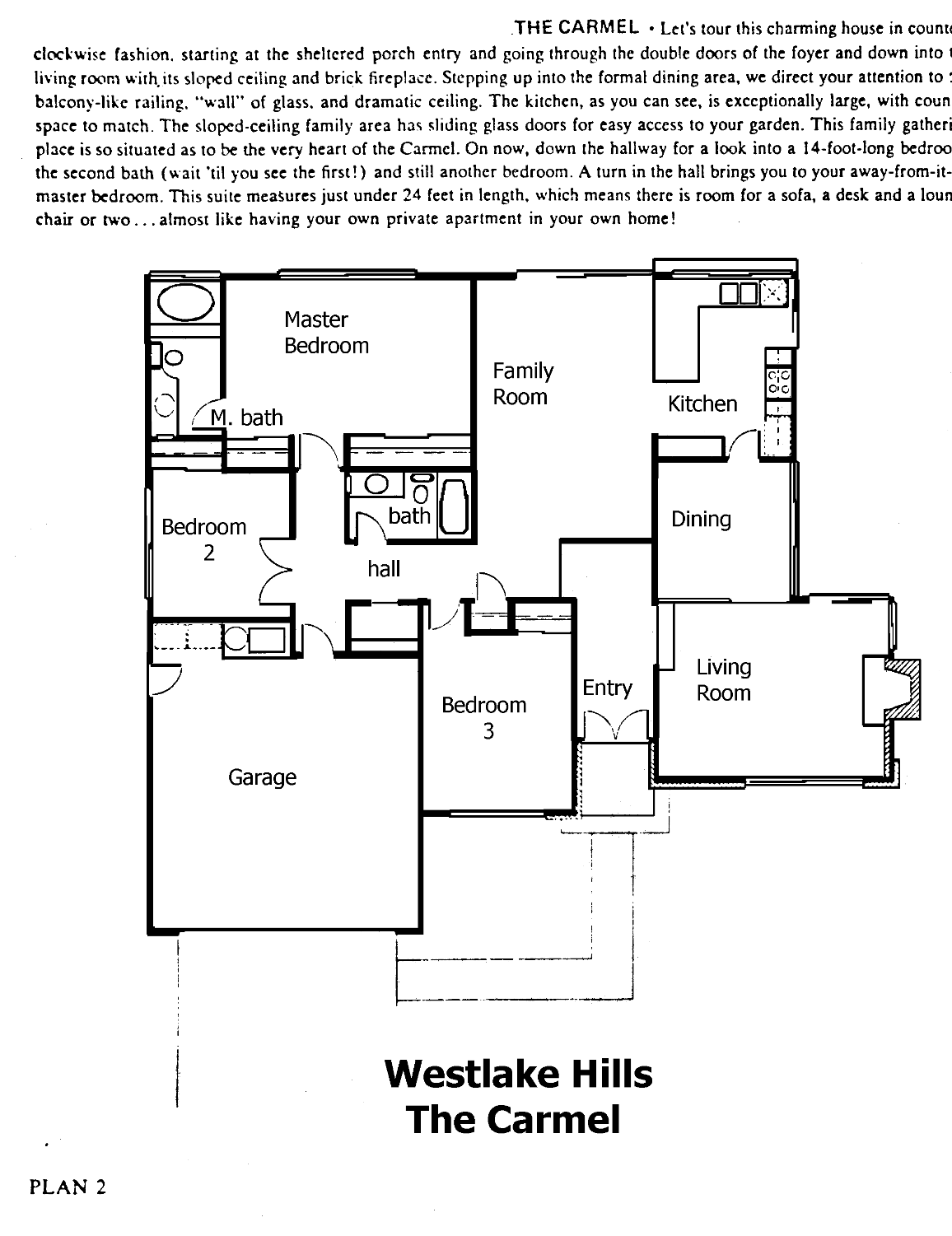
The Conejo Simi Moorpark Association of Realtors plan archive files six original plans for Westlake Hills under MLS tract 729, all with Italian and Riviera names: Carmel, Genoa, Monaco, Montego, Palermo and Portofino. They were marketing sheets rather than construction drawings, and most were printed without room dimensions, so the drawings below tell a buyer how a house was organized when it was new, not how big it is today. What the six have in common is the layout that county records still reflect across the tract: a formal living room with a vaulted ceiling near the entry, a dining area, a kitchen open to a family room across the back, and bedrooms arranged either in a single-story wing or stacked upstairs in the two-story plans. The archive does not tie each plan name to a building phase, so Gary matches a specific house to its plan from the drawing and the county square footage rather than from the street.
Drawings on file for the tract. Other plans, elevations and options may have been offered.


On the ground, the plans have drifted. County records show the smallest homes in Westlake Hills at about 1,460 square feet, the median at about 2,090, and a top end near 3,640 that can only be additions. The most common expansions are a family-room push-out toward the back yard, a converted garage bay, a bedroom or bath added over the garage on the two-story plans, and, increasingly, a guest wing or accessory unit: a January 2026 sale on East Adirondack Court advertised an attached accessory unit with guest quarters, and a June 2026 sale on Sierra Drive advertised a roughly 540-square-foot guest wing with a loft, a full bath and its own entrance. Any of these can be well done, but a buyer should compare the seller’s stated square footage against the county figure, pull the Thousand Oaks permit history for anything that does not match, and ask the property owners association whether its architectural committee approved the work.
Westlake Hills streets and how the tract is laid out
Every street in Westlake Hills is named for an American mountain range or river, which makes the tract easy to spot on a map even before the loop shape gives it away. Sierra Drive is the spine, with about 125 homes built from 1970 to 1977, and it carries East and West prefixes as it wraps around the center; Gary’s December 2018 sale at 3251 W Sierra Drive is a 1977 home on the west side of the loop. The courts branch inward and outward from Sierra and are addressed the same way, so a house can be on East Adirondack Court or West Black Hills Court depending on which side of the loop it sits on. The center of the circle is Medicine Bow Court, split into a north half that ends at Russell Park (3199 N. Medicine Bow Court) and a south half that ends at Westlake Hills Elementary (3333 S. Medicine Bow Court).

The first phase, 1970 through 1973, accounts for the streets closest to the center and the greatest number of homes: Appalachian Way (about 33 homes, 1970), Great Smokey Court (about 39, 1970), Panamint Court and Wasatch Court (about 14 each, 1970–74), Salmon River Circle (about 14, 1971), Bear River Court (about 11, 1971), Fall River Circle (about 7, 1971), Adirondack Court (about 34, 1972–73), Black Hills Court (about 45, 1972–73) and Cumberland Road (about 14, 1972–73). Homes on these streets run from about 1,460 to 2,250 square feet in county records, with medians between roughly 1,700 and 2,000. Gary’s February 2017 sale at 2908 Salmon River Circle, a 1971 four-bedroom of 2,251 square feet, is a typical first-phase home at the top of its size range, and his 2010 lease at 3113 W Black Hills Court, a 1973 home listed at 2,900 square feet with four baths, shows what a first-phase house looks like after a substantial addition.
The second phase, 1977 and 1978, sits on Allegheny Court (about 37 homes), Blue Ridge Court (about 48), Sawtooth Court (about 27) and Medicine Bow Court (about 10), plus the last homes on Sierra Drive. These are the bigger houses: county records put them at about 2,080 to 2,750 square feet with medians of roughly 2,430 to 2,600, and it is no accident that the recent sales above $1.4 million cluster on Allegheny, Blue Ridge and Medicine Bow. Every street in the tract is a public street maintained by the City of Thousand Oaks; there is no gate and no private road. Lots are consistent across both phases, with a median of about 6,970 square feet and a top end around 8,700 on the corner and cul-de-sac pads, and the courts are true cul-de-sacs with no through traffic.
A note on the count: the fifteen streets above add up to roughly 470 parcels in the county data Gary uses, while the full tract border holds about 658 homes (the association describes itself as covering about 620). The difference appears to be parcels carried under Thousand Oaks rather than Westlake Village addresses and the Wind River Court section that the county tract map lists with the 1977–78 phase. Buyers on the edges of the tract should confirm with the association whether a specific address is a member.
Why people move to Westlake Hills
The first reason people choose Westlake Hills is the school. Westlake Hills Elementary is inside the tract, most homes are within a few blocks of it, and the walk there does not cross an arterial. For a family with young children that is the whole argument, and it explains why the neighborhood holds value through soft markets.
The second is the price. With a two-year median of about $1.4 million and most homes between $1.15 and $1.6 million, Westlake Hills is the least expensive way to own a detached two-story home of more than 2,000 square feet with a Westlake Village address and Westlake High School. The same money on the Los Angeles County side buys a smaller house on a smaller lot, and in Three Springs it buys nothing at all.
The third is the association, or rather its near-absence. Dues of $43 a year, a volunteer board and an architectural committee whose job is to keep the streets looking like themselves is as light a hand as a buyer will find in a planned community; there is no pool or clubhouse to fund, no gate to staff and no special assessment risk to speak of.
The fourth is the layout. Cul-de-sac courts off a single loop road, a park at the center and no through traffic add up to a neighborhood that is quieter than its position beside the 101 suggests. And the fifth is the housing stock itself: sound 1970s plans with vaulted living rooms and level lots that take a remodel well, on a scale that a family can improve over time rather than all at once.
Living in Westlake Hills
The Westlake Hills HOA: dues, rules and monthly costs
Westlake Hills is governed by the Westlake Hills Property Owners Association, which describes itself as established in 1968 and as representing “homeowners across the community.” It is one of the least expensive associations in Westlake Village. The association’s own payment page lists yearly dues of $43, “used to cover the continued maintenance and beautification of our neighborhood and the operation of neighborhood related business activities.” MLS listings print the same obligation in several ways, which confuses buyers: recent Redfin pages show “Westlake Hills POA, $40 per year” on a June 2026 Sierra Drive sale, “$3 per month, assessed annually at $40” on a May 2026 Blue Ridge Court sale, “$40 per month” on a Medicine Bow Court sale (almost certainly the annual figure entered in the wrong field), and no HOA at all on two others. The right figure is about $40 to $43 a year, and Gary tells buyers to budget that and confirm it in the escrow disclosures. The association charges a $320 escrow package and transaction fee at resale, which is the one association cost a seller will notice.
What the dues buy is modest by design. There is no pool, clubhouse, gate, private street or common landscaping to maintain, so the money funds the association’s administration, a quarterly newsletter called The Echo, occasional beautification projects and the association’s share of improvements at Russell Park such as the 2016 picnic shade structure. The association is self-managed by a volunteer board of homeowners; there is no management company and no office phone number. Correspondence goes to [email protected] or to P.O. Box 4472, Westlake Village, CA 91359, and the association posts board photographs, events and newsletters on its website.
The part of the association that matters most to a buyer is architectural review. The CC&Rs provide that owners “proposing to perform work of any kind requiring the prior approval of the architectural committee shall apply to such committee for approval,” and the association’s application page is blunt: “No work may begin prior to Architectural Committee approval,” with applications requested 30 days or more before the anticipated start date. That covers additions, second-story work, exterior paint, roofing, fencing and similar visible changes. The association’s stated mission is preserving “the open spaces, the mature landscaping, the architectural standards,” and in practice the committee is a homeowner volunteer group rather than a professional design review, so response times depend on the board. Gary has not verified any rule restricting rentals in Westlake Hills, and the number of homes leased over the years suggests none; buyers who intend to rent should still read the CC&Rs in escrow. There is no Mello-Roos assessment in a tract of this age, and property taxes follow the ordinary Ventura County rate on the purchase price; a 2025 tax bill of about $8,900 was reported on an Adirondack Court home before its 2026 resale.
Schools serving Westlake Hills: district, elementary, middle and high
Westlake Hills is on the Ventura County side of Westlake Village, in the City of Thousand Oaks, and is served by the Conejo Valley Unified School District, not the Las Virgenes district that serves the Los Angeles County side across the freeway. Recent listings throughout the tract show the same three assigned schools: Westlake Hills Elementary at 3333 S. Medicine Bow Court, which sits inside the neighborhood, one to three tenths of a mile from most homes; Colina Middle School at 1500 East Hillcrest Drive in Thousand Oaks, about a mile and a half to two miles away, with roughly 785 students in grades six through eight; and Westlake High School at 100 Lakeview Canyon Road, which listings put under a mile from the tract. Attendance boundaries change, and the district offers an address lookup tool; buyers should verify the assignment for the specific parcel with the district before relying on it.
Westlake Hills Elementary is a kindergarten-through-fifth-grade school of about 364 students in 2025–26, with the Wildcats as its mascot and programs the school lists as STEAM, GATE, student leadership, band and strings, and chorus. State records list its formal opening date as July 1980, which likely reflects a district reorganization rather than the original campus, since the park beside it was built in 1972; buyers interested in the history should ask the district. The school is the single most common reason buyers give Gary for looking in Westlake Hills, and homes within walking distance of the Medicine Bow Court entrance sell at a visible premium to otherwise similar homes on the outer courts. Westlake High opened in 1978 and had about 2,010 students in 2023–24; it is one of the most sought-after public high schools in Ventura County, and the fact that a Westlake Hills family can reach it without crossing the 101 is part of the neighborhood’s appeal.
Because the district line runs along the county line, a buyer comparing Westlake Hills with First Neighborhood or Three Springs on the Los Angeles County side is also comparing Conejo Valley Unified with Las Virgenes Unified. Both districts are well regarded; the choice is usually made on the specific campus and on logistics rather than on district reputation, and buyers weighing private schools will find several within a short drive on both sides of the line.
Parks, trails and everyday life in Westlake Hills
Daily life in Westlake Hills is organized around the loop. The half-mile path around Russell Park and the school is where the neighborhood walks its dogs, and the cul-de-sac courts, with no through traffic, are where children ride bikes. Because the tract is enclosed by its own streets rather than by arterials, the interior is quiet in a way that the tracts along Lindero Canyon Road and Westlake Boulevard are not. The neighborhood association’s events page reflects an older, settled community: it points residents to the Sunday Westlake farmers market, the Elks Lodge Saturday tri-tip sandwiches, the Civic Arts Plaza in Thousand Oaks and the Cinepolis theater at Westlake, rather than to an in-tract social calendar.
Beyond the loop, the neighborhood sits at the foot of the hills that separate Westlake Village from the Lang Ranch and North Ranch areas, and the larger open spaces are a short drive: Lang Ranch Neighborhood Park and the open-space trailheads in the hills to the north, Triunfo Community Park on Aranmoor Avenue across the 101, and Wildwood Regional Park farther west in Thousand Oaks. The Westlake Village lake itself is south of the freeway and a few minutes away by car; Westlake Hills has no lake rights, docks or beach access, which is one of the reasons it costs less than Village Homes or the lakeside tracts. What it has instead is proximity to the North Ranch Mall shopping center on Thousand Oaks Boulevard, with a Ralphs at 3963 E. Thousand Oaks Boulevard, and to the Promenade at Westlake and its restaurants and cinema at Thousand Oaks Boulevard and Westlake Boulevard.
Medical offices, houses of worship and the everyday services along Hillcrest Drive, Lakeview Canyon Road and Thousand Oaks Boulevard are all within a few minutes. The neighborhood is not a walk-to-dinner location; nearly every errand is a short drive, and the residents who like Westlake Hills most are the ones who value the quiet interior over walkable retail.
Commuting from Westlake Hills: freeway access and the daily drive
Westlake Hills sits just north of the 101 with two interchanges within a few minutes: Westlake Boulevard to the west, which is also Highway 23 and continues north to Thousand Oaks Boulevard and south across the lake toward Malibu, and Lindero Canyon Road to the east, which drops south through the Los Angeles County side of Westlake Village. Off-peak, a resident can be on the freeway within about three to five minutes from anywhere in the loop. The Ventura County commute reality is that the 101 eastbound toward the San Fernando Valley and the Westside runs slow from roughly 6:30 to 9 a.m., and westbound toward Camarillo and Oxnard is lighter; many Westlake Hills residents work in the office parks along Agoura Road, Lindero Canyon Road and Thousand Oaks Boulevard and never touch the freeway.
Inside the neighborhood, morning drop-off at Westlake Hills Elementary concentrates on Sierra Drive and South Medicine Bow Court for about twenty minutes, and Westlake High traffic moves along Lakeview Canyon Road and Thousand Oaks Boulevard. Groceries are close: Ralphs at the North Ranch Mall on Thousand Oaks Boulevard is the neighborhood store, with Gelson’s, Trader Joe’s and Vons in the Westlake Village and Agoura Road commercial districts a few minutes farther. The Promenade at Westlake, with its cinema and restaurants, is at Thousand Oaks Boulevard and Westlake Boulevard; The Oaks mall is about ten minutes west on the 101 in Thousand Oaks.
There is no rail service in Westlake Village. The nearest Metrolink stations on the Ventura County Line are Moorpark to the north and Chatsworth to the east, each a drive of roughly 20 to 30 minutes in light traffic, and LADOT’s Commuter Express 423 runs weekday service between Thousand Oaks and downtown Los Angeles; Thousand Oaks Transit runs local bus routes through the area. The beach is reached by Kanan Road south from Agoura Hills to the Pacific Coast Highway at Kanan Dume Road, or by Westlake Boulevard and Decker Canyon Road, which is shorter on the map but slower and steeper; either way, the Malibu coast is roughly a half hour from the tract in good conditions.
The park and the school at the center
The defining physical feature of Westlake Hills is not a lake or a golf course; it is the seven acres in the middle of the loop that the master plan set aside for a school and a park before the first house was framed. Russell Park, at 3199 N. Medicine Bow Court, is a Conejo Recreation and Park District neighborhood park whose land was acquired in 1971 and developed in 1972. It is open daily from 7 a.m. to 10 p.m. and has a fully accessible playground with slides, climbing structures and large shade sails, a baseball backstop, a volleyball court, five picnic tables, five benches, a drinking fountain and a half-mile walking path around the lawn. In 2016 the district worked with the bordering property owners association to add a concrete picnic pad with a shade structure, one of the few tangible things the tiny association budget has paid for. The district lists no restrooms and no barbecue grills, which is worth knowing before planning a birthday party there.

Westlake Hills Elementary sits directly beside the park at 3333 S. Medicine Bow Court, so the two function as one open space on weekends. Because the park is inside the loop rather than on an arterial, it draws almost entirely from the neighborhood, and the walking path around it doubles as the neighborhood’s evening circuit. Listings across the tract mention “walking paths to Russell Park” as a selling point, and homes on the inner courts that back or side onto the park and school grounds are the ones buyers ask about first. The trade-off is drop-off traffic on Sierra Drive and Medicine Bow Court on school mornings, which is real but brief.
The association’s site also refers to “our playground” and to an improvement “coming soon to the playground area,” which appears to describe the district park beside the school rather than a separate private facility; buyers should not expect an association-owned pool, clubhouse or tennis court in Westlake Hills, because there is none. What they get instead is a public park they do not pay dues to maintain.
Westlake Hills home prices and the market
Westlake Hills home prices and the current market
The figures in this section were current when this guide was last reviewed. The sale record in the facts above and the listings below are drawn live from the MLS each time the page loads.
In the two years through August 2026, 25 homes in the tract sold through the MLS, at prices from $1,150,000 to $1,599,000 and a median of $1,397,000. That works out to roughly $550 to $600 per square foot for a typical home, with original-condition houses in the first-phase streets at the bottom and fully remodeled second-phase houses with pools at the top. It is the least expensive detached-home neighborhood with a Westlake Village address on the Ventura County side that still offers 2,000-plus-square-foot two-story homes, and that position has held for years.
The 2026 closings verified on Redfin show the range clearly. On East Adirondack Court, a 1972 four-bedroom of 2,587 square feet with an attached accessory unit sold in January 2026 for $1,275,000 after being listed the prior summer at $1,330,000. On Bear River Circle, a 1971 four-bedroom of 2,251 square feet with a pool, spa and solar sold in April 2026 for $1,250,000, about $555 per foot, after nine months on the market that began at $1.4 million. On Blue Ridge Court, a 1978 four-bedroom of 2,490 square feet with an updated kitchen and no pool sold in May 2026 for $1,410,000, or $566 per foot; the same house had sold for $163,000 when new in March 1979 and for $820,500 in 2018. On Medicine Bow Court, a 1978 four-bedroom of 2,434 square feet with a pool and spa on a cul-de-sac beside the school sold in June 2026 for $1,379,000, $567 per foot, after listing in February at $1.55 million. And on Sierra Drive, a 1971 home enlarged to 2,820 square feet with a 540-square-foot guest wing, bought in October 2025 for $1,220,000 and fully remodeled, resold in June 2026 for $1,575,000, or $559 per foot. Comparable sales quoted on those pages include an Allegheny Court home at $1,430,000 in May 2026 and another at $1,680,000, about $690 per foot, in October 2025, and a Sawtooth Court five-bedroom at $1,150,000, about $436 per foot, in June 2026 that presumably needed work.
Two things stand out in that record. First, the spread between original and remodeled is wide, about $430 to $690 per square foot, so a buyer’s renovation budget matters as much as the list price. Second, 2025 and 2026 sellers who priced at the 2022–24 highs sat: several of the sales above closed 8 to 12 percent below their first asking price after months on the market, and a flipped pool home on Blue Ridge Court that was bought in February 2026 for $1,280,000 was still on the market in September 2026 after four price cuts from $1,729,900 to $1,674,900. Homes priced on the recent closings, by contrast, have been selling in weeks. As of September 2026 there were only a few active listings in the tract, including a five-bedroom Salmon River Circle pool home with a guest house asking $1,749,000.
Figures are drawn from public records and MLS closings and are rounded. They are a snapshot, not a valuation; contact Gary for a current read on any specific property.
Renting in Westlake Hills: leases and rental prices
Westlake Hills has a steady rental market for a single-family tract, driven by families who want a year or two in the Westlake Hills Elementary and Westlake High attendance areas before buying, by relocations to the corporate offices along the 101, and by owners who have kept a house as a rental after moving up. Gary has leased here himself: in June 2010 he leased 3113 W Black Hills Court, a four-bedroom, four-bath 1973 home of about 2,900 square feet, at $4,100 a month, which was a top-of-market rent for the tract at the time.
Rents have risen substantially since. In the summer of 2026 three homes in the tract were listed for lease. A four-bedroom, two-and-a-half-bath 1970s home of 2,251 square feet on West Black Hills Court was listed in June at $5,100 a month and reduced in August to $4,900, on a twelve-month minimum lease. A three-bedroom, two-bath home of 1,462 square feet, the smallest plan on file for the tract, on Salmon River Circle was also asking $4,900. And a fully remodeled four-bedroom, two-and-a-half-bath home of 2,434 square feet on West Sierra Drive, with a new kitchen and a remodeled primary bath, was listed in July at $6,700 and cut twice to $6,250 by August, with pets allowed. Taken together, and hedged for a small sample, that puts an unrenovated first-phase home at roughly $4,700 to $5,100 a month, a larger second-phase home at about $5,000 to $5,800, and a fully remodeled home at $6,000 to $6,500, with pools and guest quarters adding a few hundred dollars. That is broadly in line with what comparable four-bedroom homes in Thousand Oaks 91362 were asking at the same time, most of them $4,900 to $6,000.
For landlords, the lesson from the 2026 listings is that the market corrected asking rents that started too high, and that a twelve-month lease at a realistic number rents faster than a stretch price. The association’s $43 annual dues are irrelevant to the rental calculation, and Gary has not found a rental restriction in the association’s published materials, though owners should read the CC&Rs. For tenants, the practical questions are whether the home has central air (most do, though some original units are near the end of their lives), whether the yard and pool maintenance are included, and whether the owner has upgraded the 1970s electrical panel, which affects insurance and the ability to run modern appliances. Thousand Oaks requires a minimum 30-day term on any accessory dwelling unit rental, which matters for the handful of homes here with guest units.
What inspectors find in Westlake Hills homes
Every home in Westlake Hills is between about 48 and 56 years old, and the inspection findings are the ones common to Conejo Valley tracts of that era; each house varies, and only a licensed inspector can say what a specific property needs. The first place inspectors look is the electrical panel. Homes built in the early and mid-1970s in this region were frequently fitted with Zinsco or Federal Pacific panels, both of which have documented failure histories, and insurers increasingly ask about them; a replaced 200-amp panel is a real selling point here and an original one is a negotiating item. Some early-1970s homes also received aluminum branch wiring, which an inspector will check at outlets and the panel.
Plumbing is next. Original galvanized steel supply lines in the first-phase homes are at or past their service life and show up as low water pressure and rusty water; many homes have been repiped in copper or PEX, and the question is simply whether this one has. Drain lines of the era are typically cast iron or ABS to a clay or cast-iron sewer lateral, and Gary recommends a sewer-camera inspection on every purchase in the tract, because a cracked or root-intruded lateral under a front yard is a five-figure repair. Water heaters, furnaces and air-conditioning condensers are replaced on a cycle and are easy to date; original tar-and-gravel or shake roofs were mostly replaced years ago with composition shingle or concrete tile, and a permit record such as the 2014 reroof noted on a Blue Ridge Court home is the kind of paper trail to look for.
The houses are on slab foundations, and inspectors check for slab cracks at the interior, for moisture at the exterior where planters sit against stucco, and for drainage on the lots with a slope at the rear or side, where an original wood or block retaining wall may be leaning. Original single-pane aluminum windows survive in a surprising number of homes and are a comfort and energy issue rather than a defect. Pool equipment on the pool homes is often a generation or two removed from original and should be dated. Finally, additions: the tract’s largest homes, up to about 3,640 square feet, were enlarged from plans that started around 2,000 to 2,600, and any addition, garage conversion or guest unit should be checked against City of Thousand Oaks permit records and, where it is visible from the street, against the association’s architectural approvals. None of this is unusual for the era, and none of it is a reason to avoid the neighborhood; it is the reason a buyer should carry an inspection contingency and a realistic repair budget.
Remodels that add value in Westlake Hills
The sales record in Westlake Hills rewards the remodels that address how the 1970s plans actually live. The single most valuable change is opening the kitchen to the family room and, where the plan allows, to the dining area, so the back of the house reads as one room; the June 2026 Sierra Drive resale that went from $1,220,000 to $1,575,000 in eight months did exactly that, along with a new kitchen, baths and flooring. The vaulted living rooms that define these plans are an asset and should be left alone beyond lighting and finishes. Replacing the electrical panel, repiping, new windows and new HVAC do not photograph well but show up in the price because they remove the objections buyers raise in inspection.

Additions are common and the record shows two kinds that pay. Downstairs, a family-room push-out or a bedroom-and-bath added behind the garage gives the two-story plans the main-floor bedroom that downsizers and multigenerational buyers ask for; the Blue Ridge Court pool home listed in 2026 led its marketing with its downstairs bedroom and full bath. Guest quarters pay too: the East Adirondack Court home with an attached accessory unit and the Sierra Drive home with a 540-square-foot guest wing both marketed those spaces as in-law suites or home offices, and both sold. Second-story additions on the single-level plans exist but are rarer and require association approval for the change in massing.
Accessory dwelling units deserve their own note. California law now generally requires cities to allow an accessory dwelling unit on a single-family lot and a junior ADU of less than 500 square feet inside the existing footprint, and the City of Thousand Oaks offers a gallery of pre-approved plans and waives some impact fees on units under 750 square feet. Westlake Hills lots of 6,970 to 8,700 square feet are tight for a detached unit once the setbacks and the pool are accounted for, but garage conversions and junior ADUs are feasible on most of them, and the city notes that a property with a junior ADU must be owner-occupied and that ADU rentals require a 30-day minimum term. State law limits what a homeowners association can do to block an ADU, but the Westlake Hills architectural committee can still review exterior design, so the application should go in 30 days before work starts. The remodels that do not pay are the ones that outrun the neighborhood: a $400,000 kitchen-and-bath program on a 2,250-square-foot first-phase house will not return its cost at $1.3 to $1.4 million, and Gary’s advice to sellers here is to spend on systems, the kitchen, paint, floors and the yard, and to stop there.
Buying and selling in Westlake Hills
What to weigh before buying in Westlake Hills
The freeway is close, and the homes on the south edge of the tract nearest the 101 hear it, especially at night with the windows open; buyers should stand in the back yard of a specific house at rush hour rather than trusting a daytime showing. The interior courts are much quieter than the edges.
The homes are fifty years old, and unless a seller has done the work, a buyer should expect to replace the panel, repipe, replace windows and update HVAC over the first several years of ownership, on top of cosmetic remodeling. The spread between $430 and $690 per square foot in the recent sales is the market pricing that work, and a buyer who pays a remodeled price for an original house has overpaid.
The lots are modest at about a sixth of an acre, which limits the size of a pool, a detached ADU or an addition; a buyer who wants a large yard should look at Village Homes or the hillside tracts instead. The architectural committee reviews visible exterior changes and requires approval before work begins, which is a light process but a real one. The neighborhood has no lake access, no community pool and no gate, and buyers sometimes arrive expecting one or more of those from the Westlake Village name. Finally, the county-line quirk: the address says Westlake Village, the city is Thousand Oaks, the schools are Conejo Valley Unified, and a buyer researching city services, permits and taxes should look to Thousand Oaks and Ventura County rather than to the City of Westlake Village.
Who buys in Westlake Hills
The core buyer in Westlake Hills is a family with children in or approaching elementary school, often moving up from a condo or townhome in Thousand Oaks, Agoura Hills or the west San Fernando Valley, who has done the math on Conejo Valley Unified and on the price of a comparable house south of the freeway. Many have rented in the tract or nearby first. They want four bedrooms, a yard, a school they can walk to and a total monthly cost that leaves room for the remodel.
The second group is the remodeler and the small investor. Because the neighborhood has a wide spread between original and updated homes and a reliable resale market, it attracts buyers who take an estate sale or a tired rental at $1.15 to $1.3 million, do the systems and the kitchen, and either live in the result or resell it, as the Sierra Drive and Blue Ridge Court examples in 2026 show. The third group is the long-term owner returning as a downsizer or a landlord: original families who bought in the 1970s for $50,000 to $165,000 are now selling, and some of their children are buying back into the tract for the school. Westlake Hills is a poor fit for buyers who need a single-level home of more than 2,000 square feet, a large lot, a view or a lake, and for buyers who expect a community pool for their dues.
How Westlake Hills compares with nearby neighborhoods
The closest comparison is Village Homes, the other large 1970s tract on the Ventura County side, on Triunfo Canyon Road south of the freeway. Village Homes was built in three phases from 1969 to 1978, so its homes are the same age, and its 2024–26 median of about $1.46 million is close to Westlake Hills’ two-year median of about $1.4 million. The differences are in what the money buys: Village Homes has a high share of single-story ranch plans, larger lots with a median around 7,400 square feet, a clubhouse, pool, tennis courts and a mile-and-a-quarter greenbelt, and dues of about $275 a quarter to pay for them. Westlake Hills has more two-story homes, a school and a public park inside the loop, and dues of $43 a year. Both are in Conejo Valley Unified and both feed Westlake High; Village Homes is assigned to Westlake Elementary.
Foxmoor, also on the Ventura County side and built in 1968 and 1969 around Westlake Elementary, is the other school-centered tract and the nearest thing to a twin. Its homes are slightly larger on average, its 2024–26 median is higher at about $1.55 million, and its association charges roughly $230 to $240 a quarter for a clubhouse, pool and creek greenbelt. Foxmoor buyers get the pool and the greenbelt; Westlake Hills buyers get a lower entry price, newer second-phase homes from 1977–78 and the north-of-the-freeway location closer to Thousand Oaks Boulevard and Westlake High.
Across the county line, Three Springs is a different product altogether: late-1980s homes of 2,800 to 4,300 square feet on lots with a median of about 14,000 square feet, in the Las Virgenes district, with a 2024–26 median around $2.15 million. A Westlake Hills buyer who wants a bigger house on a bigger lot and can add $700,000 to the budget is usually looking there or in North Ranch. The broader Westlake Village guide lays out the rest of the neighborhoods on both sides of the line; among them, Westlake Hills is the one that combines a school inside the tract, a public park at its center, the lowest association cost in the community and the lowest price per square foot for a two-story home.
Gary’s track record in Westlake Hills
Gary Jacobs has sold and leased in Westlake Hills across both building phases. In December 2018 he sold 3251 W Sierra Drive, a four-bedroom, three-bath second-phase home built in 1977 with 2,490 square feet, for $915,000; the aerial, dusk and backyard photographs on this page are from that listing. In February 2017 he sold 2908 Salmon River Circle, a four-bedroom, three-bath first-phase home built in 1971 with 2,251 square feet, for $847,000. And in June 2010 he leased 3113 W Black Hills Court, a four-bedroom, four-bath 1973 home enlarged to about 2,900 square feet, at $4,100 a month.
Those three transactions bracket the tract: a 1971 plan at its original size, a 1973 plan after a substantial addition, and a 1977 second-phase plan. Set against the 2026 closings, they also show how far the neighborhood has moved: a 2,251-square-foot Bear River Circle home of the same plan and year as the Salmon River sale closed in April 2026 at $1,250,000, and a 2,490-square-foot 1978 Blue Ridge Court home of the same size as the Sierra Drive sale closed in May 2026 at $1,410,000. Gary keeps the six original plan drawings, the county size and year data for every street, and the sales history for each court, and shares the comparable sales with anyone weighing a purchase or a listing in Westlake Hills.
Buying or selling in Westlake Hills: practical notes
Buyers: Learn the two phases before touring, because a 1977–78 home on Allegheny, Blue Ridge, Sawtooth or Medicine Bow is typically 400 to 600 square feet larger than a 1970–73 home on Appalachian, Great Smokey or the River circles, and the price per foot is similar. Compare the seller’s square footage with the county figure and pull the Thousand Oaks permit history for any difference. Order a sewer-camera inspection and have the inspector identify the electrical panel brand and the supply-line material on day one. Stand in the yard at rush hour on the south-edge streets. Budget $40 to $43 a year for the association and the $320 escrow package, and read the CC&Rs for the architectural rules before planning an addition. Verify the school assignment with Conejo Valley Unified rather than relying on the listing, and if walking to school is the point, measure the walk from the specific house to South Medicine Bow Court.
Sellers: The 2025–26 record is unambiguous: homes priced on the last three closings sold in weeks, and homes priced on 2022 sold months later for 8 to 12 percent less than they first asked. Before listing, replace or document the panel, the repipe, the roof and the HVAC, because those are the items buyers use to negotiate; a written permit history and association approvals for any addition are worth more than another coat of paint. Fresh interior paint, refinished or new floors, a cleaned-up yard and, on the pool homes, serviced equipment are the cosmetic work that returns its cost here; a full high-end kitchen usually does not at this price point. Order the association’s escrow package early, since a volunteer board does not turn documents around overnight. Gary prices Westlake Hills listings from the court-by-court record rather than from zip-code averages, which is how the difference between a first-phase and second-phase home, and between an original and a remodeled one, gets captured.
Questions buyers ask about Westlake Hills
How much does a house in Westlake Hills, Westlake Village cost in 2026?
In the two years through August 2026, 25 homes in Westlake Hills sold through the MLS, at prices from $1,150,000 to $1,599,000 and a median of $1,397,000. Verified 2026 sales ran from $1,250,000 for a 2,251-square-foot 1971 pool home on Bear River Circle to $1,575,000 for a remodeled 2,820-square-foot home with a guest wing on Sierra Drive, or roughly $550 to $600 per square foot, with original-condition homes closer to $430 to $500 per foot and the best remodels near $690.
How big are the homes and lots in Westlake Hills?
County records put Westlake Hills homes at about 1,460 to 2,640 square feet, with a median near 2,090 and a top end around 3,640 square feet after additions, on lots of about 6,970 to 8,700 square feet. The 1970–73 streets (Appalachian, Great Smokey, Panamint, Wasatch, Salmon River, Bear River, Fall River, Adirondack, Black Hills, Cumberland) run about 1,460 to 2,250 square feet, and the 1977–78 streets (Allegheny, Blue Ridge, Sawtooth, Medicine Bow) about 2,080 to 2,750. The six original plans, sold as MLS tract 729, were named Carmel, Genoa, Monaco, Montego, Palermo and Portofino.
What are the HOA dues in Westlake Hills and what do they cover?
Westlake Hills homes belong to the Westlake Hills Property Owners Association, a volunteer-run association established in 1968 that lists its dues at $43 per year; MLS listings print the same figure as about $40 a year or $3 a month. The dues fund neighborhood beautification, a quarterly newsletter, the architectural committee and the association’s share of improvements at Russell Park. There is no pool, clubhouse, gate or management company, and a $320 escrow package fee applies at resale. Any exterior work requires architectural committee approval before it begins.
Which elementary school does Westlake Hills go to, and what district is it in?
Westlake Hills is in the City of Thousand Oaks on the Ventura County side of Westlake Village and is served by the Conejo Valley Unified School District. Recent listings across the tract show Westlake Hills Elementary, a K–5 school of about 364 students at 3333 S. Medicine Bow Court inside the neighborhood, followed by Colina Middle School on East Hillcrest Drive and Westlake High School on Lakeview Canyon Road, less than a mile away. Attendance boundaries should be confirmed with the district for the specific address.
When was Westlake Hills built, and what should buyers check in the inspection?
Westlake Hills was built in two phases, 1970 to 1973 and 1977 to 1978, as part of the Westlake Village master plan on the Ventura County side. Homes of that age commonly have original Zinsco or Federal Pacific electrical panels, galvanized supply lines, aging sewer laterals, single-pane aluminum windows and older HVAC unless they have been updated, and the largest homes have additions that should be matched to City of Thousand Oaks permits. A licensed inspector and a sewer-camera inspection are strongly advised on every purchase in the tract.
Is Westlake Hills gated, and does it have a park or lake access?
Westlake Hills is not gated; its streets are public and there is no community pool or clubhouse. The neighborhood is built around Russell Park, a seven-acre Conejo Recreation and Park District park at 3199 N. Medicine Bow Court that opened in 1972 with an accessible playground, a baseball backstop, a volleyball court, picnic tables, a shade structure and a half-mile walking path, next to Westlake Hills Elementary. The neighborhood is north of the 101 and has no lake frontage, docks or lake rights; Westlake Lake is a few minutes away by car.
How much does it cost to rent a house in Westlake Hills?
In the summer of 2026, homes in Westlake Hills were listed for lease at $4,900 a month for a 2,251-square-foot four-bedroom on West Black Hills Court and for a 1,462-square-foot three-bedroom on Salmon River Circle, and at $6,250 a month for a fully remodeled 2,434-square-foot four-bedroom on West Sierra Drive, after all three were reduced from higher initial asking rents. Roughly, unrenovated homes rent for about $4,700 to $5,100, larger second-phase homes for $5,000 to $5,800, and remodeled homes for $6,000 to $6,500 a month. Gary Jacobs leased a 2,900-square-foot home on West Black Hills Court in 2010 at $4,100 a month.
How does Westlake Hills compare with Village Homes or Foxmoor?
All three are 1968–1978 tracts on the Ventura County side of Westlake Village in Conejo Valley Unified, but Village Homes and Foxmoor each have a clubhouse, community pool and greenbelt with dues of roughly $230 to $275 a quarter, while Westlake Hills has a public park and elementary school at its center and dues of $43 a year. Recent medians run about $1.4 million in Westlake Hills, $1.46 million in Village Homes and $1.55 million in Foxmoor. Westlake Hills is the only one of the three north of the 101, which puts it closest to Westlake High School and Thousand Oaks Boulevard.
Nearby Westlake Village neighborhoods
Thinking about Westlake Hills? Gary Jacobs has the original floor plans, the sales history for every street, and a current read on what is coming to market before it is public.
Talk with Gary Jacobs → | Back to the Westlake Village guide