

Village Greens
Westlake Village Neighborhood Guide
Village Greens
1972 · 258 condominiums on Landsburn, Instone and Kirkford — the least expensive way into Westlake Village
Listing photo: Team Nicki and Karen, Compass · CSMAR MLS
Village Greens is a 1972 condominium community of 258 homes on Landsburn Circle, Instone Court and Kirkford Way, on the Ventura County side of Westlake Village. It is the least expensive way into this market: 17 homes sold through the MLS in the two years through June 2026, at prices from $499,000 to $686,500 and a median of $560,000, in a district where the median detached house trades for four times that. What the money buys is a 920, 924 or 1,020-square-foot flat or two-level walk-up in a community with two pools, a clubhouse and sport courts, a fee that includes the water, and a Westlake High School assignment. This guide covers how it was built and by whom, the three unit types with the builder’s own drawing, the streets, the association and what it costs, schools, the whole price record, and how to tell Village Greens apart from Village Glen next door — which shares its street names and is a different association entirely.
Highlighted area is the approximate footprint of the Village Greens tract, drawn from the parcels in county records. Labels mark the other Westlake Village neighborhoods; click one to open its guide.
Not gatedVillage Greens is not a gated community.
Guard-gated communities in Westlake Village: Country Club EstatesLake SherwoodSherwood Country ClubSycamore CanyonThistleberryTrentwoodWestlake Island
Gated communities nearby: Westlake PointeWestlake CoveOak ForestMajestic OaksHidden Valley Estates
Homes for sale and recently sold in Village Greens
These lists are drawn to the outline of the Village Greens tract on the map above, so they hold Village Greens homes and nothing from the tracts next door. They come from the CSMAR multiple listing service and update as agents post them.
For sale in Village Greens right now
Active listings inside the tract.
Loading…
In escrow in Village Greens
Under contract but not yet closed — the closest read on what buyers are paying today.
Loading…
Sold in Village Greens in the last two years
Closed sales inside the tract, newest first.
Loading…
Where Village Greens is
How Village Greens came to be
Westlake Village was master-planned from 1963, when the American-Hawaiian Steamship Company, controlled by Daniel K. Ludwig, bought roughly 12,000 acres straddling the Los Angeles–Ventura county line and, with Prudential Insurance, set out to build a city in the country around a lake that did not yet exist. The dam was finished in 1969, and the tracts went up around it through the late sixties and early seventies. The Ventura County portion of the plan was annexed into the City of Thousand Oaks in 1968 and 1972; the Los Angeles County portion incorporated as the City of Westlake Village in 1981. Village Greens sits on the Ventura side, which is why the school district’s own street index prints Landsburn Circle under “Thousand Oks 91361.”
What is striking about Village Greens is that it exists at all. Westlake was sold as an aspirational community, and most of what was built in these years was detached houses on generous lots or lakefront patio homes. Village Greens was the other half of that plan — genuinely small, genuinely affordable homes, arranged as flats and two-level walk-ups around shared parking courts, with the amenity budget spent on things everyone could use: two pools, a clubhouse, a basketball court, shuffleboard, horseshoes. Fifty years on that decision is why a nurse, a teacher or a retired couple can still buy into the Westlake High School attendance area for a figure starting with a four, and it is the single most useful thing a buyer can know about this tract.
Village Greens and Village Glen were recorded together, on facing pages of the same map book, and both associations were registered in 1971. The Assessor puts Village Greens at tract 217100 on map 058MR 006 and Village Glen at 217000 on 058MR 001, with parcel numbers in separate blocks — Village Greens in the 693-0-10x, -11x and -12x pages, Village Glen in 693-0-04x and 693-0-05x. Two corporations, two managers, two dues schedules, two amenity sets. They were built at the same moment as two different products, and they still are.
The builder of Village Greens is not named in any public record Gary Jacobs has been able to verify. The recorded final map at the Ventura County Recorder would name it; until that is in hand this guide does not guess.
The building plan, with the drawing
The sheet on file for Village Greens is unlike any other in this guide series. It is not a single home — it is a building plan, showing a whole cluster in section: a central parking court with numbered stalls, and around it, on two levels, four unit types keyed 1 through 4. Reading it is the fastest way to understand what a Village Greens home actually is.
Drawing on file for the tract. The archive is what survives rather than a complete builder record, and other plans, elevations and options may have been offered.
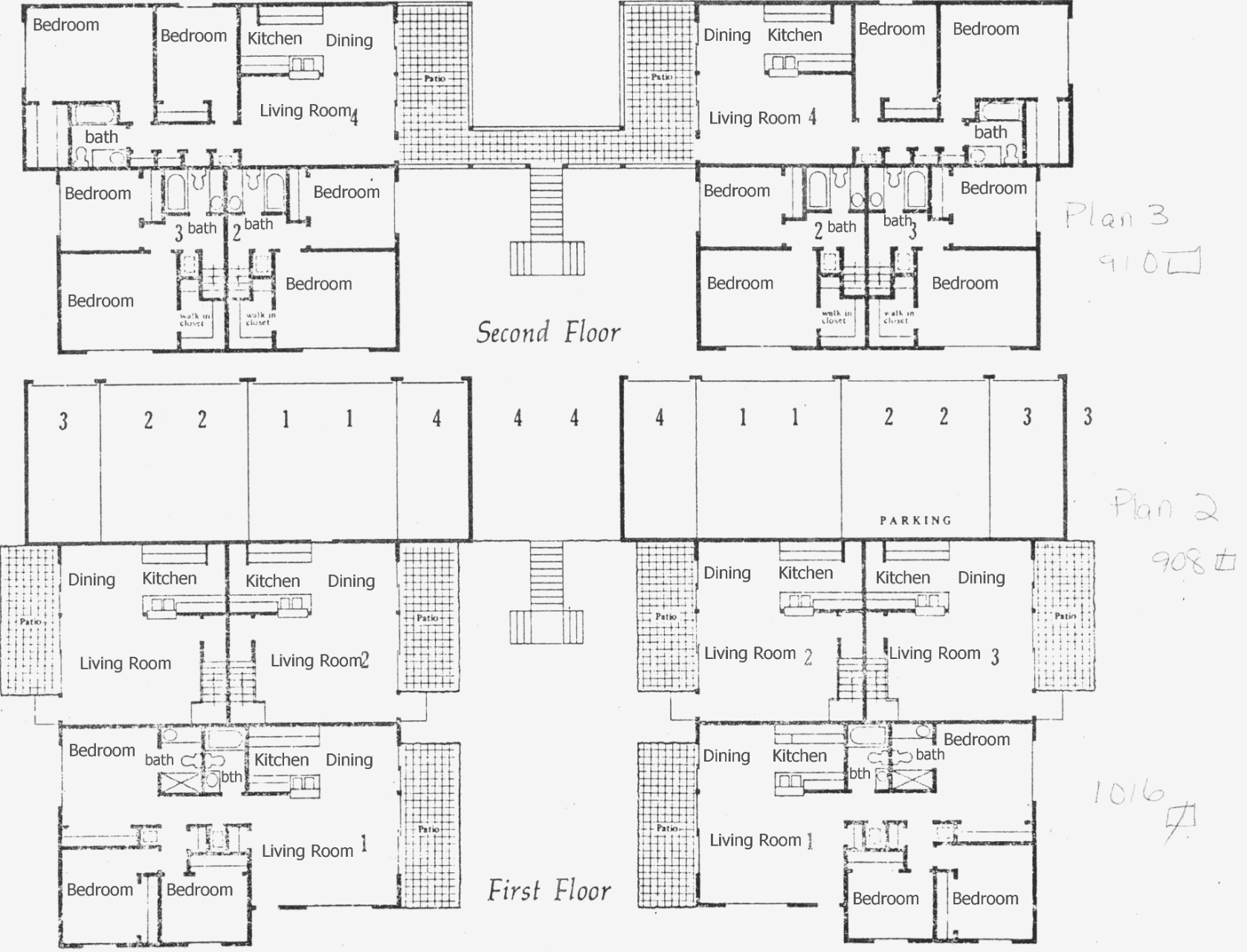
Matching the drawing to the market, the record sorts into three products. The 920-square-foot two-bedroom on one level is the entry point: eleven sales from $417,000 to $560,000, median $527,000. The 924-square-foot two-bedroom on two levels is the most common home in the tract by a distance: twenty-four sales from $440,000 to $610,000, median $550,000. The 1,020-square-foot three-bedroom on one level is the top of the range: ten sales from $495,000 to $695,000, median $650,000. Note what that ordering means — the single-level three-bedroom commands about $100,000 over the two-level two-bedroom of nearly the same era and association. Space and stairs are both being priced, and they are being priced separately.
The streets
Landsburn Circle is the spine and carries 136 of the 258 homes — more than half the tract — running as a long loop with the clusters hung off it. Instone Court has 57 and Kirkford Way 48. All three carry all three unit types, and the sale record does not separate them: a 924-square-foot two-level home has sold in the same $500,000s on each of the three streets in the same year. As in Village Glen next door, the street is not the variable here. Condition is, and so is whether the home is on one level or two.
On the eastern edge of the tract sit Twinfoot Court, Winston Court and Freeport Court, a pocket of about seventeen addresses. Twelve Twinfoot addresses carry the Village Greens subdivision code in the MLS, and the homes there are materially different — one sale on Twinfoot records a 1,913-square-foot four-bedroom on a single level, which is nothing like the rest of the tract. The school district’s street index also files these three courts under a different area code from Landsburn, Instone and Kirkford. Gary’s reading is that this pocket is not part of the Village Greens association in the way the three main streets are, and any buyer or seller on Twinfoot, Winston or Freeport should confirm the association and the dues for that specific address rather than assuming the Village Greens figures apply.
The street names to watch. Landsburn Circle and Instone Court also run past Village Glen, and a handful of listings over the years have tagged Village Greens addresses with the Village Glen subdivision code and vice versa. The reliable test is the home: if it is 920, 924 or 1,020 square feet, it is Village Greens; if it is 1,149 square feet or larger and on one level, it is Village Glen, and it will be on Stonewall, Hartland, Canterford, Glenbridge, Nottingwood or Bright Glen Circle.
Living in Village Greens
The association, the amenities and what it costs
Village Greens has the richest amenity set of any small-unit community in Westlake Village, and it is the reason the dues sit where they do. Across current and recent listings the association keeps two pools plus a shallow wading pool, a spa, a clubhouse with a conference room, changing rooms and showers, a laundry area, a basketball court, a sport court, a shuffleboard court and horseshoe courts, barbecue areas, walking paths and guest parking. For a household paying under $600,000 for a home, that is an unusual amount of shared infrastructure.
Dues in listings ran $473 a month in 2020, $485 in 2021, $490 to $510 in 2022, $510 to $610 through 2023, $610 in 2024 and $610 to $628 across 2025 and 2026. Individual units have been quoted higher — one 2026 listing at $753 — and the spread between units in the same association in the same year is wide enough that a buyer should take the figure from the specific unit’s statement and not from a comparable. The fee is reported as covering water, sewer, trash, common-area and exterior maintenance and earthquake insurance. Water, sewer and earthquake cover inside the dues is an unusually inclusive package, and it is a genuine part of the value here rather than a marketing line.
The association is the Village Green Property Owners’ Association — singular in the corporate record and on the monument sign at the entrance, plural in the MLS and in everyday use. Which form appears on the recorded CC&Rs is not something Gary has been able to confirm, and it is worth knowing only because searching the wrong one turns up nothing. A 2026 listing on Landsburn Circle names Gold Coast Association Management, 3623 Old Conejo Road in Thousand Oaks, reachable at (805) 499-7800; a Realtor-board directory from 2019 names the same company. Confirm through escrow, along with the reserve study, the insurance certificate, the owner-occupancy ratio and whether any special assessment has been discussed. Owner-occupancy is worth particular attention in a community at this price point, because it drives which loan products a buyer can use.
Schools
Village Greens is in the Conejo Valley Unified School District, and the district’s street index assigns Landsburn Circle, Instone Court and Kirkford Way to Westlake Elementary, Colina Middle School and Westlake High School — the same three schools that serve the detached tracts elsewhere in Westlake Village, at a quarter of the entry price. The index lists each street with its even and odd address ranges under the same three-school code, with no split by house number.
This is the single most under-appreciated fact about the tract. A buyer priced out of a Westlake house but set on the schools has, in Village Greens, an address that feeds the same high school as homes selling for well over $2 million a mile away. The trade is space: 920 to 1,020 square feet and two or three bedrooms. Families should verify the assignment for a specific address with the district before relying on it, and should note that the eastern courts — Twinfoot, Winston and Freeport — are filed under a different area code in the index and should be checked individually.
Parks, trails and everyday life
For a community at this price, Village Greens has an unusual amount of everyday life inside its own boundary. Two pools and a wading pool, a spa, a clubhouse with a conference room, a basketball court and a sport court, shuffleboard and horseshoes, barbecue areas and walking paths are all in the dues, and on a summer weekend the pools are where the tract meets. That is the practical answer to the question of where a 920-square-foot home puts its living room in July: outside, and shared.
Beyond the gates — there are none, but beyond the boundary — the tract sits off Agoura Road on the Thousand Oaks side of Westlake Village, close enough to the lake and to the shops and restaurants along Agoura Road that listings routinely call it walkable. The lake’s public edge at the Landing, with its restaurants and the path along the water, is the amenity Village Greens does not have to pay for. Village Greens has no lake frontage and no dock rights, and this guide does not suggest otherwise. The open-space trail system that rings the Conejo Valley, and the parks run by the Conejo Recreation and Park District on this side of the county line, are a short drive.
Getting around: freeways, errands and the daily drive
Village Greens hangs off Agoura Road, the frontage road that runs beside the 101 through Westlake Village, so the freeway is a matter of minutes in either direction and the commercial centers of Westlake Village and Thousand Oaks along the corridor are close. Landsburn Circle is a long loop with the building clusters hung off it, Instone Court and Kirkford Way are shorter, and none of the three is a through route; traffic inside the tract is residents and their guests, and each cluster wraps its own parking court.
Errands are short. Groceries, pharmacies, banks and the medical offices that cluster along the 101 corridor are a few minutes away by car, and the lake-front restaurants at the Landing are closer than that. Parking is the point to understand before buying rather than after: a Village Greens home comes with a stall in its cluster’s court rather than a private garage, and a household with two cars, a work van or a boat should read the parking rules in the CC&Rs and look at the guest parking on its own street at the hour it will need it.
Village Greens home prices and the market
Prices, by unit type
The figures in this section were current when this guide was last reviewed. The sale record in the facts above and the listings below are drawn live from the MLS each time the page loads.
In the two years through June 2026, 17 homes in the tract sold through the MLS, at prices from $499,000 to $686,500 and a median of $560,000. Over the longer record, 45 sales from July 2020 through June 2026 ran from $417,000 to $695,000 with a median of $550,000. They sort almost perfectly by unit type rather than by street.
The 920-square-foot single-level two-bedroom has eleven sales, $417,000 to $560,000, median $527,000 — the lowest entry price of any tract in this guide series and, as far as Gary can establish, the least expensive way to own in Westlake Village. The 924-square-foot two-level two-bedroom has twenty-four sales, $440,000 to $610,000, median $550,000; it is the most common home in the community and effectively sets the market. The 1,020-square-foot single-level three-bedroom has ten sales, $495,000 to $695,000, median $650,000, and it is the plan that a downsizing couple or a small family competes hardest for, because it is both the largest and the one without stairs.
Over the six-year record the whole tract has moved up roughly thirty per cent while dues rose about the same. What a seller should take from the pattern is that the two variables a buyer can actually see are floor count and condition — a renovated single-level unit has cleared $150,000 above an unrenovated two-level one in the same year. What a buyer should take from it is that the $100,000 premium on the three-bedroom single-level plan is real and durable, and that if stairs are not a problem, the 924-square-foot plan is where the value in this community sits.
What inspectors find, and what remodels pay
These homes turned fifty in 2022. On unrenovated units of this era, inspectors in the Conejo Valley commonly report original copper supply lines and cast-iron drains, aluminium-frame single-pane windows and sliders, period electrical panels and subpanels, original wall furnaces or forced-air units, and popcorn ceilings that may test positive for asbestos. Every home is different and only a licensed inspector on the specific unit can say what is actually there. In a stacked building, add two items to the list that do not arise in a detached house: the condition of the party walls and floor-ceiling assembly for sound, and whether any previous owner ran a remodel through without permits.
The division between owner and association — roof, exterior walls, the plumbing inside the walls, the slab, the patio, the stair in a two-level unit — is set by the CC&Rs and is not the same in every Westlake association. Read that section before the inspection. It matters more here than in most tracts because water and sewer are inside the dues, which changes who has the incentive to find a slow leak, and because a unit stacked above or below another has shared systems a detached house does not.
On the remodel side, at this price point the arithmetic is tighter than anywhere else in Westlake and the discipline has to match. The sales at the top of each unit type’s range are the ones with a reworked kitchen, updated baths, new flooring, new glass and recessed lighting — nothing structural, nothing that changes the footprint. A full kitchen and two baths can be a meaningful fraction of the purchase price here, so the sequence matters: price the work before removing contingencies, not after. Any change to an exterior wall, a window, a slider or a patio enclosure needs the association’s architectural approval before work starts.
Leasing in Village Greens
No lease is recorded in the MLS sources this guide draws on, so it does not quote a rent for the tract; a current figure should come from the leasing agents who work these streets. What the record does show is that investors are among the buyers, drawn by the lowest entry price in Westlake Village, a fee that carries water, sewer, trash and earthquake cover, and a Westlake High feeder address that rents to a tenant pool stretching from single professionals to retirees.
Two checks come before any purchase to lease. The first is the CC&Rs, which in many Conejo Valley associations set a minimum lease term and may cap the share of rented homes; nothing in the public record says whether Village Greens does, and the documents produced in escrow are the only reliable answer. The second is the owner-occupancy ratio on the association’s certification, which matters more here than in any pricier tract because it decides which loan products a buyer at this price point can use — both the investor’s own loan and, later, the loan of whoever buys from the investor. A community that tips too far toward rentals narrows its own buyer pool.
Buying and selling in Village Greens
The case for Village Greens
The first reason is the price. Sales in the two years through June 2026 ran from $499,000 to $686,500 with a median of $560,000, and the 920-square-foot single-level plan carries the lowest entry price of any tract in this guide series. Nowhere else in Westlake Village can a nurse, a teacher, a first-time buyer or a retired couple on a fixed income buy a home for a figure starting with a four. The second is the schools. Landsburn Circle, Instone Court and Kirkford Way feed Westlake Elementary, Colina Middle and Westlake High — the same three schools as the detached tracts a mile away that sell for four times the money.
The third is the fee. Water, sewer, trash, exterior maintenance and earthquake insurance inside the dues is an unusually inclusive package, and it removes several monthly bills and one large uninsured risk from the household budget. The fourth is the amenity set, which is richer than any other small-unit community in Westlake Village. And the fifth is the range of the plans: a single-level two-bedroom for the buyer who wants no stairs, a two-level two-bedroom for the buyer who wants the value, and a single-level three-bedroom for the buyer who wants both space and no stairs and is prepared to pay about $100,000 more for it.
What to weigh before you buy
Start with the building. These are flats and walk-ups in stacked clusters around parking courts, so a buyer takes on party walls, a floor-ceiling assembly shared with a neighbor above or below, and shared plumbing runs that a detached house does not have. Sound, and whether a previous owner ran a remodel through without permits, belong on the inspection list alongside the 1972 systems — original supply lines and cast-iron drains, single-pane aluminium windows, period panels, popcorn ceilings that may test for asbestos.
Then the floor count. The most common home in the tract, the 924-square-foot two-bedroom, is a two-level walk-up with the bedrooms upstairs, and about half of all sales are two-level; a buyer who needs one level must filter on it and should expect the premium. Then the dues. The headline figure of $610 to $628 a month hides a spread between units that has reached $753, so take the number from the specific unit’s statement, and model it rising. Then the edges of the tract: Twinfoot, Winston and Freeport Courts on the eastern side carry the Village Greens code in some listings but hold very different homes and are filed differently by the school district, so the association and the dues for an address there must be confirmed rather than assumed. Finally, financing. At this price point the owner-occupancy ratio and the association’s reserves decide which loans are available, and a buyer should have that conversation with a lender before writing an offer, not after.
Who ends up buying here
First-time buyers, more than in any other Westlake Village tract: the 920 and 924-square-foot two-bedrooms at $417,000 to $610,000 are the entry to the market, and the buyer is often someone who works in the Conejo Valley and has been renting in it. Downsizers on a budget second, and for them the target is the 1,020-square-foot single-level three-bedroom, the plan without stairs and with a room to spare, at a median of $650,000. Investors third, for the reasons set out under leasing.
The fourth group is the one the tract was built for and that the record quietly confirms: families set on the Westlake High School attendance area who cannot or will not pay for a detached house in it. For them the three-bedroom single-level plan is the one that works, and it is the plan they compete for. What a seller should take from all this is that the buyer of a Village Greens home is usually financing to the limit, is comparing unit types rather than streets, and will pay for a renovated kitchen and bath but cannot pay for much else.
How Village Greens compares with its neighbors
The nearest comparison is the one most often confused with it. Village Glen, next door on Stonewall, Hartland, Canterford, Glenbridge, Nottingwood and Bright Glen Circles, is 136 homes from the same 1972 map book, every recorded sale single level at 1,149 square feet and up, with private attached garages, a pool and spa but no clubhouse or courts, and a median sale of $770,000 across twenty sales since 2022. The $220,000 between the two medians buys a garage, two hundred more square feet and a guarantee of one level; what Village Greens keeps in exchange is the clubhouse, the second pool, the courts, and the lowest entry price in the area.
Around the lake the gap widens. Northshore, 1973 attached single-story patio homes of roughly 1,144 to 1,765 square feet with two-car garages, has traded at a median of about $1.13 million since 2024. Stoneybrook, 1980, runs $795,000 to $1.675 million across four plans, two of them single level. Westshore, 1979, is 78 attached homes of 1,540 to 2,051 square feet at a median of $1.1 million. Windward Shores and Westlake Island are a different market altogether, at medians of roughly $2.17 million and $2.8 to $3.25 million on recent sales. For a buyer working up from Village Greens, Village Glen and then Northshore are the natural next steps on the same side of the lake.
| Tract | Built | Homes | Typical home | Dues (as listed) | Recent sales |
|---|---|---|---|---|---|
| Village Greens | 1972 | 258 | 920–1,020 sq ft, about half two-level | $610–$628 a month, 2025–26; units to $753 | 45 sales 2020–26, $417,000–$695,000, median $550,000 |
| Village Glen | 1972 | 136 | 1,149 sq ft, 2 bed 2 bath, single level | $588–$690 a month, 2025–26 | 20 sales 2022–26, $662,500–$850,000, median $770,000 |
| Northshore | 1973 | About 239 | 1,144–1,765 sq ft, single-story patio homes | See the Northshore guide | 26 sales 2024–26, about $600,000–$2.5M, median about $1.13M |
| Stoneybrook | 1980 | 118 | 1,835–2,243+ sq ft, four plans, two single level | $720 a month, 2026 | 21 sales, $795,000–$1,675,000 |
| Westshore | 1979 | 78 | 1,540–2,051 sq ft attached | $723–$771 a month, 2025–26 | 17 sales 2020–26, $749,000–$1,785,000, median $1.1M |
| Windward Shores | 1973 | 92 | 1,600–2,400 sq ft detached | $300–$325 a quarter, one of two associations | 12 sales 2024–26, about $1.5M–$3.5M, median about $2.17M |
Neighbor figures are taken from the corresponding Westlake Village guides on this site and reflect the periods stated there; each guide gives its sources.
Buying or selling here: practical notes
For a buyer, start with the lender and the documents, in that order. Have a lender confirm which loan products work for this association before writing an offer, then ask escrow for the CC&Rs and read the maintenance and parking sections first, so the inspector can be pointed at what is the owner’s and not the association’s. Then the reserve study, the insurance certificate, the owner-occupancy ratio and any minutes that mention a special assessment. Take the dues from the specific unit’s statement. Confirm the floor count and the square footage on the home itself: 920, 924 or 1,020 square feet is Village Greens; 1,149 and up on one level is Village Glen. On Twinfoot, Winston or Freeport Court, confirm the association before anything else. Then compare across unit types rather than streets, because the street does not move the price and the floor count does.
For a seller, the comparable that sets the price is the last few sales of the same unit type anywhere in the tract, and the sales at the top of each type are the renovated ones. If the kitchen and baths are done, price to the top of the type and say so in the first line; if not, price to the middle and spend nothing on the footprint, because it will not pay and may not be approved. State the unit type and the floor count plainly, make sure the listing carries the Village Greens subdivision and the correct square footage, and spell out what the dues include — water, sewer, trash and earthquake cover is a selling point at this price and buyers do not always know to look for it.
Questions buyers ask about Village Greens
How much does a home in Village Greens cost?
In the two years through June 2026, 17 Village Greens homes sold through the MLS, at prices from $499,000 to $686,500 and a median of $560,000. Over the longer record, 45 sales from July 2020 through June 2026 ran from $417,000 to $695,000, with a median of $550,000. By unit type: the 920-square-foot single-level two-bedroom has sold from $417,000 to $560,000 (median $527,000), the 924-square-foot two-level two-bedroom from $440,000 to $610,000 (median $550,000), and the 1,020-square-foot single-level three-bedroom from $495,000 to $695,000 (median $650,000).
Is Village Greens the least expensive place to buy in Westlake Village?
On the sale record Gary has assembled across the Westlake Village tracts, yes — the 920-square-foot single-level plan in Village Greens has the lowest entry price of any tract in the area, with sales starting at $417,000. It comes with a Westlake Elementary, Colina Middle and Westlake High School assignment and an association fee that includes water, sewer, trash and earthquake insurance. The trade is size: two bedrooms in 920 square feet.
Are Village Greens homes single story?
About half of them. The 920-square-foot two-bedroom and the 1,020-square-foot three-bedroom are recorded as one level; the 924-square-foot two-bedroom, which is the most common home in the community, is a two-level walk-up with the bedrooms upstairs. Across the sale record the split runs roughly twenty-three single-level to twenty-seven two-level, so a buyer who needs one level should filter on floor count rather than assume it, and should expect to pay a premium of around $100,000 for the single-level three-bedroom.
What are the Village Greens HOA dues and what do they cover?
Listings show $473 a month in 2020 rising to $610 to $628 in 2025 and 2026, with individual units quoted as high as $753 — the spread between units is wide, so take the figure from the specific unit. The fee is reported as covering water, sewer, trash, common-area and exterior maintenance and earthquake insurance. The association keeps two pools and a wading pool, a spa, a clubhouse with a conference room, a laundry area, basketball, sport, shuffleboard and horseshoe courts, walking paths, barbecues and guest parking. Gold Coast Association Management, (805) 499-7800, is named as the manager on a 2026 listing; confirm through escrow.
What is the difference between Village Greens and Village Glen?
They are two separate associations recorded on facing pages of the same 1972 map book, not two phases of one community. Village Greens is 258 condominiums on Landsburn Circle, Instone Court and Kirkford Way at 920, 924 and 1,020 square feet, about half of them two-level, median sale $550,000, managed by Gold Coast, with two pools, a clubhouse and sport courts. Village Glen is 136 single-level homes at 1,149 square feet and up on Stonewall, Hartland, Canterford, Glenbridge, Nottingwood and Bright Glen Circles, median sale $770,000, managed by PMP, with a pool and spa and private attached garages. If a listing says 924 square feet it is Village Greens whatever the subdivision field says.
Where do children in Village Greens go to school?
Conejo Valley Unified assigns Landsburn Circle, Instone Court and Kirkford Way to Westlake Elementary, Colina Middle School and Westlake High School, according to the district’s published street index, with no split by house number. The eastern courts — Twinfoot, Winston and Freeport — are filed under a different area code in the same index and should be checked individually. Verify with the district for a specific address.
Which Village Greens unit type is the best value?
If stairs are not a problem, the 924-square-foot two-level two-bedroom: it is the most common home in the tract, it sets the market at a median of $550,000, and it trades about $100,000 below the single-level three-bedroom of nearly the same era and association. If one level is the requirement, the 920-square-foot single-level two-bedroom is the entry at a median of $527,000, and the 1,020-square-foot single-level three-bedroom at a median of $650,000 is the plan a downsizer or a small family competes for because it has both the space and no stairs.
Are Twinfoot, Winston and Freeport Courts part of Village Greens?
Not reliably. Twelve Twinfoot Court addresses carry the Village Greens subdivision code in the MLS, but the homes there are materially different — one recorded sale is a 1,913-square-foot four-bedroom on one level — and the school district files these three courts under a different area code from Landsburn, Instone and Kirkford. A buyer or seller on any of the three should confirm the association, the dues and the school assignment for that specific address rather than assume the Village Greens figures apply.
Nearby Westlake Village neighborhoods
Thinking about Village Greens? Gary Jacobs has the building plan for the tract, the full sale record broken out by unit type, and a current read on what is coming to market before it is public. At this price point the difference between the right unit and the wrong one is most of a year’s appreciation, and he can tell you which is which before you write the offer.
Talk with Gary Jacobs → | All single-story homes in Westlake Village | Back to the Westlake Village guide