

Westlake Island, Westlake Village CA: Homes & Schools
Westlake Village Neighborhood Guide
Westlake Island
Guard-gated
Guard-gated island in Westlake Lake · about 330 waterfront homes, 1967–1981, many rebuilt
Aerial photo: Niceley, CC BY-SA 4.0, via Wikimedia Commons
Westlake Island is the man-made island in the middle of Westlake Lake, the 125-acre private lake at the center of Westlake Village. It is reached by a single bridge with a 24-hour guard house, every lot on it touches the water, and nearly every home has its own dock, which makes it the one neighborhood in the Conejo Valley where a buyer can step off the patio into an electric boat and cruise to dinner at The Landing. The island is also split by the Los Angeles–Ventura county line, which affects schools, city services and even the address on the tax bill. This guide covers how the island was built in the late 1960s, the original floor plans, the streets and the county line, the two associations every owner pays, the lake rules, schools, and where prices have landed.
Highlighted area is the approximate footprint of the Westlake Island tract, drawn from the parcels in county records. Labels mark the other Westlake Village neighborhoods; click one to open its guide.
Guard-gatedWestlake Island is one of seven guard-gated communities in Westlake Village, with a staffed gate around the clock.
Other guard-gated communities in Westlake Village: Country Club EstatesLake SherwoodSherwood Country ClubSycamore CanyonThistleberryTrentwood
Gated communities nearby: Westlake CoveWestlake PointeOak ForestMajestic OaksHidden Valley Estates
Homes for sale and recently sold in Westlake Island
These listings are drawn to the outline of the Westlake Island tract shown on the map above, so they cover Westlake Island and nothing from the tracts next door. They come from the CSMAR multiple listing service and update as agents post them. A section can legitimately come back empty: in a tract this size, weeks can pass with nothing for sale.
For sale in Westlake Island now
Every active listing inside the tract.
Loading…
In escrow in Westlake Island
Under contract but not yet closed, which is the earliest read on where prices are heading.
Loading…
Sold in Westlake Island, last two years
Closed sales with price, size and year built.
Loading…
Where Westlake Island is
The history of Westlake Island: how the tract was built
Westlake Island exists because a shipping billionaire decided a new town needed a lake. In 1963 the American-Hawaiian Steamship Company, controlled by Daniel K. Ludwig, bought the 12,000-acre Albertson Ranch straddling the Los Angeles–Ventura county line for about $32 million and hired A. C. Martin and Associates to master-plan a “city in the country” for roughly 70,000 people. In 1964 the company commissioned Bechtel to do a planning study, and the first version of that plan had no lake at all. Later studies concluded that a lake would do more than anything else to sell the idea of the place, so the plan was redrawn around one. Work on the basin and the concrete dam across Triunfo Creek began in 1965–66 under Pascal and Ludwig Engineering, and the lake project was finished in 1969 at a cost of about $3.5 million. The dam runs about 635 feet across and stands about 30 feet high on its downstream face, poured from 22,500 cubic yards of concrete, and the lake it holds back covers 125 acres with an average depth of about 10 feet and a little over eight miles of shoreline.
The island was part of the design from the start. Rather than dig a simple bowl, the engineers sculpted the lake bed into coves, finger channels and a large central island, and the island was built up from earth excavated out of the lake bottom. That gave the developer something no other Conejo Valley tract could offer: a few hundred lots where every single one fronted the water, reached by one road. The first houses on the island carry 1967 and 1968 completion dates in county records, which means the earliest owners moved in while the lake was still being filled and stocked (the association’s own history records an initial stocking of 3,000 largemouth bass and 3,000 channel catfish, with a University of California, Riverside scientist advising).
The county line complicated everything. It runs roughly through the middle of the island, so the bridge onto it had to satisfy the building codes of both Los Angeles and Ventura counties and was built right on the line. The developer even named the approach road for the situation: La Venta Drive is not Spanish for “the sale” here but a mash-up of “LA” and “Ventura,” christened in 1966–67 when the streets were laid out. In 1968 Ludwig formed the Westlake Lake Management Association to own and run the lake and dam, and in 1974 he turned membership and control of it over to the homeowners; the association was structured for more than 1,300 members at build-out, which is about where it stands today. The Ventura County side of the master plan was annexed into the City of Thousand Oaks in 1968 and 1972, and the Los Angeles County side incorporated as the City of Westlake Village on December 11, 1981. Westlake Island straddles that history: the original streets on the Los Angeles side, built 1967–1981, are in the City of Westlake Village, and the streets built on the Ventura side in the mid- to late 1970s are in Thousand Oaks, though everyone on the island uses a Westlake Village address.
Westlake Island original floor plans, with the builder drawings
The island was sold as MLS tract 711, and the Conejo Simi Moorpark Association of Realtors plan archive lists ten original plans for it, all with nautical or island names: Bahama, Buccaneer, Caribbean, Columbia, Constellation, Dover, Empress, Intrepid, Islander and Martinique. They were lakefront designs first and foremost. The lots were narrow and shallow by Westlake Village standards, roughly 5,000 to 8,500 square feet, and every one of them had a street side and a water side, so the plans were drawn to put the living room, family room and primary bedroom on the lake and the garage, entry and secondary bedrooms toward the street. Most of the original homes were either single-story or two-story lakefront plans in the 2,000 to 3,000 square foot range. Gary Jacobs keeps the plan sheets on file and can identify which plan a given house started as.
Drawings on file for the tract. Other plans, elevations and options may have been offered.
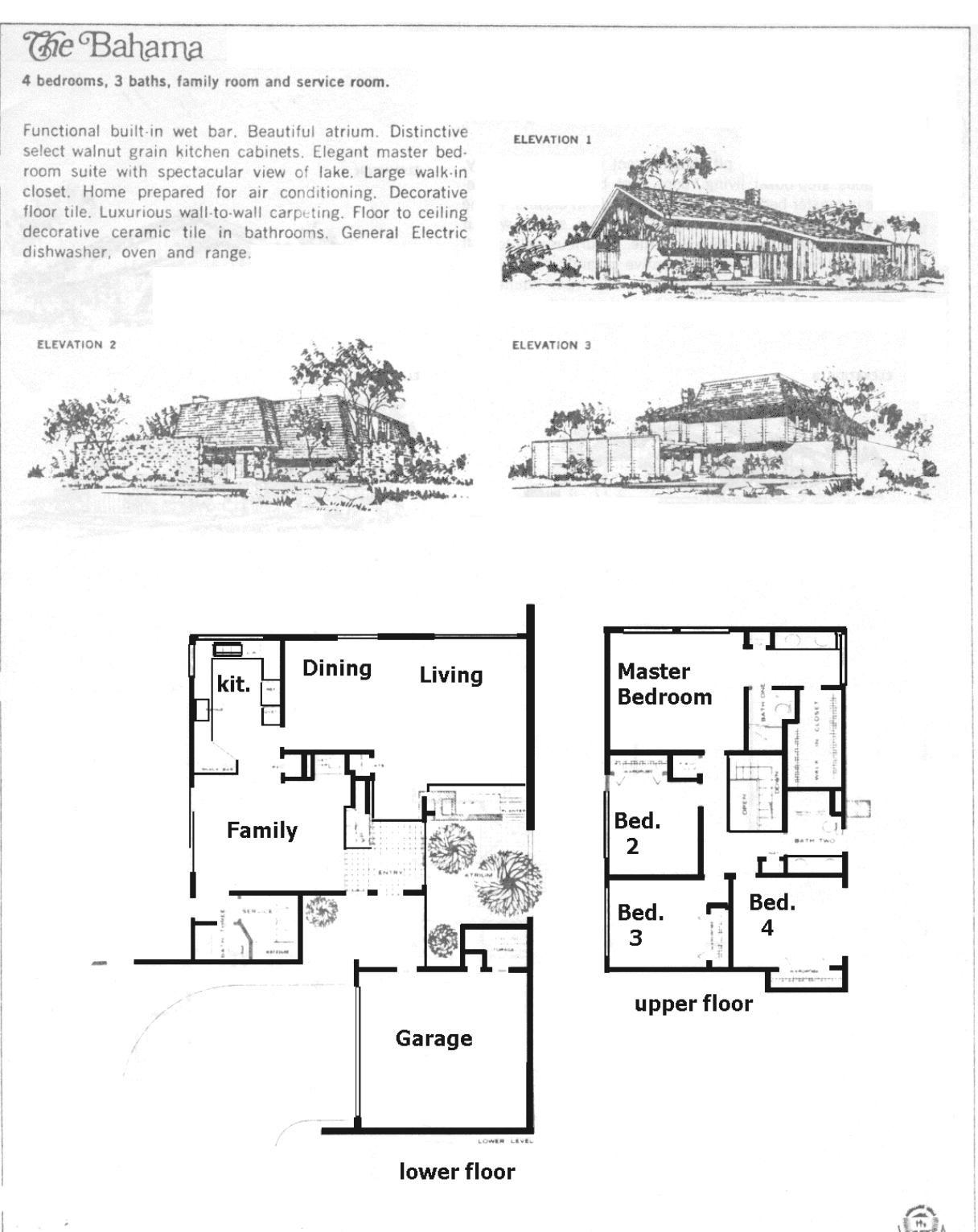
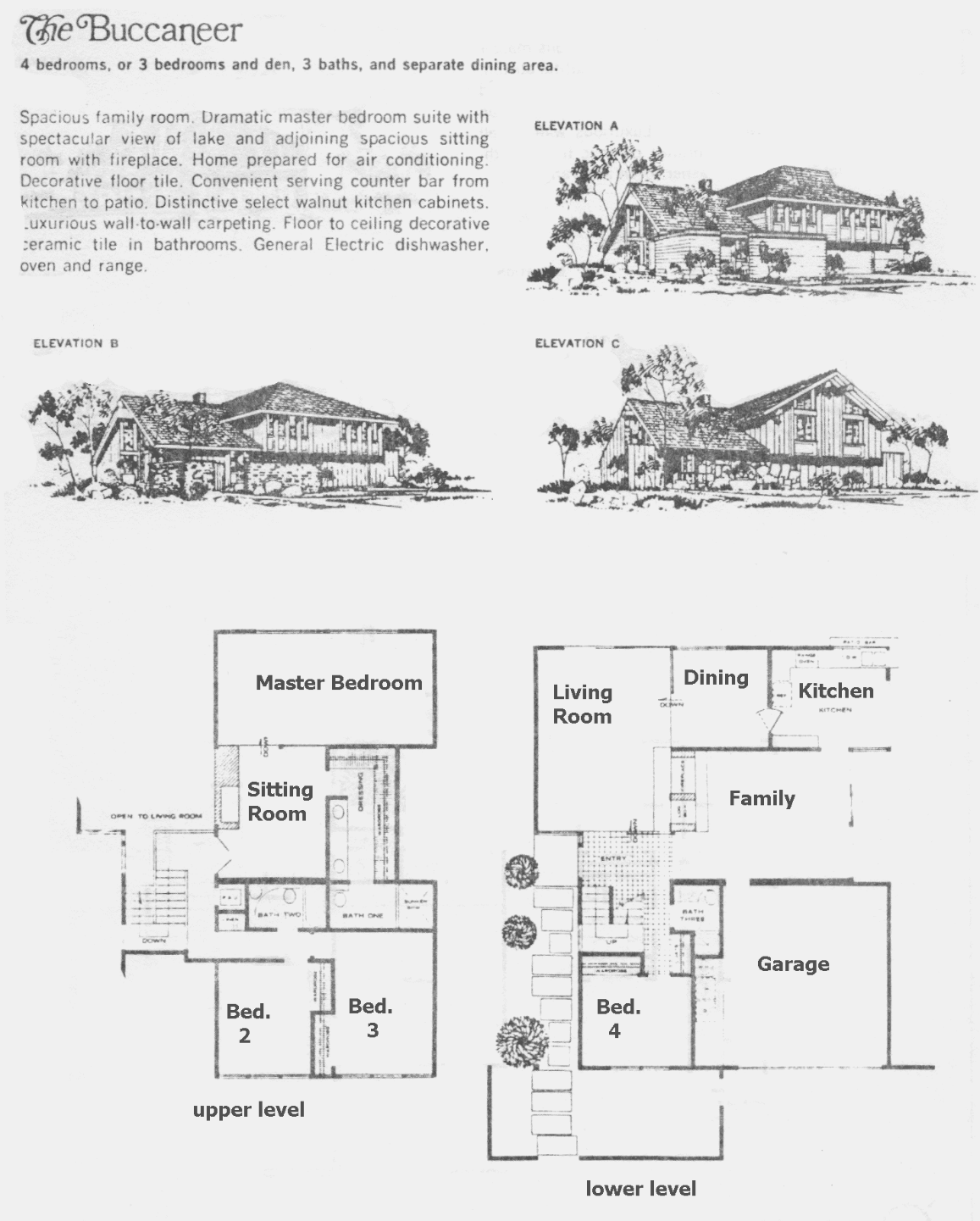
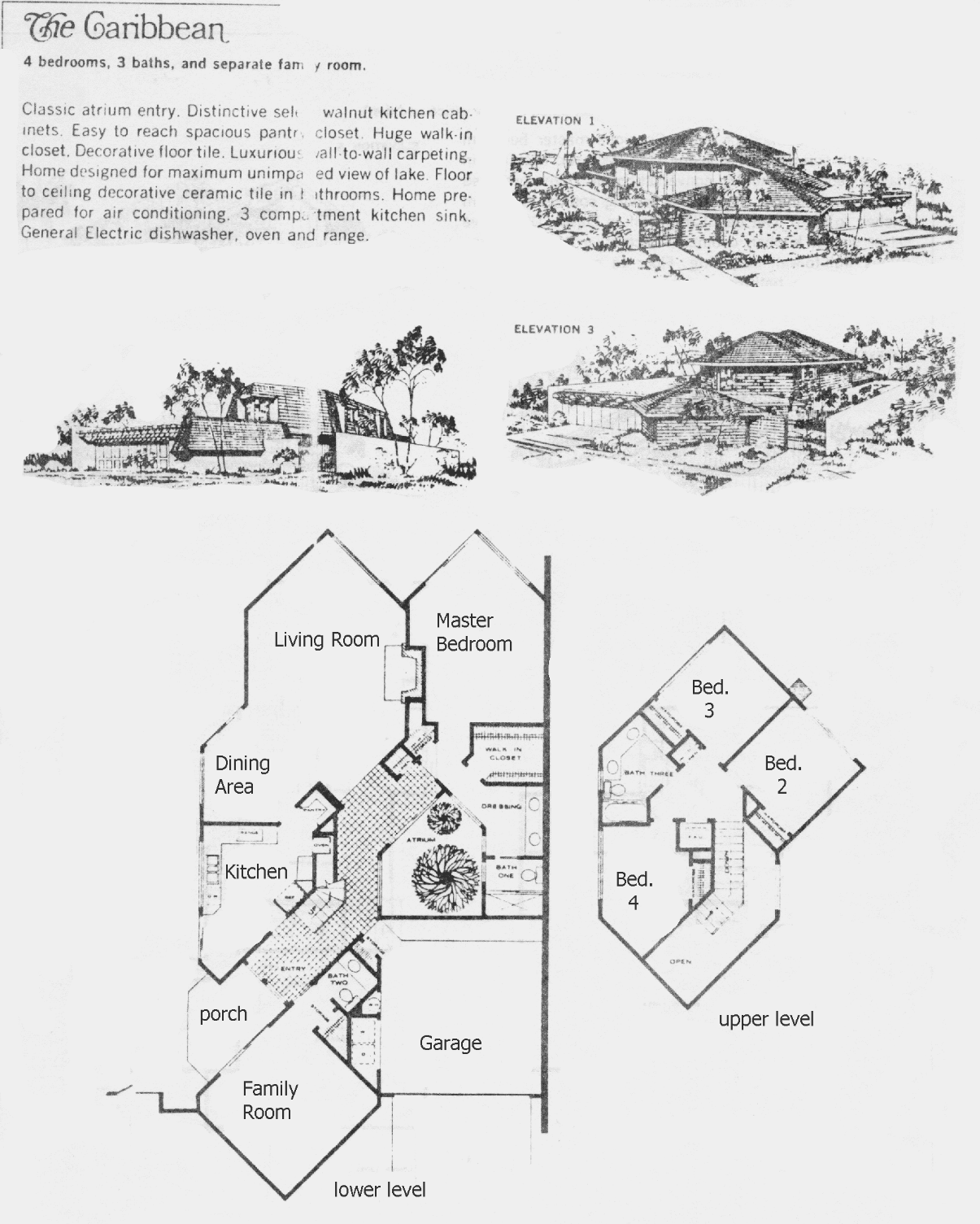
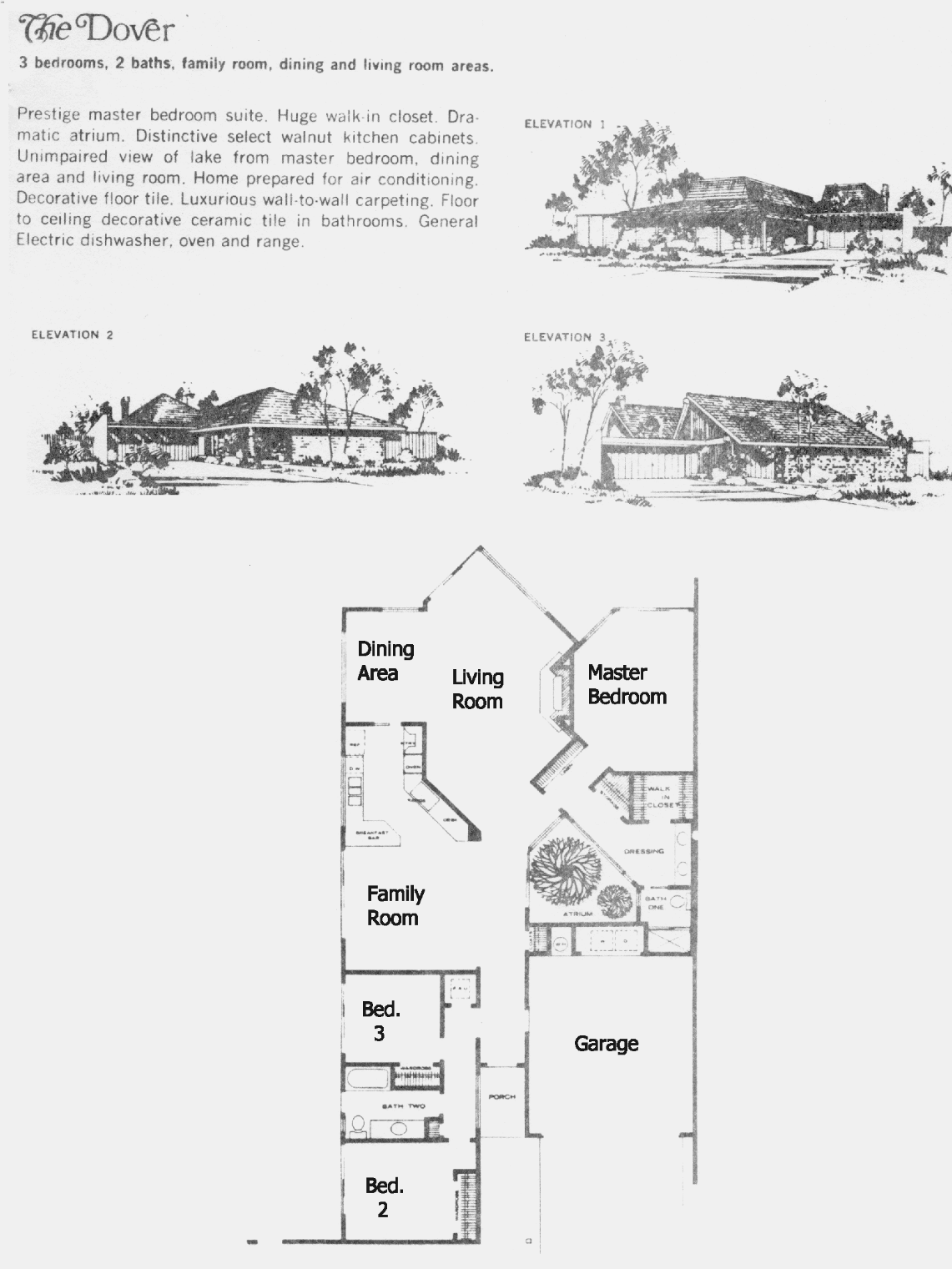
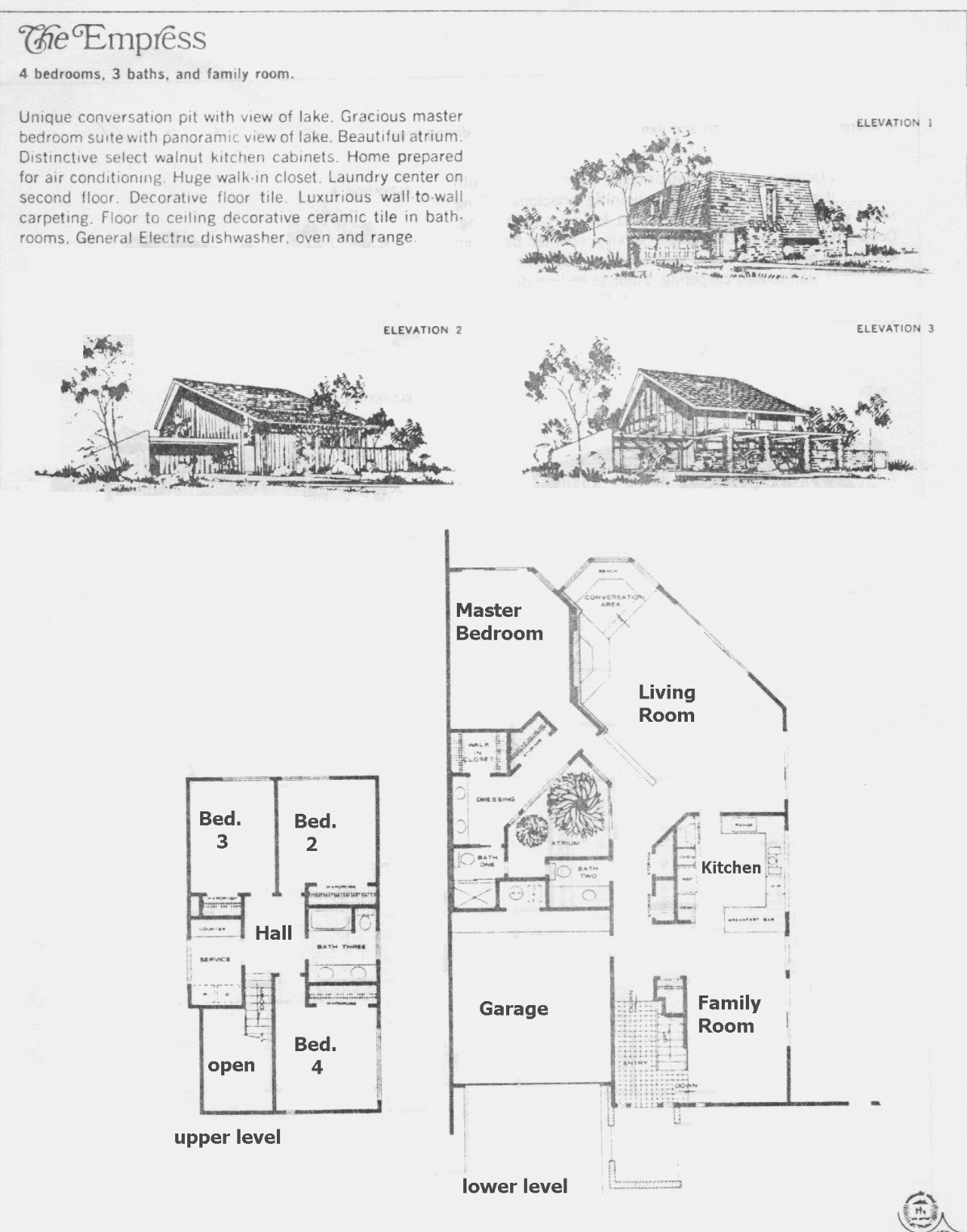
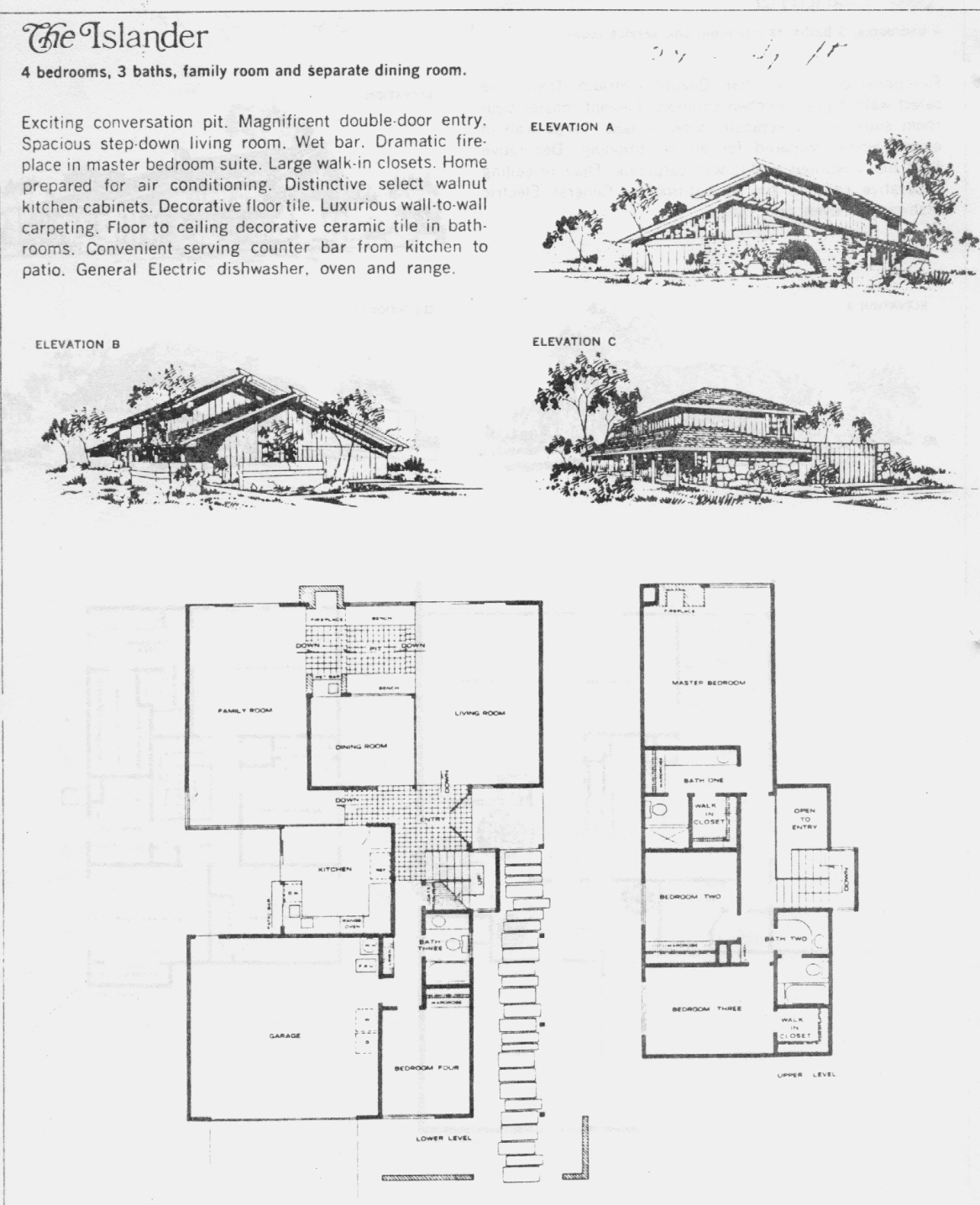
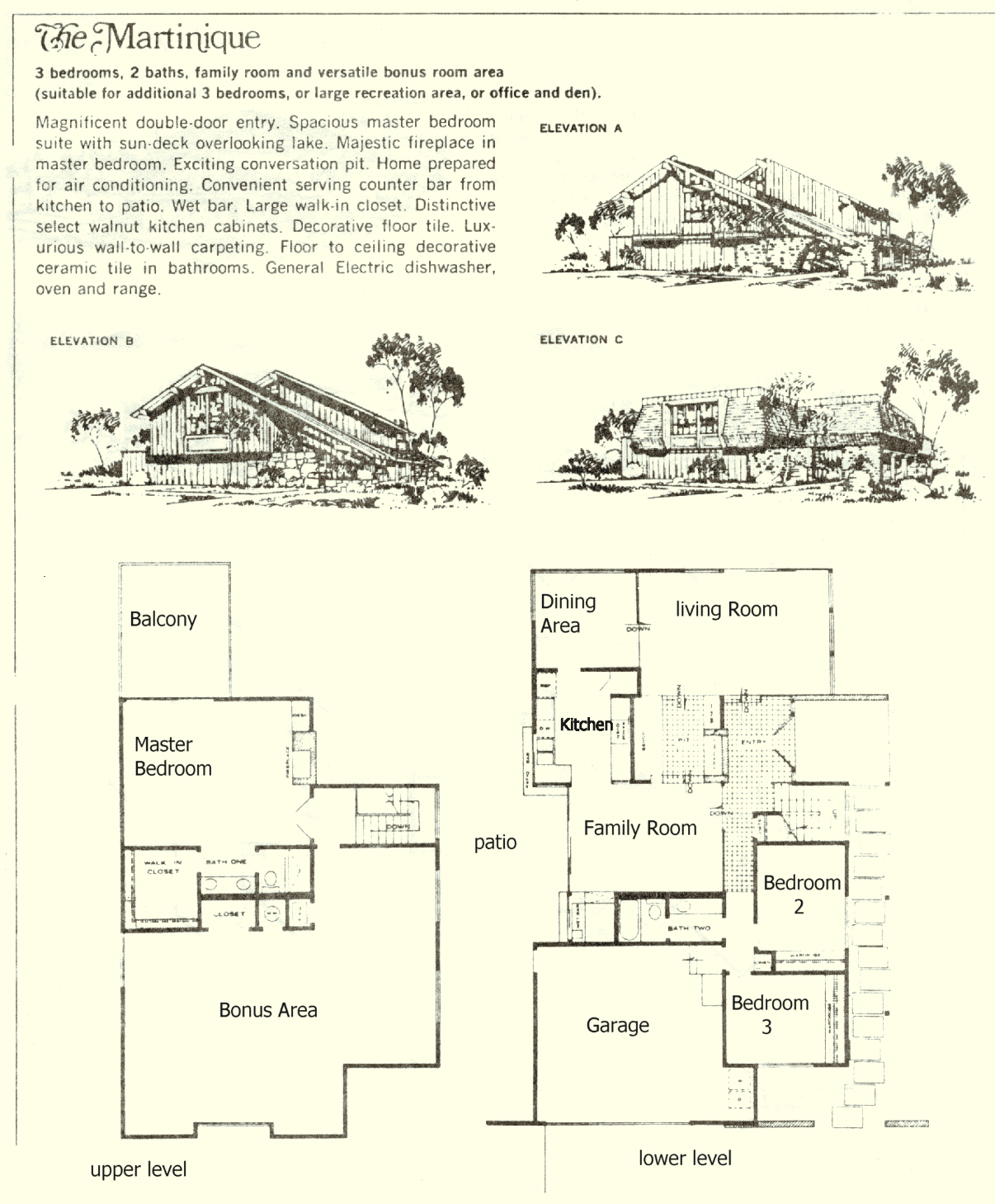
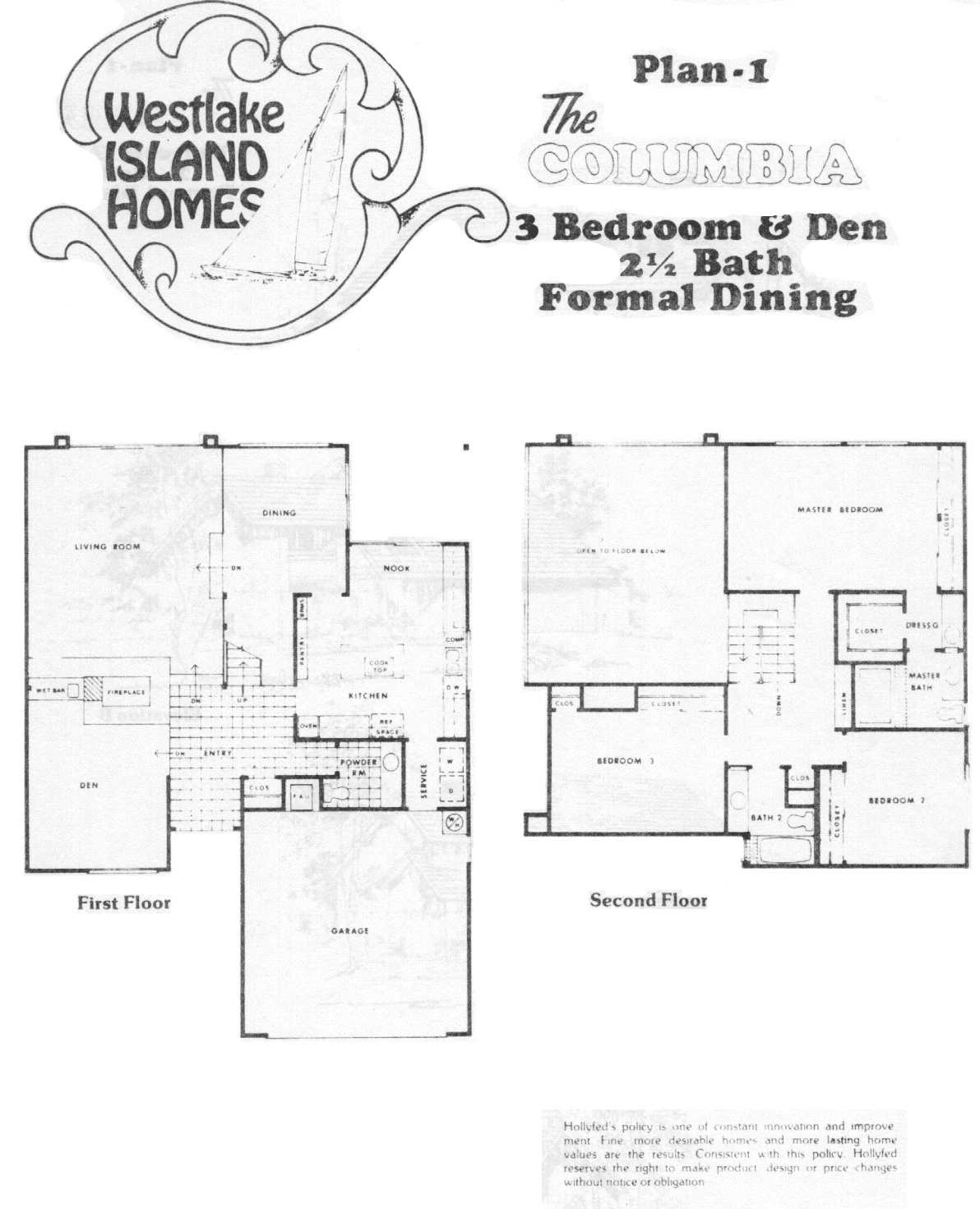
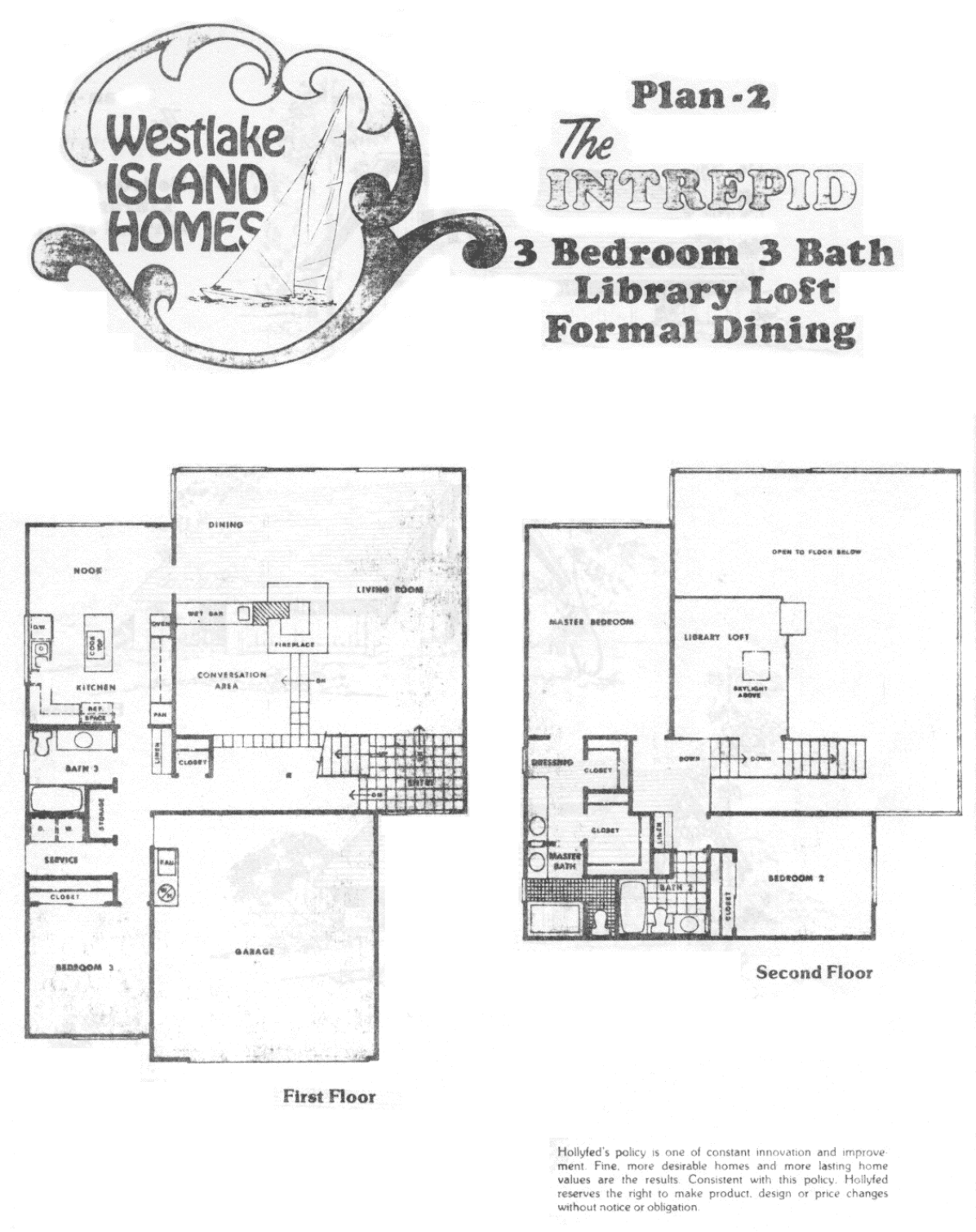
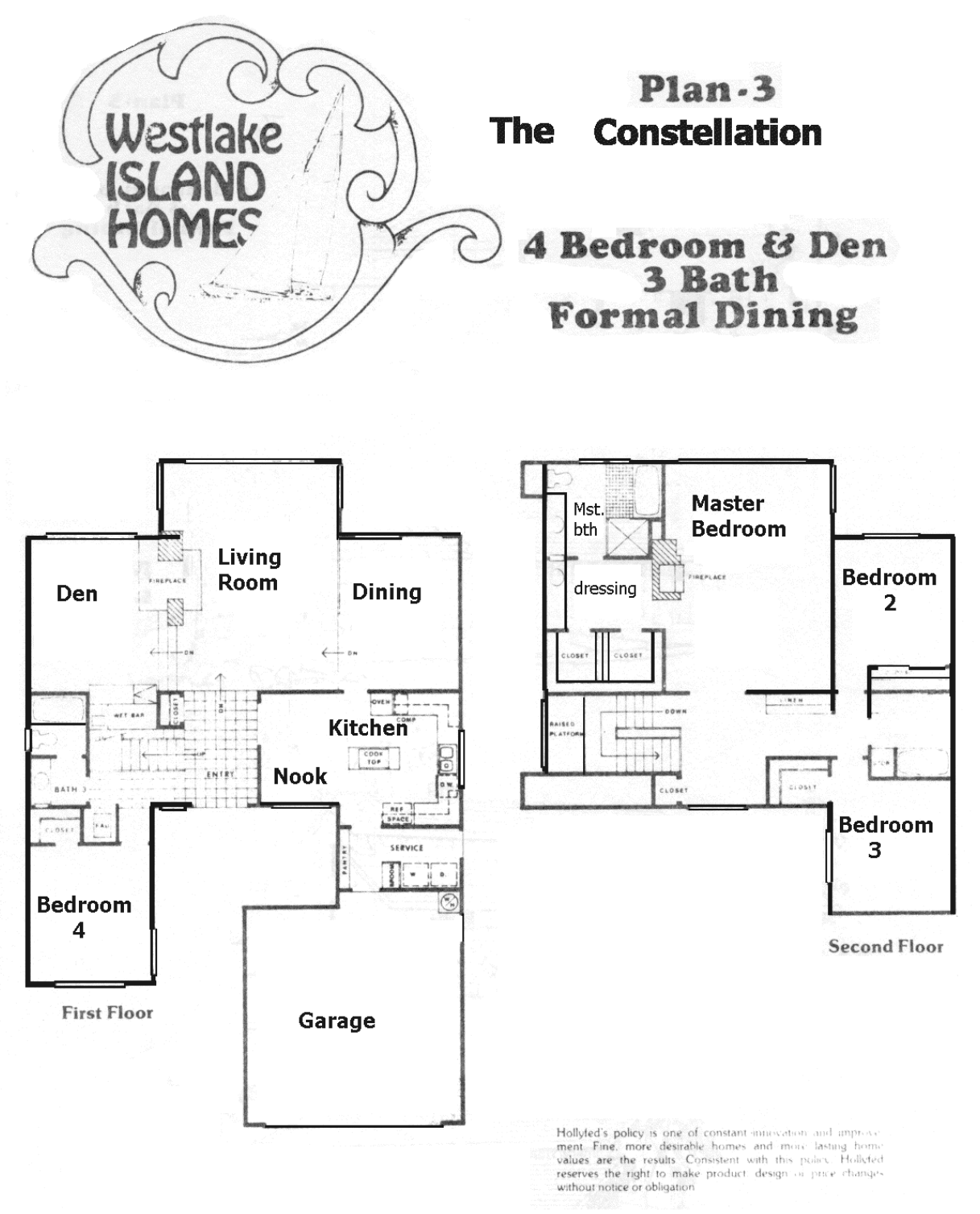
What the plans mean on the ground today: county records put the median Westlake Island home at about 2,700 square feet, with the tenth-to-ninetieth percentile running from about 2,019 to 4,027 square feet and the largest house on the island at about 8,100. That spread is the story of the neighborhood. A meaningful share of the housing stock is no longer the original plan at all; owners have pushed second stories over single-story plans, extended toward the water, and in a number of cases scraped the lot and rebuilt from the foundation up, which is why county records show completion dates as late as 2008, 2015 and 2021 on a tract that was substantially finished by 1981. Buyers should assume that any island listing over about 3,500 square feet has been expanded or rebuilt, ask for the permit history from the City of Westlake Village or the City of Thousand Oaks depending on which side of the line the parcel is on, and treat the dock as a separate item to inspect, since a standard home inspection does not cover it.
Westlake Island streets and how the tract is laid out
The whole island is served by one entrance. La Venta Drive leaves the mainland on the Westlake Boulevard side of the lake, crosses the bridge past the guard house at 1401 La Venta Drive, and then splits into the island’s internal loop. The street names carry the sailing theme all the way around: Whitesail, Mariner, Freshwind and Fairbreeze Circles on the Los Angeles County half; Bluesail, Redsail, Eastwind, Southwind and Westwind Circles on the Ventura County half; and Oakshore Drive and La Venta Drive, which ring the island itself. Nearly all of them are short loops or cul-de-sacs off the main road, which keeps through-traffic to zero and makes the streets themselves unusually quiet for a neighborhood of about 330 homes.
County records sort the island into two halves along the Los Angeles–Ventura county line, which crosses the island rather than following a street. The Los Angeles County side — Whitesail, Mariner, Freshwind and Fairbreeze Circles, the 32100 to 32272 block of Oakshore Drive and the 4100 block of La Venta Drive, 139 addresses in all — sits on tract map 26946 and was built between roughly 1967 and 1981. The Ventura County side — Bluesail, Redsail, Eastwind, Southwind and Westwind Circles, the 2400 to 2660 block of Oakshore Drive and the 1475 to 1575 block of La Venta Drive, 190 addresses — went up mostly between 1975 and 1979. House numbers are the quickest tell: addresses in the 3900s and 4000s are Los Angeles County, while the Ventura side runs in the 1200s to 1500s on the circles and the 2400s on Oakshore. In practice the oldest houses on the island are on the Los Angeles side and the Ventura side is a few years newer, though remodels have blurred that difference considerably. Because the line does not follow a street, buyers should confirm the county, the city and the school district from the parcel record rather than from the street name.
One point is worth stating plainly, because it is easy to get wrong and it changes which sales are comparable: Mainsail, Bowsprit, Charthouse, Capstan, Brigantine and Weatherly Circles carry the same nautical names but are not on the island. Those 122 addresses sit on the Los Angeles County mainland to the southwest, in the Southshore tract beside Leeward, and not one of them falls inside the island shoreline. A sale on Mainsail is not an island comparable, whatever the street name suggests.
Street by street, counted from the Ventura County master address file and the Los Angeles County assessor parcel file, every address inside the island shoreline:
| Street | County | Homes | Address range |
|---|---|---|---|
| Oakshore Drive | Ventura | 46 | 2400–2660 |
| Southwind Circle | Ventura | 31 | 1313–1426 |
| Eastwind Circle | Ventura | 28 | 1401–1521 |
| Redsail Circle | Ventura | 28 | 1363–1471 |
| Bluesail Circle | Ventura | 25 | 1275–1376 |
| Westwind Circle | Ventura | 17 | 1275–1318 |
| La Venta Drive | Ventura | 15 | 1475–1575 |
| Oakshore Drive | Los Angeles | 30 | 32100–32272 |
| Whitesail Circle | Los Angeles | 27 | 4000–4063 |
| Mariner Circle | Los Angeles | 26 | 4000–4061 |
| Freshwind Circle | Los Angeles | 24 | 3900–3958 |
| Fairbreeze Circle | Los Angeles | 17 | 3900–3946 |
| La Venta Drive | Los Angeles | 15 | 4100–4168 |
Because every lot fronts the water, the meaningful distinction between lots is not view versus no view but which water they front. Homes on the outer edge of the island face the main lake, with the long views across to the shoreline neighborhoods and, on the east and south sides, toward The Landing and the hills; those with main-channel frontage are the ones that command the highest prices. Lots on the interior finger channels have a more intimate, canal-like setting, often looking across a narrow waterway at a neighbor’s dock, and they trade at a discount to main-channel homes of the same size. Lot width also matters more than lot area here, since width is what determines how much dock and how much lake a house actually gets; one 2008 rebuild on La Venta Drive on a roughly 10,000 square foot lot advertised 162 feet of frontage, which is several times what a standard island lot has.
The lake, the docks and the boats
Westlake Lake and its dam are private, owned and operated by the Westlake Lake Management Association, a nonprofit governed by a 33-member volunteer board elected each year by roughly 1,300 lakefront and lake-access homeowners plus the commercial parcels around the water. Buying a house on Westlake Island makes the buyer a member of WLMA, and the association’s rules govern what can happen on the water and at the dock. The important ones are worth knowing before making an offer, because they are what make the island what it is.
Boats are small, slow and quiet by rule. Under the WLMA rules, nothing over 18 feet in overall length or 8 feet 6 inches in beam is allowed on the lake, and all powerboats must be electrically propelled, with exceptions only for the association’s own work boats, licensed service vendors and the Westlake Yacht Club patrol boat. The speed limit is five miles per hour on the open lake and three in the finger basins. Inflatables, jet skis, stand-up paddleboards and multi-hulled sailboats are prohibited. Boating is generally permitted from an hour before sunrise until 11 p.m., with running lights required after sunset. Swimming is prohibited except in sailing training or by accident. Fishing requires an annual WLMA permit badge, hours are one hour before sunrise to one hour after sunset, hooks must be barbless or pinched, and live bait is not allowed. The result is a lake that is used constantly, on a summer evening the channels are full of Duffy-style electric boats, kayaks and small sailboats, but never loud.
The dock is the part buyers most often misunderstand. A private dock on Westlake Lake is not a deeded property right; it is a permit issued by WLMA to the lakefront lot owner, one permit per lot, and WLMA’s rules state that no lot owner holds an inherent right to use the water regardless of how much shoreline they have. When a house sells, the dock permit conveys automatically to the buyer, but only if the seller is in good standing with the association: not more than 30 days delinquent on permit fees, carrying the required permit insurance, and in compliance with any hearing decisions. If the seller is not in good standing and the delinquency is not cured before transfer or within 15 days’ notice afterward, the permit is cancelled and the dock is subject to removal at the owner’s expense. Repairs and modifications to a dock require prior written WLMA approval, contractors must carry insurance naming WLMA as additional insured, and the association can order an unsightly dock repaired on 15 days’ notice. Up to three watercraft can be registered at one private dock, and registration renews each January 1. A buyer’s agent on the island should therefore be ordering the WLMA good-standing letter, the dock permit file and the boat registrations as part of due diligence, alongside a separate dock and seawall inspection by a marine contractor, because none of that is in a standard home inspection.
Why people move to Westlake Island
Every lot is on the water. That is not a marketing phrase; it is the tract map. On the mainland shore of Westlake Lake, a lakefront home is one of a few in its neighborhood and prices accordingly. On Westlake Island, waterfront is the baseline, and a buyer chooses between kinds of water rather than whether to have it.
The private dock and the electric-boat culture. Because the WLMA rules cap boats at 18 feet and require electric power, the lake is quiet and safe enough that families let children pilot the boat to The Landing for dinner. Homes with a dock in the back and a Duffy tied to it are the island’s defining image, and the two-hour guest mooring at The Landing means an evening out never involves a car.
A real guard gate with a single entrance. Many Westlake Village communities are gated, but the island’s geography makes its gate unusually effective: one bridge, one guard house at 1401 La Venta Drive, staffed around the clock, and no way onto the island by road except past it. Streets are cul-de-sacs and loops with no through traffic at all.
A neighborhood that keeps renewing itself. Because the land is worth so much relative to the original 1960s and 1970s houses, the island has attracted a steady stream of full rebuilds, with county records showing completions as recent as 2021. The result is a streetscape that mixes well-kept original plans with new construction, and buyers can find both.
The setting inside the master plan. The island sits at the physical center of Westlake Village, minutes from the 101, with the whole lake as the front yard and the Santa Monica Mountains as the backdrop. It is also, thanks to La Venta Drive, one of the few places in California where a street name is a joke about two counties.
Living in Westlake Island
The Westlake Island HOA: dues, rules and monthly costs
Every Westlake Island owner belongs to two associations, and listings vary in how they report the combination. The first is the Westlake Island Property Owners Association, a nonprofit civic association tax-exempt since 1971, which funds the 24-hour guard gate, the bridge, the private streets and the island’s common areas. Its ProPublica-published filings show about $1.2 million of revenue against $1.27 million of expenses in the fiscal year ending June 2024, more than 93 percent of it from member assessments, and a jump to about $2.4 million of revenue and $2.7 million of expenses in the year ending June 2025, which suggests a special project or reserve-funded work in that year; buyers should ask for the current budget, reserve study and any special assessment history. The second is the Westlake Lake Management Association, which owns and maintains the lake and the dam and administers the dock and boat rules described above. Its office is at 32353 Triunfo Canyon Road, Westlake Village, (818) 889-5377, and its published contact email is at PMP Management, the same firm shown as manager on a 2026 island listing; buyers should confirm the current management for the island association directly.
Dues are meaningful but not extreme for a guard-gated lakefront community. A March 2026 island sale reported $950 per quarter (about $317 a month), and an earlier 2026 MLS listing about $850 per quarter, with amenities listed as guard gate, lake and security. Other recent listings have shown the two associations broken out differently, for example about $500 per quarter plus about $1,360 per year on a La Venta Drive home, or $260 a month plus $2,400 a year on a Bluesail Circle home that closed in 2023, and earlier research put the island association at roughly $3,050 per year with the lake association at about $780 to $800 per quarter. The honest summary is that combined assessments have typically run on the order of $3,500 to $6,500 a year depending on the year and how each listing counted them, and the only reliable number is the one in the escrow disclosure package. WLMA also charges separately for annual lake-use badges (about $60 for an adult and $33 for a senior in 2026) and for dock and boat registration.
Both associations have architectural and use rules. The island association reviews exterior changes, and WLMA must approve anything at or over the water, including seawall work, which owners and even the island association cannot perform on their own because WLMA handles shoreline work under its agreements with the state Department of Fish and Wildlife. Gary’s advice to buyers planning a remodel is to read both sets of rules before writing the offer rather than after. Mello-Roos is not something that typically appears on 1960s and 1970s tracts in Westlake Village, but the direct assessments on any specific parcel’s tax bill should be confirmed. Los Angeles County parcels are billed by Los Angeles County and served by the City of Westlake Village; Ventura County parcels are billed by Ventura County and served by the City of Thousand Oaks.
Parks, trails, The Landing and everyday life in Westlake Island
The island’s recreation is the water. Owners boat, fish and kayak from their own docks, and the lake hosts a calendar of community events including Fourth of July fireworks and a holiday boat parade that island residents watch from their patios. The natural destination is The Landing, the lakeside commercial center at 32129 Lindero Canyon Road on the north shore, with restaurants that offer indoor and outdoor lakefront dining, a boardwalk and guest docks. WLMA allows boats to tie up at The Landing docks for up to two hours at a time, after which the boat must leave for at least an hour before returning, which tells you how popular the trip is. The Westlake Yacht Club, at 32119 West Lindero Canyon Road at The Landing, offers sailing instruction for all ages and runs the patrol boat that is one of the few gas-powered exceptions on the lake.
On land, the island itself has no park, but the loop of Triunfo Canyon Road and the adjacent streets around the lake is a popular walking and cycling circuit, and Westlake Village Community Park, the Three Springs and First Neighborhood parks and the Santa Monica Mountains trailheads are a few minutes away by car. Shopping is at the Westlake Plaza and Village centers along Agoura Road and Westlake Boulevard, and the 101 is about five minutes from the gate via Westlake Boulevard or Lindero Canyon Road. Because the island is guard-gated with one entrance, deliveries, guests and contractors are logged at the gate, which residents generally regard as a feature rather than a nuisance.
Commuting from Westlake Island: freeway access and the daily drive
Every trip off Westlake Island starts the same way: across the bridge on La Venta Drive, past the guard house, to Triunfo Canyon Road on the south shore. From there the choice is Westlake Boulevard, which is State Route 23 and meets US 101 about a mile north of the lake, or Lindero Canyon Road, reached by Agoura Road, with its own interchange a little to the east. Off-peak, either on-ramp is roughly five minutes from the gate; Westlake Boulevard is the busier because it also carries the shopping-center traffic on both sides of the freeway, so residents heading east toward Agoura Hills or Calabasas often prefer Lindero Canyon, and Hampshire Road, one interchange west, is the alternate when Westlake Boulevard backs up. The 101 itself is the constraint. The Ventura Freeway between Westlake Village and the San Fernando Valley slows badly in both directions at commute hours, and an island resident working in the Valley or downtown should plan on an hour or more each way at peak against perhaps forty-five minutes to the west Valley off-peak. Those are rough ranges, not measurements.
Errands are close. Gelson’s Westlake Village is at 2734 Townsgate Road, just north of the freeway; Trader Joe’s is at 3835 East Thousand Oaks Boulevard and Ralphs is in the North Ranch Mall at 3963 East Thousand Oaks Boulevard, both a short drive up Westlake Boulevard and a turn onto Thousand Oaks Boulevard. The Promenade at Westlake, with its cinema, restaurants and grocery, sits at Westlake Boulevard and Thousand Oaks Boulevard on the north side of the 101, five to ten minutes from the gate off-peak. The Landing on Lindero Canyon Road is a few minutes by car and about the same by electric boat from the dock, which is why it is the default dinner for many island households. The Oaks mall in Thousand Oaks, off the 101 at Hillcrest Drive, is a ten-to-fifteen-minute drive off-peak, and Westlake Village Community Park and the medical and professional offices along Lindero Canyon Road and Townsgate Road are within the same radius.
The school run depends on the side of the county line. Families on the Los Angeles County streets drive to White Oak Elementary inside First Neighborhood on the east shore, a loop around the lake by Triunfo Canyon Road, Westlake Boulevard and Agoura Road, and then to Lindero Canyon Middle School and Agoura High School in Agoura Hills by Lindero Canyon Road or the freeway. Families on the Ventura County streets go the other way, to Westlake Elementary in the Foxmoor tract off Westlake Boulevard south of the lake, Colina Middle School off Hillcrest Drive and Westlake High School on Lakeview Canyon Road, none more than a few miles. Oaks Christian School on La Tienda Drive, north of the freeway, is a short drive. Because the island has one exit, the morning school departure and the contractor arrivals at the gate overlap, and residents learn to leave a few minutes early rather than sit behind a delivery truck at the guard house.
Public transit is thin, as it is throughout the Conejo Valley. Metrolink’s Ventura County Line stops at Moorpark and Simi Valley, each roughly twenty to thirty minutes from the island by car off-peak, with up to about ten weekday trains each direction on the line as a whole, fewer reaching Moorpark, and limited weekend service; there is no station in Thousand Oaks or Westlake Village. LADOT’s Commuter Express routes 422 and 423 run weekday peak-hour buses between stops in Thousand Oaks and Agoura Hills and Hollywood, the San Fernando Valley and downtown Los Angeles, and Thousand Oaks Transit and Ventura County Transportation Commission buses cover local and intercity routes along the 101; schedules change and should be checked. The coast is the island’s other geographic advantage. Westlake Boulevard continues south as State Route 23 past Potrero Road and becomes Decker Canyon Road, a steep and winding two-lane route to Pacific Coast Highway near Trancas in western Malibu; Kanan Road from Agoura Hills, reached by the 101 or Agoura Road, is the wider and more forgiving way down Kanan Dume Road to Zuma Beach. Either is on the order of thirty to forty-five minutes to the sand off-peak, longer on summer weekends.
Schools: one island, two districts
The county line through Westlake Island is also a school-district line. Homes on the Los Angeles County streets, in the City of Westlake Village, are in the Las Virgenes Unified School District and are served by White Oak Elementary (on the east side of the lake in First Neighborhood), Lindero Canyon Middle School and Agoura High School. Homes on the Ventura County streets, in the City of Thousand Oaks, are in the Conejo Valley Unified School District: Westlake Elementary, Colina Middle School and Westlake High School, all within roughly one to three miles of the island. Recent listings on Bluesail Circle and La Venta Drive, both on the Ventura side, list the Conejo Valley schools; listings on Whitesail or Mariner should show the Las Virgenes schools. Two families on the same island, a few hundred feet apart, can be zoned to different high schools. Both districts are well regarded, but they are different, and the assignment should be verified with the district for the exact parcel before an offer is made; Gary does this on every island transaction. Private options nearby include Oaks Christian School in Westlake Village.
Westlake Island home prices and the market
Westlake Island home prices and the current market
The figures in this section were current when this guide was last reviewed. The sale record in the facts above and the listings below are drawn live from the MLS each time the page loads.
Westlake Island is the most expensive neighborhood of its size in Westlake Village on a per-square-foot basis, and the reason is simple: the land is waterfront and there is no more of it. In the two years through March 2026, five homes on the island sold through the MLS, at prices from $2,800,000 to $3,246,719 and a median of $2,837,500 — a tight band, because the island trades on frontage far more than on finish. Over the longer MLS record since 2020, island sales have run from $1,799,000 for a smaller original-condition home on an interior channel to $5,850,000 for a large rebuilt main-channel house. Sale counts published elsewhere for “Westlake Island” tend to run higher because they fold in the Mainsail and Bowsprit streets in Southshore on the mainland; those are not island sales and they are not island comparables. Against a median home of about 2,700 square feet, that works out to roughly $1,000 to $1,200 per square foot for typical closings, well above the $550 to $750 range that prevails in the hillside tracts like Three Springs or the non-lakefront streets of First Neighborhood. The premium is for the water, not the house.
Turnover is low: five MLS sales in the two years through March 2026 across about 330 homes is under 1 percent a year, so at any moment there are typically only a handful of homes available and buyers who want a specific type of frontage may wait a year or more for it. Main-channel and outer-edge lots, wide lots, and fully rebuilt homes sit at the top of the range; original single-story plans on interior channels are the entry point and are frequently bought by owners who intend to expand or rebuild. Island escrows also take longer than average. One local analysis found that roughly 60 percent of Westlake Island sales run into contingency extensions, most of them tied to association document review or dock issues, which is a reason to have the WLMA and island association paperwork in hand before listing.
Figures are drawn from public records and MLS closings and are rounded. They are a snapshot, not a valuation; contact Gary for a current read on any specific property.
Leasing on Westlake Island
Westlake Island has a rental market, and it is a small one. In a September 2026 scan of public rental listings for Westlake Village, one of roughly twenty-seven single-family houses advertised for rent was on the island itself, on Redsail Circle on the Ventura County side; two more were on Mainsail Circle in Southshore, on the mainland just southwest of the bridge. Against about 330 island homes, that suggests only a handful of houses for lease at any moment and perhaps a dozen or two island leases in a typical year; most owners live in their houses, and the ones who leave tend to sell. For a long-run benchmark on the streets around the lake, Gary Jacobs leased 3808 Mainsail Circle in Southshore, a 1,568-square-foot 1973 home, in January 2010 for $2,725 a month; a house of nearly the same size on the same street was advertised at $7,200 a month in 2026, which is the clearest available measure of how far rents around Westlake Lake have moved.
The 2026 asking rents cluster tightly. On the island itself, a three-bedroom two-story of about 2,745 square feet on Redsail Circle, with its own dock and weekly gardening included, asked $7,450 with a deposit of $14,900, and an earlier listing for a remodeled main-channel home of about 2,550 square feet on Oakshore Drive, offered furnished with the dock, asked $7,000. Just off the island, in Southshore, a two-bedroom, two-bath original plan of about 1,590 square feet on Mainsail Circle was listed at $7,200 a month; a four-bedroom, three-bath 1974 home of about 2,600 square feet at 3801 Mainsail Circle went at $8,795, unfurnished, on a twelve-month lease with association dues included; and a five-bedroom home of roughly 2,950 square feet on the same circle asked $8,900. The working range for an island house in original or lightly updated condition is therefore roughly $7,000 to $9,000 a month, about $3 per square foot, with the lake and the dock rather than the interior driving the number. Fully rebuilt homes of 4,000 square feet and up seldom appear in public lease listings, and anyone pricing one should assume a premium well above that range and confirm it against current listings.
Tenants are bound by the lake rules, and the owner answers for them. The Westlake Lake Management Association rules require a member who leases or lends a home to give the tenant a copy of the rules, hold the owner responsible for the conduct of tenants and guests on the water, allow temporary exclusive use of the private dock to be transferred to a residing tenant who registers a boat there under a written arrangement with the owner, and make annual fishing badges available to lessees. Because the dock is a WLMA permit issued to the lot owner rather than a right that comes with the lease, an island rental agreement should say explicitly whether the tenant may use the dock, whose boat may be tied there and who carries the insurance. The island association’s own leasing policy, including any minimum term, is not published, and tenants must be registered with the guard house, so a buyer planning to rent a home out should ask the association before closing. Two other practicalities: the Redsail Circle deposit of two months’ rent is the most a small landlord can generally ask under the state deposit law that took effect in July 2024, with larger landlords limited to one month; and furnished island leases draw a distinct tenant, typically an executive relocating to Amgen in Thousand Oaks or to the employers along the 101 corridor, or a family waiting out a rebuild elsewhere in Westlake Village.
What inspectors find in Westlake Island homes
The original Westlake Island homes were completed between 1967 and 1981, and an unrenovated example carries the systems of that era. What follows is common in Westlake Village homes of this age; every house varies, and only a licensed inspector looking at the specific property can say what applies. Galvanized steel water lines were still in use in the late 1960s and turn up in some of the earliest Los Angeles County-side homes, where low pressure upstairs or rust-tinted water after a vacation are the signs; by the mid-1970s copper was standard, and a repipe to copper or PEX is one of the most frequent line items in a remodeled island listing. Drain lines of the period are cast iron below the slab and ABS above it, and a camera inspection of the sewer lateral is money well spent on a house that sits on placed fill beside a lake, since settlement can put a belly in the line. A few Ventura County-side homes finished in 1978 and 1979 fall inside the years when polybutylene supply pipe was sold; it is uncommon in this tract, but worth a look.
Electrical panels deserve a direct question. Zinsco and Federal Pacific Stab-Lok panels were installed across the Conejo Valley through the 1970s, and many inspectors and insurers now treat both as a replacement item; some carriers ask about the panel brand on the application. A share of houses built nationally between roughly 1965 and 1973 were wired with aluminum branch circuits, which overlaps with the first phases on Oakshore Drive, Whitesail, Mariner and the other early island streets; the usual remedy is a certified connector retrofit at every device rather than a rewire. Original aluminum-frame single-pane sliders, which on a lakefront plan can run the whole water side of the house, show up on nearly every unrenovated inspection, both for energy loss and for corroded rollers and failed seals in the damp air off the lake. Roofs have generally been replaced once or twice since the original shake and tar-and-gravel of the period; heating and cooling equipment and ducting are usually in the attic and often on their second or third generation; tract-era insulation is thin.
The island adds its own list. Every lot is on engineered fill placed in a former creek valley, and every house sits on a slab a few feet above lake level, so inspectors look for slab moisture and efflorescence on the water side, for cracks in patio hardscape that suggest differential settlement, for drainage that carries water away from the foundation rather than pooling behind the seawall, and for corrosion at anything metal near the water. The seawall is a WLMA matter: the association exclusively performs shoreline repair and owners are prohibited from doing it, so the useful question is what WLMA’s records show about that stretch of shoreline. The dock is the owner’s, is outside the scope of a home inspection, and should be checked separately by a dock contractor for rot, corroded fasteners, flotation or piling condition, electrical service to the dock and boat charger, and whether the structure matches the WLMA permit on file. Patios, decks, covers and extensions built toward the water are the most common unpermitted improvements here, and second-story additions are widespread, so how new framing meets old and whether the original slab was engineered for the added floor matter more than in most tracts. Permit history comes from the City of Westlake Village for the Los Angeles County streets and the City of Thousand Oaks for the Ventura County streets.
Remodels that add value in Westlake Island
The remodel arithmetic on Westlake Island is unusual because the land carries so much of the value. In April 2026 a 1969 single-story home of about 2,184 square feet on the main channel at 32200 Oakshore Drive closed at $3,350,000, roughly $1,530 per square foot. Compare that with Southshore, on the mainland a few hundred feet away: a 3,572-square-foot home on Charthouse Circle closed the previous November at $2,115,000, under $600 per foot, and a heavily remodeled 3,298-square-foot 1974 home at 3827 Mainsail Circle with a rebuilt composite dock sold in April 2026 for $3,000,000, about $910 per foot. The lesson from that small sample, hedged accordingly, is that frontage and position set the price, square footage adds to it at a much lower rate than the finishes suggest, and the island itself rather than proximity to the water in general is what carries the top of the range. A remodel pays on the island when it improves how the house uses the water and when the lot’s frontage justifies the spend; it does not reliably pay when it simply adds rooms.
The projects that recur in island listings follow from the original plans. The 1960s and 1970s designs put the living room, family room and kitchen in separate rooms along the water side, often with the kitchen turned inward; opening those walls into one lakeside great room with a wide slider or folding door to the patio is the most common project on the island and is what buyers of the Caribbean, Dover and Empress single-story plans generally set out to do. On the two-story Bahama, Buccaneer and Islander plans the upstairs primary suite already faces the lake, so the work runs to enlarging the bath and closet into an adjacent bedroom and extending the lakeside balcony. Conversation pits and atriums are usually filled in. A ground-floor primary suite, which downsizing buyers ask for by name, is added to two-story plans where a secondary bedroom or family room can be converted, and single-story plans with the primary bedroom on the water are a large part of why original Caribbean and Dover homes attract empty-nesters.
Second-story additions and full rebuilds are the top of the ladder. County records show completions as late as 2008, 2015 and 2021 on a tract finished by 1981, and homes of 4,000 to 8,100 square feet on lots of 5,000 to 10,000 square feet exist only because owners built up and out to the setback. A pop-top over a single-story plan gives a second-floor lake view and can roughly double the living area without touching the footprint; the cost is a structural engineering exercise on a 1970s slab and a year or more of construction behind a guard gate, and the reward is the gap between original-plan comparables and rebuilt ones, which on a main-channel lot can run into seven figures. On an interior channel the margin is thinner and should be priced against interior-channel rebuilds only. Both associations review exterior work: the island association reviews elevations, height and materials, and WLMA must approve in writing anything at or over the water, including dock changes, patio structures near the seawall and lighting, before work begins.
Accessory dwelling units are a limited opportunity. State law now requires cities to approve an ADU of at least 800 square feet with four-foot side and rear setbacks on nearly any single-family lot, allows a junior ADU of up to about 500 square feet inside the existing house, and prevents associations from prohibiting them outright, though reasonable conditions are allowed and buyers should confirm the current rules with both the island association and the relevant city. On a typical island lot of about 5,360 square feet, a detached backyard unit competes with the patio and the water and is rarely worth the trade; a garage conversion or a junior unit carved from a downstairs bedroom with its own entrance is the realistic form, and it suits multigenerational households more than rental income, since the gate complicates a separate tenant.
Buying and selling in Westlake Island
How Westlake Island compares with nearby neighborhoods
The neighborhoods that share the lake or the county line with Westlake Island are the natural comparisons, and the contrast is sharper than in most of Westlake Village because the island is the only tract where every lot is waterfront. On the east shore, First Neighborhood was built in 1966 to 1968 by the same developer on about 655 lots with a median near 7,500 square feet, larger than the island’s 5,360. Its eight Colony Park plans are close cousins of the island’s designs at a slightly smaller size, a median of about 2,370 square feet against the island’s 2,700. The difference is the water and the gate: First Neighborhood has a limited number of lakefront homes and many more interior ones, no gate, and a conventional association with a pool, greenbelts and a community center for about $170 per quarter. Recent closings there ran mostly from about $1.3 million to $2.4 million with a median near $1.7 million, against the island’s $2.8 million to $3.25 million and median of about $2.84 million over the last two years. Both are in Las Virgenes Unified with White Oak Elementary inside First Neighborhood, so a family on the Los Angeles County side of the island sends its children to the same school as the neighbors across the water at roughly half the price per square foot.
South of the lake, Three Springs is the opposite proposition. Built in 1988 to 1990 by several builders on hillside lots with a median of about 14,000 square feet, its homes run 2,800 to 4,300 square feet, mostly two-story, with an association charging about $270 a year for entry landscaping and architectural review. Closings from 2024 to 2026 ran from about $1.5 million to $2.9 million with a median around $2.15 million, which buys a house more than a thousand square feet larger than the island median on a lot two to three times the size, at roughly half the price per foot, with newer systems and no lake, dock or gate. A buyer choosing between them is choosing between a third of an acre in the hills with a view of the lake and an eighth of an acre on the lake with a boat.
Across the county line, the Ventura County side of the island shares its schools with two flatland tracts west of Westlake Boulevard. Foxmoor, built in 1968 and 1969 around Westlake Elementary, has about 270 homes with a median near 2,460 square feet on lots near 6,970 square feet, a pool, clubhouse and greenbelt for about $230 to $240 per quarter, and 2024 to 2026 closings from about $1.14 million to $2.7 million with a median of about $1.55 million, roughly $600 to $650 per square foot. Village Homes, along Triunfo Canyon Road, went up in phases from 1969 to 1978, so its later homes match the age of the island’s Ventura County streets; it has about 622 homes with a median near 2,200 square feet on lots near 7,400 square feet, a pool, spa, clubhouse, tennis and greenbelt for about $260 to $275 per quarter, and a 2024 to 2026 median close to $1.46 million at roughly $550 to $750 per foot. Both feed Westlake Elementary, Colina Middle and Westlake High, the same assignment as Bluesail, Redsail, Eastwind, Southwind, Westwind and La Venta on the island. Neither has a gate or water.
Put together, Westlake Island trades at roughly one and a half to two times the price per square foot of any adjacent tract, on the smallest lots, with the highest combined assessments and the only around-the-clock guard gate among them. The neighbors offer more house, more yard, simpler paperwork and, in First Neighborhood and Foxmoor, an elementary school inside the tract. The island’s premium holds because it is not competing on those terms: within a mile there are thousands of comparable-era homes on land, and about 330 on the water.
What to weigh before buying in Westlake Island
Lots are small. The median Westlake Island lot is about 5,360 square feet, and the largest ordinary lots are under 9,000. There is no room for a large pool and a lawn, and the side yards are tight. A buyer who wants acreage or a big backyard is looking at the wrong neighborhood; what the island offers instead is the lake itself.
Two associations, two sets of rules, and a dock that is a permit rather than a deed. Anything touching the water needs WLMA approval, the shoreline cannot be repaired by the owner, boats are limited in size and type, and a seller’s delinquency can put the dock permit at risk for the buyer. The paperwork is more involved than in a typical Westlake Village tract, and escrows run longer as a result. Combined assessments are also higher than in most non-gated neighborhoods nearby.
The age of the original construction. Most island homes were built between 1967 and 1979 on fill placed in a former creek valley. Buyers should expect original-era plumbing, electrical and roofing on unrenovated homes, ask about seawall and dock condition, and budget for a marine contractor’s inspection in addition to the usual ones. Unpermitted dock and patio additions on older island properties are common enough that local agents warn about them; permit history from the relevant city is worth pulling.
The county line. The island is split between two counties, two cities and two school districts, which means two families on the same island may have different schools, different city services, different building departments and different property-tax bills. It is not a problem so much as a detail that has to be confirmed parcel by parcel, and a buyer who assumes an address is in one district because the neighbor’s is can be surprised.
Price per foot. At roughly $1,000 to $1,200 per square foot, the island is the most expensive way to buy square footage in Westlake Village. Buyers who value interior space over waterfront will get more house for the money in the hillside tracts.
Who buys in Westlake Island
Lake-lifestyle buyers first. Anyone whose picture of Westlake Village is a dock, an electric boat and an evening cruise to The Landing belongs on the island, because it is the only neighborhood where that picture is guaranteed rather than a matter of finding one of a few lakefront lots.
Downsizers and empty-nesters who want a guard gate and a low-maintenance lot. A 2,500-square-foot single-story original plan on a 5,000-square-foot lot, with a dock instead of a lawn, is exactly the profile many Conejo Valley owners are looking for when they sell a big Three Springs or North Ranch house, and the 24-hour gate suits owners who travel.
Rebuilders. Because the land value dominates, buyers who want to build a new lakefront home in Westlake Village usually end up on the island, purchasing an original-condition plan and replacing it. The rebuilds of the last twenty years are their comparables.
Families targeting a specific district, with care. Both the Las Virgenes and Conejo Valley districts are available on the island, but only by choosing the right side of the county line, so a family with a district preference should search by street rather than by tract.
Buyers who should probably look elsewhere: those who need a large flat yard, a three-car garage and a big house for the money, or who would rather not deal with two associations and a boat registry. For them, Three Springs or the interior streets of First Neighborhood are better fits.
Gary’s track record on Westlake Island
Gary Jacobs’ history on the island goes back more than fifteen years: in January 2010 he leased 3808 Mainsail Circle, a 1,568-square-foot home built in 1973 in Southshore, on the Los Angeles County shore just off the island, at $2,725 per month, a figure that says a great deal about how far Westlake Village lakefront values have moved since. Most of Gary’s recent lake-area work has been in the neighborhoods that surround the island, including the lakefront and interior streets of First Neighborhood and the hillside tracts above the south shore, and that work is what gives him a current read on how island homes compare with mainland lakefront. For any Westlake Island address, Gary can identify the original plan, pull the sales history for the street, explain which recent closings were main-channel versus interior-channel and which were rebuilds, and walk a buyer or seller through the WLMA dock and association paperwork before it becomes an escrow problem.
Buying or selling in Westlake Island: practical notes
Buyers: decide what kind of water matters before touring. Main-channel and outer-edge frontage costs more and holds value better; interior channels are quieter and cheaper. Confirm the county, city and school district from the parcel record, not the street name. Order the WLMA good-standing letter, the dock permit file and the boat registrations early, and hire a marine contractor to inspect the dock and seawall, because the home inspector will not. Ask for permit history on any addition, particularly anything built toward the water. Read both associations’ rules before writing an offer if a remodel or a particular boat is part of the plan, since the 18-foot length and electric-only rules are not negotiable.
Sellers: the single most effective preparation on Westlake Island is paperwork. Being current with both associations, having the dock permit in good standing, and assembling the WLMA documents, the island association budget and the permit history before listing removes the most common cause of contingency extensions on the island. Beyond that, the water side of the house sells it: the patio, the dock and the view from the family room deserve more attention than the street elevation. Photograph from the water. Price against the right comparables, meaning the same kind of frontage and the same category (original, expanded or rebuilt), because a main-channel rebuild is not a comp for an interior-channel original plan even at the same square footage.
Questions buyers ask about Westlake Island
How much do homes on Westlake Island cost?
In the two years through March 2026, five homes on Westlake Island in Westlake Village sold through the MLS, at prices from $2,800,000 to $3,246,719 and a median of $2,837,500. Typical homes trade at roughly $1,000 to $1,200 per square foot, with main-channel frontage and rebuilt homes at the top of the range and original single-story plans on interior channels at the bottom.
How big are Westlake Island homes and lots?
County records show a median Westlake Island home of about 2,700 square feet, with most between about 2,000 and 4,000 and the largest around 8,100 square feet. Lots are small, running from about 5,000 to 8,600 square feet with a median around 5,360, and every lot is on the water. The original plans were 1960s and 1970s lakefront designs sold under names such as Bahama, Islander and Martinique; many have been expanded or completely rebuilt.
What are the HOA dues on Westlake Island and what do they cover?
Owners pay two associations: the Westlake Island Property Owners Association, which funds the 24-hour guard gate, bridge and private streets, and the Westlake Lake Management Association, which owns and maintains the lake and dam and regulates docks and boats. A March 2026 sale showed $950 per quarter combined (about $317 a month), up from about $850 on earlier listings; other recent listings have reported the two associations in different splits, so buyers should rely on the escrow disclosures for current amounts. WLMA also charges separately for annual lake-use badges and dock and boat registration.
Which school district serves Westlake Island?
Both, depending on the side of the county line. Homes on the Los Angeles County streets (in the City of Westlake Village) are in Las Virgenes Unified: White Oak Elementary, Lindero Canyon Middle and Agoura High. Homes on the Ventura County streets (in the City of Thousand Oaks) are in Conejo Valley Unified: Westlake Elementary, Colina Middle and Westlake High. Assignments should be confirmed with the district for the specific parcel.
Is Westlake Island gated?
Yes. The island has a single entrance, the bridge on La Venta Drive, with a guard house at 1401 La Venta Drive staffed 24 hours a day. There is no other road onto the island, and all of the internal streets are loops and cul-de-sacs with no through traffic.
Can you have a boat on Westlake Lake, and what are the rules?
Yes; nearly every Westlake Island home has a private dock, and up to three watercraft can be registered at one dock. Under Westlake Lake Management Association rules, boats may not exceed 18 feet in length or 8 feet 6 inches in beam, all powerboats must be electric, and the speed limit is 5 mph on the lake and 3 mph in the finger channels. Jet skis, inflatables, paddleboards and multi-hull sailboats are prohibited, and swimming is not allowed. The dock itself is a WLMA permit that transfers to a buyer only if the seller is in good standing.
When were the homes on Westlake Island built, and what should buyers check?
The island was created when the lake was built between 1965 and 1969, and the original homes were completed between 1967 and 1981, most of them from 1968 to 1979. Many have been expanded or rebuilt since, with some completions as recent as 2021. Buyers of original-era homes should expect period plumbing, electrical and roofing, pull permit history for any additions, and have the dock and seawall inspected by a marine contractor, since a standard home inspection does not cover them.
How does Westlake Island compare with First Neighborhood or Three Springs?
Westlake Island is smaller-lot, guard-gated and entirely waterfront, at roughly $1,000 to $1,200 per square foot. First Neighborhood, on the east shore of the lake, mixes a limited number of lakefront homes with many more interior homes on similar-era plans at a much lower price per foot. Three Springs, in the hills south of the lake, offers late-1980s two-story homes on lots two to three times the size of an island lot, typically in the $550 to $750 per square foot range, with no water access. The island is for buyers who want the lake; the other two are for buyers who want more house and yard for the money.
Nearby Westlake Village neighborhoods
Thinking about Westlake Island? Gary Jacobs has the original floor plans, the sales history for every street, and a current read on what is coming to market before it is public.
Talk with Gary Jacobs → | Back to the Westlake Village guide